

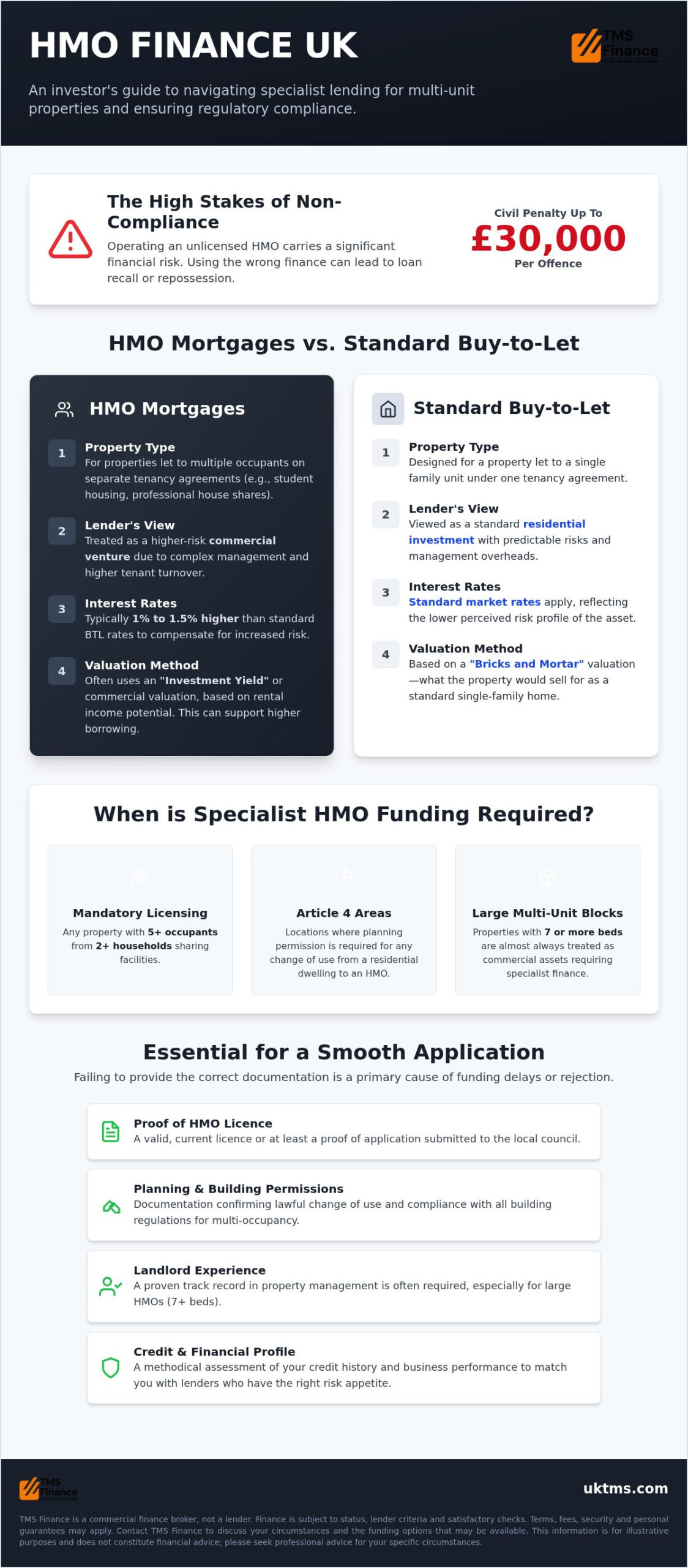
Operating an unlicensed HMO in 2026 carries a civil penalty of up to £30,000 per offence, yet many investors still struggle to secure the specialist HMO finance uk needed to meet these strict regulatory standards. You likely understand that multi-unit properties offer superior yields compared to standard buy-to-let assets, but the financial barriers are becoming increasingly steep. Higher interest rates and rigorous licensing requirements mean that a standard mortgage often won’t suffice for these complex, high-risk projects.
This guide explains the current specialist lending market, helping you identify the right funding structures to support your multi-unit investments while maintaining full compliance. We’ll examine the documentation required to avoid application delays, the impact of the 2026 interest rate environment, and how specialist finance can bridge the gap between a residential conversion and a fully operational property. By understanding the specific criteria lenders use for commercial valuations and licensing proof, you can protect your capital and ensure your portfolio remains a stable, profitable asset.
Key Takeaways
- Learn how specialist HMO finance uk provides the capital required for high-yield multi-unit conversions while managing 2026’s regulatory standards.
- Understand the difference between “bricks and mortar” and investment yield valuations, as this distinction determines your total borrowing capacity.
- Identify when to use bridging finance for rapid auction purchases or property development loans for large-scale residential-to-HMO conversions.
- Recognise the essential documentation required, such as licensing proof and planning permissions, to ensure a seamless and compliant application process.
- Discover how a methodical assessment of your credit profile and trading history helps match your project with lenders who have the right risk appetite.
What is HMO Finance and How Does it Impact Your Investment Strategy?
HMO finance uk is a specific category of commercial lending designed for properties let to multiple occupants on separate tenancy agreements. Unlike a standard buy-to-let mortgage, these products account for the increased management intensity and regulatory risks associated with multi-unit blocks. You must understand that What is a House in Multiple Occupation (HMO)? is defined by its occupancy rather than just its physical structure. Specialist finance allows professional landlords to leverage the higher rental yields of these assets to scale their portfolios effectively.
Attempting to fund an HMO with a standard residential or basic buy-to-let mortgage is a significant risk. Residential lenders typically prohibit letting a property to more than one family unit. If a lender discovers a property is being operated as an HMO without the correct finance in place, it constitutes a breach of mortgage terms. This can lead to the immediate recall of the loan or repossession, potentially devastating your credit profile and capital. Using the correct specialist product ensures your investment remains compliant and secure.
The Commercial Reality of HMO Conversions
Converting a single-family dwelling into a multi-unit property requires substantial upfront capital. You must account for mandatory safety upgrades, such as fire-resistant doors, hardwired smoke detection systems, and enhanced soundproofing between units. These setup costs are significantly higher than standard refurbishments. Operational expenses also rise, with management fees often sitting between 12% and 15% of gross rent. Specialist HMO finance uk is a tool for professional landlords to scale while managing these increased overheads.
When Specialist HMO Funding is Required
Lenders require specialist funding whenever a property meets specific occupancy criteria. A mandatory licence is required for any property occupied by five or more people from two or more separate households who share facilities. This includes:
- Student accommodation and professional house shares where occupants are not related.
- Properties located in Article 4 direction areas where planning permission is required for change of use.
- Large multi-unit blocks where you’ve divided the property into several self-contained bedsits.
Lenders will strictly verify your compliance with local council rules and planning permissions before releasing funds. Failing to provide proof of a valid licence application can lead to immediate application rejection or delays in funding. By securing specialist finance, you align your borrowing with the actual commercial usage of the property, protecting your investment from regulatory and financial interference.
TMS Finance is a commercial finance broker, not a lender. Finance is subject to status, lender criteria and satisfactory checks. Terms, fees, security and personal guarantees may apply. Contact TMS Finance to discuss your circumstances and the funding options that may be available.
HMO Mortgages vs. Standard Buy-to-Let: Key Differences
HMO mortgages are structurally different from standard buy-to-let (BTL) products because lenders view them as higher-risk commercial ventures. While a standard BTL mortgage assumes a single tenancy agreement with one family, HMO finance uk covers properties where multiple individuals share facilities under separate contracts. This complexity leads to higher interest rates, typically 1% to 1.5% above standard BTL rates. Lenders price for the increased risk of voids, higher wear and tear, and the administrative burden of managing multiple tenants.
Lenders also categorise these properties based on scale. A small HMO (up to 6 beds) might fall under some lenders’ “complex BTL” criteria. However, large HMOs with 7 or more beds are almost exclusively treated as commercial assets. For these larger projects, lenders require a proven track record in property management. If you’re a first-time landlord, many lenders will limit your borrowing or require you to appoint a professional management agency to mitigate operational risks.
Valuation Methods and Their Impact on Borrowing
The method a lender uses to value your property significantly affects your leverage. Most standard BTL lenders use a “bricks and mortar” valuation. This assesses what the property would sell for as a single-family home. In contrast, specialist HMO lenders often use an “investment yield” or “commercial” valuation. This method calculates value based on the property’s gross rental income minus operating expenses, multiplied by a market yield.
Commercial valuations often result in a higher figure, especially in areas with high rental demand. This allows you to secure a larger loan amount, which is vital for recouping capital after a conversion. During the planning phase, you should focus on the Gross Development Value (GDV). This is the estimated market value of the property once all works are complete. Understanding these figures early helps you view our property finance products to find a match for your project’s specific scale.
Lender Assessment Factors for Multi-Unit Blocks
Lenders scrutinise the property’s physical suitability for multiple occupancy. They’ll check room sizes against national standards and ensure you follow official government guidance on HMO licensing. Without a valid licence or a clear path to obtaining one, securing long-term finance is difficult. Lenders won’t release funds until they’re satisfied the property meets all safety and space requirements.
Your personal experience is the final piece of the assessment. Lenders want to see that you understand the logistical challenges of multi-unit management. They’ll review your portfolio and your history of managing similar projects. If you’re ready to discuss your requirements with a professional, you can start your application for an initial assessment of your project.
TMS Finance is a commercial finance broker, not a lender. Finance is subject to status, lender criteria and satisfactory checks. Terms, fees, security and personal guarantees may apply. Contact TMS Finance to discuss your circumstances and the funding options that may be available.
Funding Options for HMO Acquisitions and Refurbishments
Selecting the right HMO finance uk depends on whether you’re purchasing a turnkey asset or a property requiring significant structural change. For professional investors, the speed of capital deployment is often the deciding factor in securing a high-yield site. You must align your funding choice with the current condition of the property and your long-term exit strategy.
Bridging Loans for HMO Projects
Bridging finance is a primary tool for rapid acquisitions, particularly at auction where completion is usually required within 28 days. These short-term loans provide the liquidity needed to secure a property before it’s ready for a standard commercial mortgage. Lenders prioritise your repayment route, which is typically refinancing onto a long-term product. For a deeper look at these mechanisms, see our Bridging Loan Guide for UK Property Developers. Using a bridge can prevent you from missing out on lucrative opportunities due to slow traditional lending cycles.
Development Finance for Conversions
Large-scale conversions from residential to multi-unit blocks require property development finance. This funding covers both the purchase price and the construction costs needed to meet mandatory licensing standards. Lenders release funds in stages based on work completed, which helps you manage cash flow during the build. You must account for the risk of cost overruns or planning delays. These factors can impact your ability to refinance on time, potentially leaving you on a higher interest facility for longer than planned.
A critical phase often overlooked is the refurbishment-to-let transition. This involves using a short-term facility to complete works and then switching to a long-term commercial mortgage once the property is tenanted and licensed. This transition is essential for capital recycling. If you delay the refinance, the interest costs of a development loan can quickly erode your profit margins. Moving to a term product as soon as the property is stabilised protects your cash flow.
For established HMO portfolios, commercial mortgages provide long-term stability. These are suitable for properties that are already fully compliant and generating income. Lenders assess the debt service cover ratio to ensure the rental income comfortably exceeds the monthly repayments. Because these loans are secured against the property, your asset could be at risk if repayments are not maintained. Establishing a clear funding timeline from purchase to long-term hold is the most reliable way to protect your capital.
TMS Finance is a commercial finance broker, not a lender. Contact TMS Finance to discuss your circumstances and the funding options that may be available.
Eligibility Criteria and Documentation for HMO Finance UK
Securing HMO finance uk requires a methodical approach to documentation. Lenders view these projects as commercial operations rather than simple property holdings. They primarily assess the risk through your credit profile and trading history. For most investors, borrowing through a Special Purpose Vehicle (SPV) is standard, but lenders will still scrutinise the personal financial standing of the directors.
You should expect to provide a personal guarantee for a commercial property loan. This acts as a secondary layer of security for the lender. It demonstrates your commitment to the project and ensures the lender has recourse if the business fails to meet its obligations. Lenders often require a minimum net worth or a certain level of equity in other assets before they’ll consider an application for a multi-unit project.
Regulatory and Licensing Requirements
Lenders won’t approve an application if the property doesn’t meet local standards. You must verify the mandatory HMO licensing status with the local authority before applying. Licensing directly impacts lender security; an unlicensed property cannot legally generate the income required to service the debt. Finance is subject to status and lender criteria.
You also need to understand Article 4 directions in your target area. These local planning restrictions can remove permitted development rights for HMOs. If your property falls within an Article 4 zone, you’ll need full planning permission for a change of use. Lenders will require evidence of this permission before they release funds for a conversion project. Meeting these standards for HMO finance uk is a non-negotiable part of the process.
The Importance of a Credible Application
A successful application for HMO finance uk relies on a comprehensive document package. Lenders need to see that the project is viable and that you’ve planned for contingencies. You’ll need to provide certified business accounts, personal tax returns, and three to six months of bank statements for all directors. Providing this information clearly helps avoid unnecessary delays.
- A detailed schedule of works with quotes from accredited contractors.
- A management plan outlining tenant vetting, maintenance, and compliance.
- Evidence of your exit strategy, such as a mortgage offer for refinancing.
Documenting your property management experience is essential. If you lack a track record, providing a CV that highlights relevant business management skills can help build credibility. You must also provide clear cash-flow forecasts and evidence of your exit strategy. A thorough management plan shows the lender you’re a safe pair of hands for a complex multi-unit asset.
TMS Finance is a commercial finance broker, not a lender. Contact TMS Finance to discuss your circumstances and the funding options that may be available.
Securing HMO Funding Through a Specialist Commercial Broker
Securing HMO finance uk is a methodical process that requires a strategic approach to lender selection. A specialist commercial broker acts as a professional partner, identifying which lenders have the specific risk appetite for your multi-unit project. Instead of making multiple applications that could impact your credit profile, a broker conducts an initial assessment to match your project with suitable facilities. This discussion focuses on your funding purpose, the property’s licensing status, and your required completion timeline.
Packaging a complex property application for lender review is where technical expertise becomes critical. Lenders prioritise clarity and compliance. A broker ensures that your schedule of works, management plans, and financial forecasts are presented in a format that addresses lender concerns regarding security and affordability. When you receive an offer, you’ll need to review the commercial terms carefully. This involves understanding the interest structure, arrangement fees, and the specific obligations tied to the security provided.
The TMS Finance Brokerage Process
Our process begins with an initial assessment to understand your cash-flow plans and investment goals. We review the technical details of the property and your experience as a landlord to determine the most appropriate lender fit. We then manage the document collection phase, ensuring all regulatory proofs are in place before submission. This structured approach reduces the risk of delays and provides completion support through to the release of funds. Professional guidance is essential for these transactions as it helps manage the friction between strict licensing rules and lender criteria.
Costs, Risks, and Alternatives to Borrowing
You must recognise that HMO finance uk secured against property carries significant risk. If you don’t maintain repayments, the secured property or asset could be at risk of repossession. Beyond interest rates, you should account for valuation fees, legal costs, and potential early repayment charges. These expenses must be factored into your financial calculations to ensure the project remains profitable over the long term. You should also consider the impact of personal guarantees on your wider financial position.
If debt finance isn’t suitable for your current situation, consider alternatives like joint ventures or using existing working capital. Joint ventures allow you to share the capital burden and risk with a partner, though this involves sharing equity and control. We encourage all clients to seek independent professional tax and legal advice before committing to a finance agreement. This ensures you fully understand the long-term impact on your business structure and personal liability.
TMS Finance is a commercial finance broker, not a lender. Contact TMS Finance to discuss your circumstances and the funding options that may be available.
Scaling Your Multi-Unit Property Portfolio
Professional property investors must treat multi-unit projects as commercial enterprises to succeed in the 2026 market. Securing specialist HMO finance uk ensures your funding aligns with the high-yield nature of these assets while maintaining strict regulatory compliance. By focusing on investment-based valuations and thorough documentation, you protect your capital and build a more resilient portfolio.
TMS Finance is an NACFB member with national UK coverage and a specific focus on property and development finance. We act as a dependable partner to help you identify the most appropriate facilities for your specific acquisitions or conversions. If your property business needs funding for an HMO acquisition, conversion, or refurbishment, speak to our team to begin your assessment.
We look forward to supporting your next multi-unit investment with expert guidance and a methodical approach to lender selection. Taking the time to package your application correctly reduces the friction of the lending process and helps you secure the capital required for your project.
TMS Finance is a commercial finance broker, not a lender. Contact TMS Finance to discuss your circumstances and the funding options that may be available.
Frequently Asked Questions
Is HMO finance more expensive than a standard mortgage?
HMO finance is structurally more expensive than a standard mortgage because lenders account for higher operational risks and management intensity. Interest rates are typically 1% to 1.5% higher than standard buy-to-let products. This reflects the increased wear and tear and the administrative burden of managing multiple tenancies. You should also factor in higher arrangement fees and specialist valuation costs when you’re calculating the total cost of your borrowing.
Can I get HMO finance as a first-time landlord?
Yes, some lenders will consider first-time landlords for HMO finance uk, but the criteria are often stricter. You’ll likely need to demonstrate a strong personal credit profile and might be required to use a professional letting agent for management. Lenders may also limit the number of bedrooms or the total loan amount for those without a proven track record. Providing a detailed management plan can help build lender confidence during the assessment.
What is the maximum LTV for HMO development finance?
The maximum Loan-to-Value (LTV) for HMO development finance typically sits at 75% of the Gross Development Value (GDV). Some specialist lenders might offer up to 80% LTV in specific circumstances, but a 25% deposit is the standard requirement for most multi-unit projects. Lenders will also assess the Loan-to-Cost (LTC) ratio; this usually covers up to 90% of the actual construction costs while ensuring the total debt stays within LTV limits.
Do I need planning permission before applying for HMO finance?
You generally need planning permission or proof of permitted development before a lender will formalise an offer for HMO finance uk. While you can start an initial discussion without it, lenders won’t release funds for a conversion until the legal change of use is confirmed. This is especially critical in Article 4 areas where standard permitted development rights for small HMOs have been removed by the local council.
What happens if my HMO license is refused after securing finance?
If an HMO license is refused after you’ve secured finance, it usually constitutes a breach of your mortgage terms. Lenders require properties to be fully compliant with local regulations to maintain their security. Refusal could lead to the lender recalling the loan or demanding immediate repayment. You should always engage with the local authority’s licensing department early to ensure your project meets all mandatory safety and space standards before completion.
TMS Finance is a commercial finance broker, not a lender. Contact TMS Finance to discuss your circumstances and the funding options that may be available.