

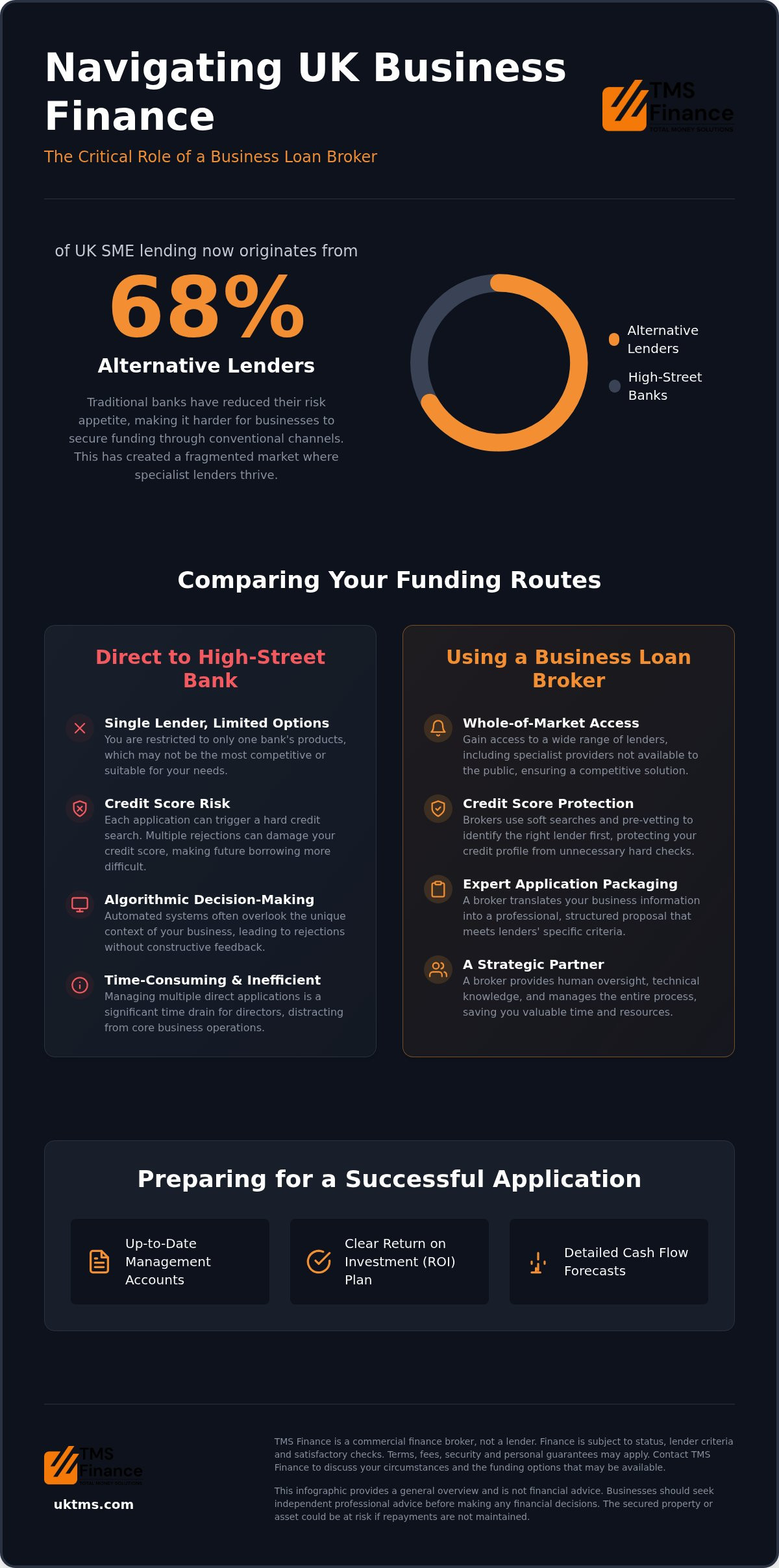
Did you know that 68% of small business lending in the UK now originates from alternative providers rather than traditional high-street banks? This significant shift highlights the growing difficulty of securing capital through conventional channels. If you’re struggling with slow bank decision-making or feel overwhelmed by complex financial jargon, you’re facing a common challenge. Engaging an expert business loan broker UK provides the professional guidance needed to strengthen your application and protect your credit score from unnecessary rejection.
We recognise that managing commercial finance is a serious responsibility where precision and compliance are paramount. A specialist broker acts as a safe pair of hands to manage the funding process while identifying competitive solutions for your specific requirements. This article outlines the mechanics of different funding types, including asset finance and property development, alongside clear details on eligibility and costs. We also examine the risks, security requirements, and sensible alternatives to ensure your business remains protected and well-informed throughout the application journey.
Key Takeaways
- Understand why 68% of SME lending now comes from alternative providers and how this fragmented market affects your funding options.
- Learn how a business loan broker UK identifies competitive funding solutions while mitigating the risk of credit score damage from bank rejections.
- Contrast the speed and broader market access of a commercial broker against the single-product limitations of traditional high-street banking.
- Identify the critical documentation required, such as management accounts and clear ROI plans, to present a professional application to lenders.
- Gain insight into how a strategic finance partner manages the entire process to save your business time and ensure total compliance.
The Evolving Landscape of SME Lending in the UK
The relationship between UK businesses and traditional high-street banks has undergone a fundamental shift. Decades ago, a local bank manager understood a firm’s operational history and local reputation. Today, centralisation and algorithmic decision-making have replaced that personal connection. This automation often overlooks the nuances of complex businesses, leading to higher rejection rates for those who don’t fit a standard template. When a bank’s automated system declines an application, it rarely provides the strategic feedback necessary to fix the underlying issue.
As traditional banks reduce their risk appetite for loans under £500,000, an expert business loan broker UK becomes a vital strategic asset. These professionals restore the advisory relationship that modern banking has discarded. Instead of a rigid “yes or no” response, a broker provides the human oversight and technical knowledge needed to present a business case effectively. This role is often defined by its ability to act as a What is a Commercial Broker, bridging the gap between a company’s capital requirements and a lender’s specific risk appetite.
The Rise of Alternative Lenders
The UK market is now highly fragmented. Challenger banks and niche debt funds have stepped in where high-street names have retreated. Research indicates that specialist banks accounted for 60% of gross SME lending in 2025. Many of these institutions operate exclusively through professional intermediaries. They rely on brokers to perform initial due diligence and ensure the proposal meets their specific criteria. Without a broker, your business may remain unaware of these competitive funding products that aren’t advertised to the general public.
Why “Direct to Lender” Often Fails for SMEs
Approaching lenders directly carries significant risks that many directors overlook. Every direct application typically triggers a hard credit search. Multiple searches in a short period can damage your business credit score, making you appear high-risk to future creditors. Professional brokers prevent this by using soft searches or pre-vetting applications before a formal submission is made. This “Safe Pair of Hands” approach protects your financial reputation while the broker identifies the most suitable path forward.
Beyond credit scores, direct applications often lack the technical “polishing” required for success in 2026. Lenders expect high-quality management information and a clear articulation of the expected return on investment. Managing this complex process across several different lenders is a massive time drain for any director. A broker manages these logistical headaches, allowing you to focus on your core operations while they secure the necessary capital through a methodical and structured approach.
What is a Business Loan Broker and How Do They Work?
A commercial finance broker is a professional intermediary that connects UK enterprises with suitable lending institutions. Unlike high-street banks that only offer their own products, a business loan broker UK provides a broader view of the market. They operate within a framework of FCA regulations for business loan brokers, ensuring that the advice provided is professional and compliant. Their primary responsibility is to act as a “financial matchmaker,” aligning a business’s specific funding requirements with the risk appetites of various lenders.
This role requires significant technical expertise. A broker doesn’t just pass on documents; they translate complex business accounts and management information into a structured proposal that lenders can understand. Whether your business requires unsecured working capital or complex asset finance, a broker ensures the request is presented in the strongest possible light. Their scope covers everything from invoice finance to property development, providing a comprehensive solution for diverse B2B needs.
The Role of the Commercial Finance Broker
The process begins with thorough financial health checks and feasibility studies. A broker examines your current debt obligations and options to refinance existing business loans and cash flow to determine what level of borrowing is sustainable. This methodical approach prevents businesses from taking on debt that could jeopardise their operational stability. It’s about finding the right fit for the long term, not just a quick fix.
Structuring the debt is equally important. A broker ensures that repayment profiles match the business’s income patterns to help reduce monthly business loan repayments. They also take charge of negotiating interest rates, fees, and restrictive covenants. By acting as a professional representative, they often secure terms that a business owner might struggle to obtain alone, acting as a buffer between the client and the lender’s bureaucracy.
Bespoke vs. Automated Lending
Modern lending is increasingly driven by algorithms. While efficient, these automated systems often reject viable businesses due to minor technicalities or industry-specific risks. A human broker provides the “storytelling” element that software lacks. They can justify a temporary dip in profits or explain a complex project timeline, providing the context a lender needs to approve a loan. Engaging an experienced business loan broker UK allows you to present a case that algorithms might otherwise ignore.
A commercial broker serves as a strategic partner for SME liquidity, providing the expertise needed to maintain cash flow through diverse funding channels.
This professional oversight ensures that your application is not just another number in a system. If you’re ready to explore your options, you can begin a business loan application to see which funding routes are currently available.
Broker vs. High Street Bank: Comparing Your Funding Routes
Choosing between a direct bank application and using a business loan broker UK is a decision that impacts your firm’s long-term financial health. A high-street bank is a single provider governed by a rigid internal credit policy. If your business falls outside their current risk appetite, the answer is a simple “no.” In contrast, a professional broker operates with a broader perspective, identifying lenders whose criteria align with your specific operational profile.
Many directors assume that “loyalty” to their current business bank will result in a better deal. This is rarely the case in modern commercial finance. Banks often rely on the inertia of existing customers to maintain higher margins. A broker introduces competition into the process. When multiple lenders compete for your business, you gain leverage to secure more favourable interest rates and lower arrangement fees.
Objectivity is another critical differentiator. A bank employee’s primary responsibility is to the institution and its shareholders. A broker’s success is directly tied to your ability to secure funding. They act as a strategic advocate for the borrower, ensuring the debt structure is sustainable and the terms are fair. This “Safe Pair of Hands” approach provides the professional oversight needed to manage complex logistical challenges in finance.
The “Whole of Market” Advantage
Accessing a wide range of lenders is essential in a fragmented market. While a high-street bank offers a limited suite of funding products, a broker can access hundreds of specialist providers. These niche lenders often have a deeper understanding of specific industries, such as property development or heavy plant hire. They may offer higher leverage or more flexible repayment terms that a generalist bank simply cannot match. This variety ensures that your business isn’t forced into a “one-size-fits-all” solution that could restrict future growth.
Regulatory Protection and Compliance
Safety and professionalism are non-negotiable in commercial finance. Using an FCA-regulated broker provides a layer of protection that direct applications to unregulated entities might lack. Regulated firms must adhere to “Treating Customers Fairly” (TCF) standards, which mandate clear communication and the avoidance of hidden costs. This regulatory framework, combined with professional indemnity insurance, creates a secure environment for high-stakes transactions. It ensures that every step of the process is methodical, transparent, and designed to protect your business interests.
If you’re concerned about the consequences of a bank rejection, starting a business loan application through a regulated broker is a prudent first step toward securing the capital you need.
Essential Checklist: Preparing Your Business for a Successful Loan
Preparation is the fundamental difference between a swift approval and a protracted rejection. Lenders in 2026 operate with high precision and require a methodical presentation of your company’s financial health. A professional business loan broker UK acts as a strategic partner to ensure your application meets these rigorous standards before it reaches a credit committee. Following a structured checklist prevents delays and demonstrates to lenders that your business is a well-managed and low-risk prospect.
- Step 1: Audited accounts and up-to-date management information (MI). Lenders require a clear view of historical performance alongside real-time data. Provide at least two years of full accounts and current-year figures to show your recent trajectory.
- Step 3: Identification of available security or director guarantees. Be prepared to discuss what collateral is available. Approval often depends on the strength of security, and many lenders will require a personal guarantee from directors.
- Step 4: Cash flow forecasting and debt serviceability analysis. Present a detailed forecast that accounts for the new debt. This proves your business can afford the repayments without straining operational liquidity.
- Step 5: Selecting a broker with national coverage. A business loan broker UK with a national reach understands regional market variations and maintains relationships with a wider variety of specialist funding products.
The Information Pack: What Lenders Really Want to See
Transparency is essential for maintaining a professional relationship with creditors. If your business has faced previous credit issues, such as a CCJ or a period of poor cash flow, declare it early. Lenders appreciate honesty and a clear explanation of how the issue was resolved. An Executive Summary should lead the pack, providing a concise overview of the business, the funding requirement, and the repayment strategy. A well-prepared pack can reduce approval times by up to 50%.
Common Pitfalls to Avoid
Avoid over-leveraging at all costs. Taking on more debt than your cash flow can comfortably service puts the entire operation at risk. Approval depends on affordability, and if repayments are not maintained, any secured property or assets could be at risk. Incomplete documentation is another frequent cause of failure; missing bank statements or unsigned accounts often result in immediate rejection. Finally, always look beyond the headline interest rate. Understand the total cost of capital, including arrangement fees and legal costs, to calculate the true APR.
A well-structured proposal is the key to accessing competitive rates. If you are ready to prepare your application, you can start a business loan application today to receive professional guidance on your funding options.
TMS Finance: Your Strategic Partner for Commercial Funding
TMS Finance serves as a dependable partner for enterprises requiring a methodical and disciplined approach to commercial funding. As an FCA-regulated appointed representative, we prioritise the protection of our clients through total compliance and expert execution. Our role as a business loan broker UK is to act as a “Safe Pair of Hands,” managing the complexities of the lending market so you don’t have to. We focus on the practical delivery of results, ensuring that every financial solution is bespoke and aligned with your operational requirements.
Our expertise is deeply anchored in technical sectors, including asset finance, property development, and working capital. We understand that in high-risk environments, precision is non-negotiable. Whether you are funding heavy plant machinery or managing a large-scale construction project, our team applies the same level of planning and organisation found in complex logistical operations. This commitment to professionalism ensures that we identify competitive funding routes while mitigating the risks associated with modern banking bureaucracy.
Why Leading UK Businesses Choose TMS Finance
We provide more than just a gateway to lenders; we offer a strategic partnership. Our national UK coverage allows us to support businesses across the country with a consistent, reliable service. We maintain a safety-first culture, where 24/7 support and meticulous planning are standard practice. This proactive nature allows us to deploy solutions rapidly, often succeeding where traditional high-street banks have failed due to their rigid automated systems.
Our status as a regulated business loan broker UK signals a high level of competence and accreditation. We move beyond flashy marketing to focus on the stability and predictability of your funding. By providing integrated solutions rather than just services, we solve the logistical headaches of capital procurement. This allows you to focus on your core business growth while we manage the financial logistics; for firms with vehicle fleets, coordinating these efforts with specialists like fleetmaxxsolutions.co.uk can further enhance operational efficiency.
The process begins with a professional, no-obligation consultation to assess your specific circumstances. We perform the initial due diligence and health checks required to build a robust application. From the first assessment to the final drawdown, we manage every interaction with lenders, ensuring that all documentation is compliant and transparent. This structured flow saves your business time and reduces the pressure on your internal resources.
Contact TMS Finance today for a professional funding assessment to discuss your requirements. You can also begin the process by completing our business loan application online.
TMS Finance is a commercial finance broker, not a lender. Finance is subject to status, lender criteria and satisfactory checks. Terms, fees, security and personal guarantees may apply. Contact TMS Finance to discuss your circumstances and the funding options that may be available.
Securing Your Firm’s Financial Future in 2026
The lending landscape has moved beyond the era of the local bank manager. Success now depends on your ability to present a technical, data-driven case to a fragmented market of specialist providers. Engaging a professional business loan broker UK provides the safe pair of hands needed to manage this complexity while protecting your credit profile. This methodical approach ensures your business isn’t left at the mercy of automated algorithms that often overlook viable commercial opportunities.
We provide the professional oversight and national coverage required to identify competitive solutions across asset finance, property development, and working capital. Our commitment to FCA-regulated professionalism gives you peace of mind that your funding journey is compliant and secure. Secure your business growth with expert guidance from TMS Finance and take the first step toward a more stable financial future.
TMS Finance is a commercial finance broker, not a lender. Finance is subject to status, lender criteria and satisfactory checks. Terms, fees, security and personal guarantees may apply. Contact TMS Finance to discuss your circumstances and the funding options that may be available.
Frequently Asked Questions
How do business loan brokers get paid?
Brokers typically receive a commission from the lender once the finance is drawn down. Some brokers also charge an engagement or success fee to the client, which should be disclosed at the start. This fee structure ensures the broker’s incentivised to find a viable and competitive lender. All costs must be transparently outlined in the initial terms of business to ensure total compliance and fairness for the borrower.
Is it better to use a broker or go directly to a bank?
Using a broker’s often more efficient because they provide access to a wider range of lenders than a single bank. While a bank only offers its own products, a business loan broker UK identifies specialist providers whose risk appetites align with your sector. This competition often leads to more favourable terms. Brokers also manage the technical application process, saving you time and reducing the risk of a rejection affecting your credit profile.
What is a “whole-of-market” business loan broker?
A “whole-of-market” broker has access to a broad range of lenders across the entire commercial finance industry. This includes high-street banks, challenger banks, and niche debt funds. They aren’t restricted to a small panel of providers. This breadth allows them to find bespoke solutions for complex requirements, such as property development or asset finance, which a single institution might not be able to accommodate under its rigid and automated credit policy.
Can a broker help if I have been rejected by my bank?
Yes, brokers specialise in finding alternative routes when traditional banks decline an application. A rejection from a high-street bank’s often due to their internal risk algorithms rather than a lack of business viability. A broker examines the reasons for rejection and identifies alternative lenders with different criteria. They help restructure the proposal and provide the technical guidance needed to justify the loan to a more flexible specialist lender who understands your industry.
Do I need to be FCA-regulated to use a broker?
No, you don’t need to be FCA-regulated to use a broker. However, it’s vital the broker you choose is regulated. TMS Finance is an FCA-regulated appointed representative, ensuring we adhere to strict professional standards like “Treating Customers Fairly.” Regulation provides a safe pair of hands and professional indemnity protections. This is essential for high-stakes commercial transactions where precision and compliance are non-negotiable for the borrower.
What types of business finance can a broker help with?
Brokers assist with a wide variety of B2B funding products. This includes unsecured business loans, asset finance for machinery, and invoice finance to manage cash flow. They’re also experts in property-specific funding, such as commercial mortgages, property development finance, and bridging loans. By understanding the nuances of each product, a broker ensures the debt structure’s sustainable and matches the specific operational needs of your enterprise while mitigating risks to your assets.
How long does the business loan application process take with a broker?
The timeline depends on the complexity of the deal and the type of finance required. Unsecured loans can sometimes be approved in a matter of days, while complex property development or asset finance may take several weeks. A broker speeds up this process by ensuring all documentation’s complete and technically sound before submission. This methodical approach reduces approval times and prevents the logistical headaches of managing multiple lender requests simultaneously.
Will using a broker affect my business credit score?
Using a broker can actually protect your credit score. When you apply directly to multiple lenders, each one may perform a hard credit search, which can lower your score. A professional business loan broker UK often uses soft searches or pre-vets your application with lenders before a formal submission’s made. This prevents unnecessary marks on your credit file while the broker identifies the most suitable funding path through a structured and transparent process.
TMS Finance is a commercial finance broker, not a lender. Finance is subject to status, lender criteria and satisfactory checks. Terms, fees, security and personal guarantees may apply. Contact TMS Finance to discuss your circumstances and the funding options that may be available.