

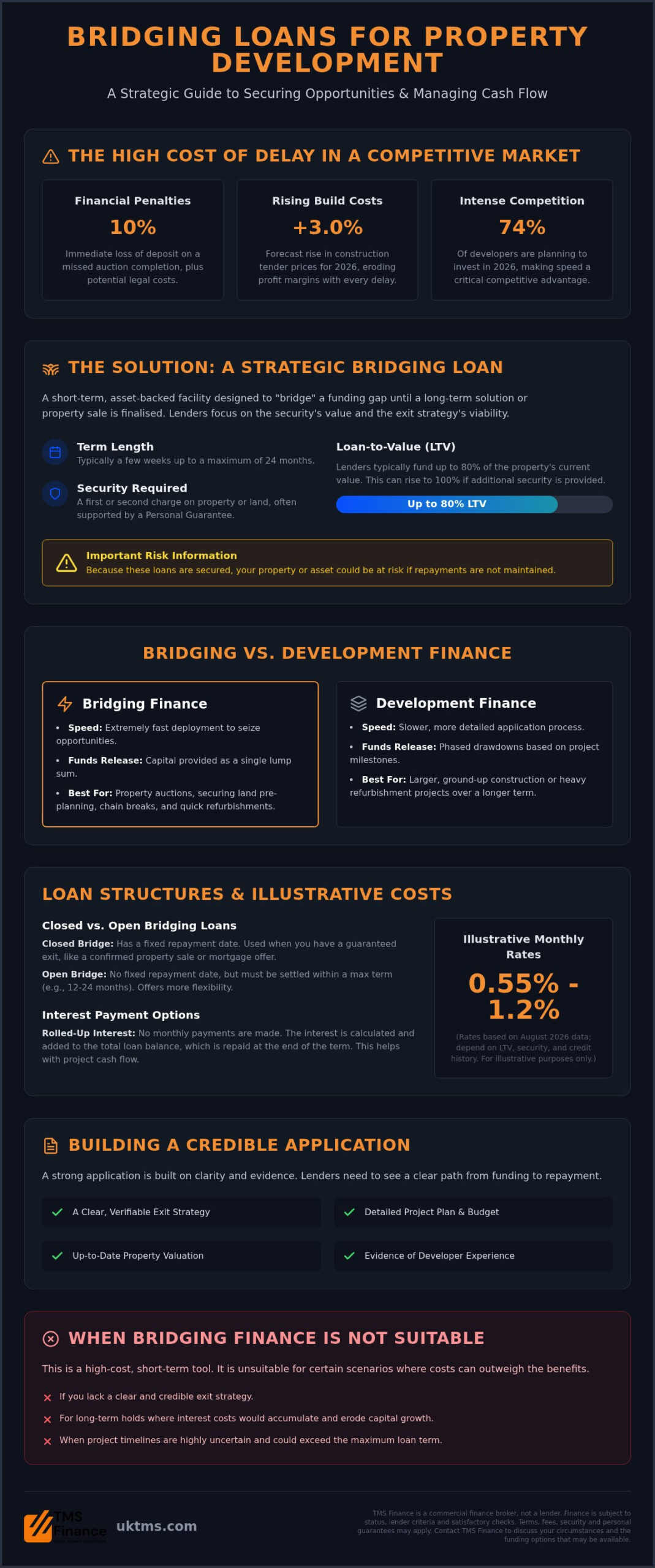
A missed auction bid or a stalled site doesn’t just delay your timeline; it can collapse the entire viability of a project. Many developers find that traditional bank lending moves too slowly to capture high-value opportunities, especially with 74% of developers planning to invest in 2026. This creates a competitive environment where speed is a non-negotiable requirement for success. You likely recognise the frustration of managing cash-flow gaps between construction phases or the risk of losing a site because of a deadline mismatch.
Using a bridging loan for property development acts as a tactical tool to prevent these crises. This guide provides a professional overview of how bridging finance can secure your next project, manage funding gaps, and ensure development deadlines are met without a cash-flow crisis. You will understand the exact documents required, the current 2026 interest rates, and how to structure a credible exit strategy. We will also outline when this finance is not suitable and the risks to your security, ensuring you have the clarity needed to make an informed decision for your business.
Key Takeaways
- Learn how to prevent lost deposits and missed auction opportunities by using short-term finance to close funding gaps quickly.
- Understand how a bridging loan for property development is structured, including how lenders calculate Loan-to-Value (LTV) against your assets.
- Discover the critical differences between bridging and development finance regarding deployment speed and how funds are released.
- Identify the essential documentation and security requirements needed to build a credible application that meets lender criteria.
- See how a professional broker identifies the right lender fit from available options to manage complex project timelines.
Closing the Funding Gap in Property Development
Property development relies on precise timing. When a project hits a cash-flow mismatch, the consequences are rarely just administrative. They are financial. For many, a bridging loan for property development provides the liquidity needed to maintain momentum when traditional lenders take weeks to process an application. This speed is vital in a market where 74% of developers are looking to invest in 2026; the ability to deploy capital quickly is a significant competitive advantage.
What is a bridging loan? Essentially, it’s a short-term, asset-backed finance option designed to “bridge” the gap until a long-term funding solution or a property sale is finalised. It allows developers to act decisively, whether they are securing a new site or managing the mobilisation costs of a construction contract. Without this flexibility, many projects risk stagnation before they even begin.
The Cost of Delay in UK Property Deals
Missing a completion deadline, particularly in an auction environment, often results in the immediate loss of a 10% deposit. Beyond the lost capital, developers face legal penalties and potential “notice to complete” costs. With construction tender prices forecast to rise by 3.0% in 2026, every month of stagnation adds to the eventual build cost. Delays don’t just cost time; they erode your profit margins.
Speed of execution is often more valuable than the headline interest rate. If a developer cannot mobilise a contract because of a funding delay, the project risk profile increases. Short-term borrowing allows for immediate site possession, protecting the initial investment and keeping the project on schedule. This proactive approach ensures that labour and materials are secured before further price increases occur. For professionals who need to manage their own financial flexibility during these intensive periods, ILoveYourLoans provides personal and installment loan options to help bridge personal cash flow gaps.
Bridging as a Strategic Development Tool
Strategic use of a bridging loan for property development allows you to secure sites before planning permission is granted. This approach is often more effective than waiting for a commercial mortgage, which typically requires a higher level of certainty and documentation. It also facilitates quick refurbishments, enabling you to increase a property’s value before transitioning to a lower-cost, long-term loan.
However, this finance is not suitable for every scenario. It’s a high-cost tool designed for short durations. If your project lacks a clear exit strategy, such as a guaranteed sale or a confirmed refinance route, bridging could lead to significant financial strain. It is also unsuitable for long-term holds where the interest would eventually outweigh the capital growth. You can explore various funding options to see which fits your specific project timeline and exit plan.
The Mechanics of Bridging Loans for Development
A bridging loan for property development is a short-term, asset-backed facility. It is secured against property or land, providing a fast injection of capital to cover immediate costs. For smaller-scale financial needs or immediate liquidity, some individuals might also research payday loans online as a way to manage short-term cash requirements. Unlike a traditional mortgage, lenders focus primarily on the value of the security and the viability of the exit strategy. Most agreements run for a few weeks up to a maximum of 24 months, reflecting the temporary nature of the funding. This term length aligns with current 2026 regulatory shifts, where the FCA has consulted on extending regulated terms to match the needs of modern developers.
Loan-to-Value (LTV) ratios for bridging typically reach up to 80% of the current property value. If you provide additional security, such as other properties in your portfolio, some lenders may consider funding up to 100% of the purchase price. Because these loans are secured, your property or asset is at risk if repayments are not maintained. Lenders usually require a first or second charge on the title, often supported by a Personal Guarantee from the company directors to ensure commitment to the project exit.
Closed vs. Open Bridging Loans
A closed bridge has a fixed repayment date. This structure is common when a developer has a confirmed exit, such as a mortgage offer waiting for completion or a signed sale contract. It provides certainty for the lender and can sometimes result in more favourable terms. An open bridge is more flexible; it has no fixed repayment date but must be settled within a maximum term, usually 12 or 24 months. This is useful when the exit depends on a property sale where the timeline is less predictable.
Interest and Fee Structures Explained
Interest is typically quoted monthly rather than annually. In August 2026, monthly rates generally range between 0.55% and 1.2% depending on the LTV, property type, and your credit history. Many developers opt for “rolled-up” interest. This means you don’t make monthly payments; instead, the interest is added to the loan balance and settled at the end of the term. This approach preserves your cash flow during the critical construction phase when capital is needed for labour and materials. For broader financial support, Pixie Loans can help you find personal credit solutions to manage your own liquidity while your business capital is committed to the site.
You should also account for several setup costs that impact the total repayment amount:
- Arrangement fees: Typically 1% to 2% of the total loan amount.
- Valuation fees: These vary by property complexity, often ranging from £500 to over £2,500.
- Legal fees: You are usually responsible for both your own legal costs and the lender’s representation.
If you are unsure which structure best fits your project timeline, you can start your finance application to review the current market options available for your specific circumstances.
Bridging Loan vs. Development Finance: Key Differences
Choosing the right facility depends on the project’s scope and the speed required to deploy capital. While a bridging loan for property development and development finance are both used by professionals, they serve different operational stages. The primary differentiator is how the lender assesses risk and releases the capital. Bridging is a speed-first product, whereas development finance is a structure-first facility.
In a bridging agreement, the lender typically releases the funds as a single lump sum at the start. This is ideal for site acquisition. Development finance, however, uses staged drawdowns. Capital is released in arrears after a Monitoring Surveyor or Quantity Surveyor verifies that specific build milestones have been met. This structured release ensures the lender’s exposure remains aligned with the increasing value of the site as the build progresses.
Speed of deployment also varies significantly. A bridging loan can often be finalised within 10 to 14 days, making it suitable for time-sensitive deals. For real estate investors requiring this level of agility, Jet Lending, LLC specializes in short-term financial products designed to meet rapid funding needs. Development finance, by contrast, requires deeper technical due diligence, including a review of build contracts, warranties, and planning conditions. This process can take six to eight weeks. For experienced developers, senior development finance rates in early 2026 range from 6.5% to 9.5% per annum, reflecting the lower risk of a structured build compared to a rapid bridge.
A bridging loan for property development is the standard choice for auction purchases where you must complete within 28 days. It’s also effective for light refurbishments where the structural integrity of the building remains unchanged and the project duration is under 12 months. Developers frequently use it to secure land while they wait for long-term development funding to be finalised. It acts as a tactical entry tool rather than a long-term build partner. For projects involving aesthetic or energy-efficiency upgrades, sourcing high-quality uPVC or aluminium glazing from Trade Tech Windows & Doors can help maximise the final value of the asset.
For ground-up construction or heavy structural conversions, development finance is more appropriate. It’s designed to manage the complexities of multi-stage projects where you need to pay contractors at set intervals. Engaging a reliable partner like Horns Construction ensures that these milestones are achieved, allowing for the timely release of staged drawdowns. If your build timeline exceeds 24 months, the annualised rates of development finance are generally more sustainable than the monthly compounding interest of a bridge. It provides the necessary oversight and capital flow for large-scale residential or commercial schemes where project complexity requires a specialised lender.
Securing a bridging loan for property development requires more than just a valuable asset. Lenders evaluate the project’s risk by looking at three main pillars: your experience, the security provided, and the project’s purpose. Professional lenders want to see a “Safe Pair of Hands” at the helm of the development. This often involves demonstrating robust risk management; consulting with specialists like Paterson Insurance Brokers can help you secure tailored insurance solutions that mitigate project risks and satisfy lender requirements. If you’re an experienced developer with a track record of similar projects, you’ll likely access more competitive terms. For those with less experience, having a robust professional team, including a reputable main contractor and architect, is essential to mitigate perceived risk.
Submit your development details for a professional review
The Critical Nature of the Exit Strategy
The exit strategy is the most important part of your application. Since a bridging loan is a temporary facility, the lender needs absolute clarity on how the debt will be settled. If your plan is to sell the finished units, you must provide evidence of local market demand and comparable sales data. If you intend to refinance onto a long-term commercial mortgage, providing a Decision in Principle from a long-term lender adds significant weight to your case. Lenders frequently reject applications because the exit plan is speculative. You should also prepare a “Plan B,” such as a bridge-to-let option, in case the market slows or a sale falls through. Developers planning to retain completed units within a portfolio should also consider how buy-to-let mortgages and commercial property finance can provide a structured long-term funding solution once the bridge is repaid.
Valuation and Site Information
Every lender requires an independent valuation from a surveyor on their approved panel. You cannot use a valuation you have commissioned yourself. This report confirms the current Open Market Value and the projected Gross Development Value (GDV). With construction costs forecast to rise by 3.0% in 2026, your cost forecasts must be precise. If your budget appears unrealistic, the lender may view the project as high-risk. It’s advisable to obtain professional advice from a Quantity Surveyor to ensure your figures are robust and reflect the current labour and material costs in the UK market.
The Role of a Broker in Securing Development Funding
TMS Finance is a commercial finance broker, not a lender. Understanding this distinction is vital when looking for a bridging loan for property development. A lender provides the capital and sets the terms directly. A broker acts as your representative. We identify the most suitable lender from a broad range of options based on your specific project requirements. This saves you time and prevents multiple credit searches that could impact your credit profile. For developers looking for equivalent personalised financial guidance in other jurisdictions, you can learn more about The Home Loan Partners to see how they assist clients in the Australian market.
Lenders often have very specific preferences for the types of projects they fund. Some focus on residential conversions while others prefer commercial-to-residential schemes. We identify which lenders have the strongest appetite for your project type at any given time. This ensures your application is presented to a partner likely to approve the facility. Professional packaging is the cornerstone of this process. A lender is more likely to commit when they receive a complete, well-organised pack that addresses their core concerns regarding security and exit.
Our approach focuses on your long-term business objectives. We look beyond the immediate need for capital to understand how the repayment will impact your future cash flow. As NACFB members, we adhere to professional standards that prioritise clarity and transparency. We provide guidance on the exact information needed for a credible application, ensuring you understand all commercial terms and repayment obligations before signing. You can explore our range of property finance products to see how we support different development stages.
The TMS Finance Process
The process begins with an initial discussion to understand your project and timing requirements. We review your headline business information and the security you intend to provide. Once we identify a potential fit, we assist with document collection and the final lender presentation. This methodical approach reduces the risk of last-minute hurdles during the legal process. Our goal is to provide a “Safe Pair of Hands” that manages the logistical headaches of funding while you focus on the build. You can start your business loan application today to begin the review process.
TMS Finance is a commercial finance broker, not a lender. Finance is subject to status, lender criteria and satisfactory checks. Terms, fees, security and personal guarantees may apply. Contact TMS Finance to discuss your circumstances and the funding options that may be available.
Securing Your Next Development Project
Speed is the defining factor in the 2026 property market. Whether you’re managing a cash-flow gap or securing an auction site, a bridging loan for property development provides the necessary liquidity to keep your project on schedule. We’ve explored the mechanics of these facilities, the importance of a credible exit strategy, and the technical differences between bridging and development finance.
As NACFB members with UK-wide national coverage, TMS Finance provides the commercial finance brokerage expertise required to manage complex property deals. We act as a professional partner, ensuring your application is packaged correctly to meet specific lender criteria. This methodical approach reduces the risk of project stagnation and protects your initial investment.
Proactive planning and professional guidance ensure that your funding supports your build rather than creating a cash-flow crisis. Taking the right steps now secures your project’s future.
TMS Finance is a commercial finance broker, not a lender. Finance is subject to status, lender criteria and satisfactory checks. Terms, fees, security and personal guarantees may apply. Contact TMS Finance to discuss your circumstances and the funding options that may be available.
Frequently Asked Questions
Can I get a bridging loan for a property in poor condition?
Bridging finance is specifically designed for properties that traditional banks consider unmortgageable. This includes sites with structural issues or missing essential facilities like kitchens and bathrooms. When assessing a project’s viability, it is crucial to identify hidden infrastructure issues early; you can check out T.M. Drainage for guidance on common drainage problems that might affect a property’s value. Lenders evaluate the property’s potential value after the proposed works are complete. This allows you to purchase a distressed asset and complete the necessary refurbishments before transitioning to a long-term mortgage once the property is in a habitable state.
Managing cash flow during a long-term refurbishment can be challenging, but using a broker like I Need Cash can help you find personal or homeowner loans to maintain your financial flexibility until the project is complete.
To further explore your options for individual financial support, you can learn more about how Personal Loans helps individuals find the right borrowing solutions.
Borrowing limits for a bridging loan for property development are usually based on the current value of the asset or the projected Gross Development Value (GDV). Most lenders offer up to 80% Loan-to-Value (LTV) on the purchase price. For ground-up projects, funding is typically capped at 65% to 75% of the GDV. Providing additional security can sometimes allow for higher borrowing levels depending on the lender’s specific criteria.
What is the typical interest rate for a bridging loan in 2026?
In August 2026, monthly interest rates generally range from 0.55% to 1.2%. These rates vary based on the project’s risk profile, your experience, and the LTV ratio. Interest is frequently rolled up, meaning no monthly payments are required during the build phase. You should also account for arrangement fees of 1% to 2% and valuation costs. Total repayment amounts will vary based on the facility’s duration and the lender’s terms.
Do I need a personal guarantee for a bridging loan?
Lenders usually require a personal guarantee from company directors when the borrower is a limited company. This acts as a secondary layer of security alongside the charge on the property. It ensures that the individuals behind the project are committed to the exit strategy. You should obtain independent legal advice to understand the implications for your personal assets, as a guarantee creates a significant legal obligation beyond the corporate entity.
What happens if I cannot repay the loan on time?
If you cannot settle the facility by the agreed date, the lender may apply default interest rates and additional fees. Because the finance is secured, the property or asset is at risk of repossession if repayments are not maintained. It is essential to have a credible backup plan, such as a bridge-to-let refinance, in case your primary exit through sale or long-term funding is delayed by market conditions.
TMS Finance is a commercial finance broker, not a lender. Contact TMS Finance to discuss your circumstances and the funding options that may be available.
2 responses