

Securing a commercial lot loan in 2026 is no longer about chasing the lowest headline rate, but about matching your project’s specific risk profile to a lender that understands your sector. You’ve likely faced the frustration of high-street banks demanding 40% deposits or taking months to review a straightforward land purchase. It’s common to feel uncertain about whether a particular plot of land even qualifies for a standard mortgage, especially when traditional lenders seem increasingly risk-averse.
We understand that delay often means a lost opportunity in a competitive market. This guide provides a clear roadmap for financing commercial property and land across the UK. You’ll learn about the specific finance options available, the eligibility criteria you must meet, and the exact steps to take for a successful application. We will examine how to package your documentation to secure competitive terms and why identifying the right lender fit is more critical than ever in today’s selective market. By the end of this article, you will have the knowledge needed to approach lenders with confidence and precision, ensuring your project moves from the planning phase to completion without unnecessary friction.
Key Takeaways
- Understand why securing land or property units provides long-term stability and asset growth for your firm.
- Distinguish between long-term commercial mortgages and tactical bridging finance used for quick purchases or auction completions.
- Identify how LTV ratios and your firm’s trading history impact the terms of a commercial lot loan and overall lender appetite.
- Prepare a robust application by gathering essential documents, including filed accounts, VAT returns, and detailed cash-flow forecasts.
- Learn why using a specialist broker to identify lender fit is more efficient than making multiple direct applications to high-street banks.
Funding Commercial Lots: Strategic Property Acquisition for UK Firms
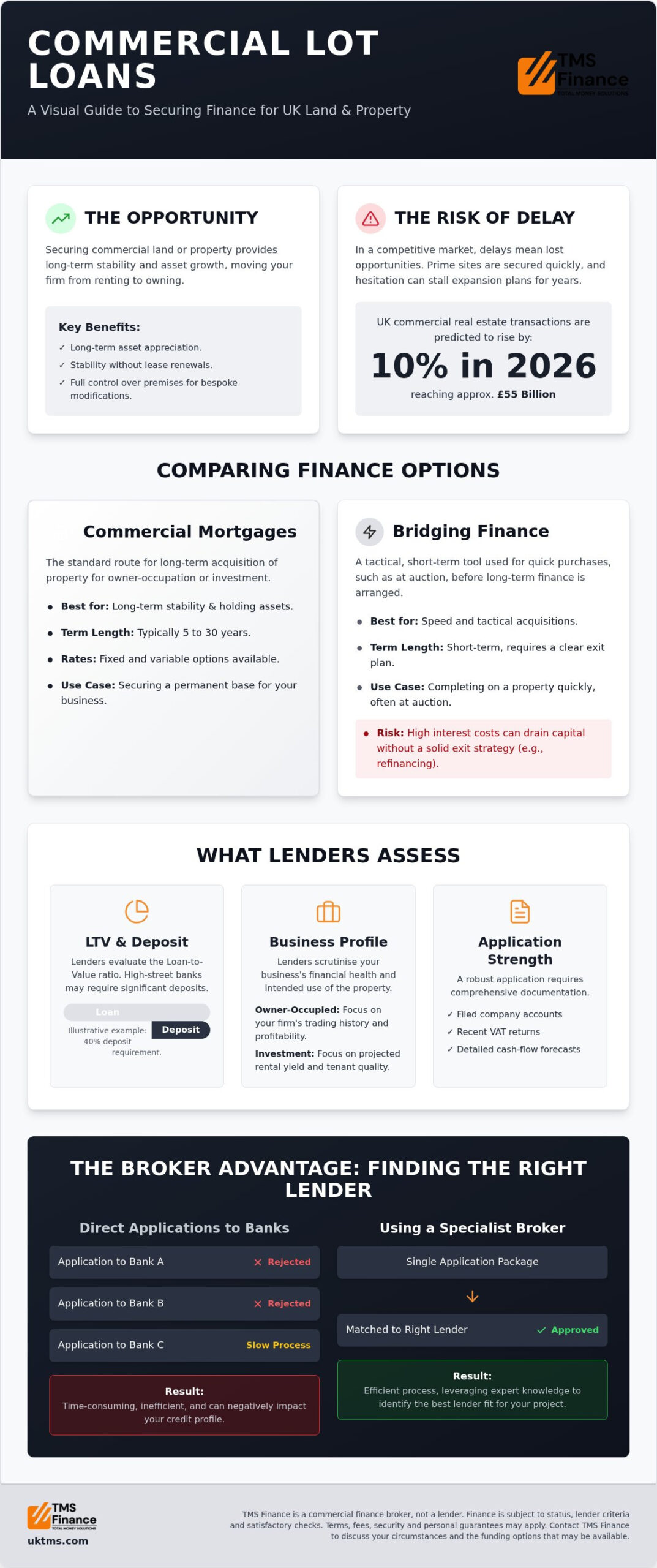
A commercial lot loan is a specialist finance facility designed for the acquisition of land or specific property units. Unlike traditional business loans, these are secured against the asset itself, providing the capital needed to move from renting to owning. For many UK firms, the transition to property ownership is a move toward long-term stability. It removes the uncertainty of lease renewals and allows for asset growth as the property value appreciates over time. Owning the site also gives you total control over the premises, allowing for bespoke modifications that support your specific operational requirements.
Delaying a purchase in the current climate carries specific risks. Market data suggests that commercial real estate transaction volumes in the UK are predicted to rise by 10% in 2026, reaching approximately £55 billion. With increased activity, prime sites are secured quickly. Missing a completion deadline or losing a plot to a competitor can stall your business expansion for years. When a strategic site becomes available, having a pre-arranged finance structure ensures you can move with the speed the market demands.
Owner-Occupied vs Commercial Investment
The structure of your finance depends heavily on how you intend to use the site. If you plan to trade from the lot as your company headquarters, lenders view this as an owner-occupied purchase. These often attract different terms compared to investment purchases, where the primary goal is generating rental income from third-party tenants. A Commercial mortgage is the standard route for these acquisitions, but the underwriting process differs between the two models. Lenders will scrutinise your business’s trading history for owner-occupied loans, while investment loans focus more on the projected rental yield and the quality of the prospective tenants.
The Risk of Inappropriate Funding
Selecting the wrong financial product can have a severe impact on your business’s cash flow. If you use high-interest short-term bridging finance without a clear exit strategy, the monthly costs can quickly drain your working capital. It’s vital to ensure the facility matches your long-term goals. While a standard unsecured loan might seem simpler to apply for, it rarely provides the scale of capital required for a property purchase and lacks the longer repayment terms that make land acquisition viable. You can view our range of commercial finance products to see how different facilities are structured to protect your liquidity and support sustainable growth.
Comparing Finance Options: Mortgages vs Bridging Loans
Selecting the right commercial lot loan depends entirely on your project’s timeline and the current state of the asset. While some firms require a long-term facility to secure a permanent base, others need a tactical tool to acquire land quickly before it’s lost to a competitor. With the Bank of England base rate currently at 3.75%, understanding the cost of capital across different products is essential for maintaining a healthy balance sheet. Each funding route carries specific risks and benefits that must be weighed against your firm’s cash-flow requirements.
For projects involving construction or significant refurbishment, development finance is often the most appropriate choice. This facility is structured to release funds in stages, mirroring the progress of the build. Conversely, if you’re dealing with smaller land-related costs or preliminary site works, a revolving credit facility can provide flexible access to capital without the need for a full mortgage application. It’s about ensuring the scale of the finance matches the scale of the task.
Commercial Mortgages for Long-Term Stability
Established firms typically opt for a commercial mortgage when purchasing a lot they intend to hold for several years. Unlike residential agreements, these loans usually offer repayment terms between 5 and 30 years. In the 2026 UK market, businesses must choose between fixed and variable rates. Fixed rates provide certainty for budgeting, while variable rates may benefit those who anticipate a future drop in the base rate. You can explore our full range of commercial finance products to compare how these facilities align with your long-term strategy. While the UK market has its own nuances, looking at international benchmarks like the SBA 504 loan program shows how structured, long-term asset financing is a global standard for business growth.
Bridging Loans for Fast Acquisitions
When speed is the priority, such as during a property auction or a time-sensitive site acquisition, bridging finance acts as a vital stop-gap. These loans can often be arranged much faster than a standard mortgage, allowing you to secure a commercial lot loan before a competitor can intervene. However, the higher cost of bridging finance means you must have a verified exit route in place. This is usually a transition to a long-term mortgage or the sale of the asset after planning permission is granted. For a deeper analysis of this tactical tool, refer to our Bridging Loan Guide to understand the specific requirements for 2026. If you’re ready to discuss which option fits your current acquisition, you can start your application process online today.
Lender Assessment: What Factors Influence Your Application?
Lenders don’t just evaluate the land you’re buying; they scrutinise the person or business behind the purchase. Loan to Value (LTV) ratios for a commercial lot loan are typically more conservative than those for developed buildings. While you might secure 75% LTV on a standing warehouse, raw or unimproved land often attracts LTVs of 50% to 60%. This reflects the higher risk of illiquidity if the site isn’t developed as planned. For detailed insights into technical assessments, industry guides on commercial property land loans highlight how these ratios shift based on site condition and planning status.
Your bank conduct and credit profile are central to the decision. Lenders examine your current account statements to see how you handle daily liabilities. Frequent unarranged overdrafts or returned direct debits suggest financial instability, even if your filed accounts look strong. They want to see a clean history of debt management and a clear credit profile for all directors. The specific property type and its location also carry weight. A lot in a prime industrial zone with good transport links is far more attractive than a remote rural plot with restricted access.
Affordability and Repayment Route
Lenders use the Debt Service Cover Ratio (DSCR) to ensure your business can afford the debt. This calculation compares your net operating income to your total debt obligations. Typically, a ratio of 1.25x or higher is required, meaning your profit must cover the loan repayments with a 25% buffer. You’ll need to provide evidence of consistent business profits or guaranteed rental income to prove the interest is covered. Because these are high-value transactions, security and personal guarantees are standard requirements to mitigate lender risk. To further safeguard your business interests during such acquisitions, you can learn more about WS Insurance Brokers. If the repayments aren’t maintained, the secured property or asset could be at risk.
For investors seeking streamlined funding models, Simplified Commercial Lending provides specialized mortgage products for rental and investment properties that focus on asset performance rather than requiring tax returns.
A proven track record is essential for larger acquisitions. Lenders are more comfortable with borrowers who’ve successfully managed similar projects in the same sector. For example, a developer with experience in industrial lots will find more options than a newcomer. Different sectors, such as hospitality or retail, have varying levels of lender appetite in 2026. Professional guidance helps present your complex experience clearly, ensuring the lender sees you as a reliable partner. You can view our range of commercial finance products to see which lenders suit your specific sector. If you’re ready to see which facility matches your profile, you can submit your details online for a preliminary review.
Preparing for Completion: Essential Documents and Requirements
Securing a commercial lot loan requires a methodical approach to documentation. Lenders view the quality of your paperwork as a direct reflection of your business’s management. Missing a single bank statement or failing to provide a clear cash-flow forecast can stall the process for weeks. In 2026, the underwriting process is highly structured, focusing on the protection of the lender’s capital through rigorous checks. You must present a complete package that proves both your firm’s stability and the property’s viability.
Initial requirements include at least six months of business bank statements and your last three years of filed accounts. These documents allow lenders to verify your trading history and debt-servicing capacity. If the property purchase involves VAT, you must provide your latest VAT returns. This is particularly important because Stamp Duty Land Tax (SDLT) is calculated on the VAT-inclusive total, which can significantly increase your upfront costs. Additionally, every director must provide identification and proof of address to satisfy standard Know Your Customer (KYC) regulations.
The Financial Evidence Checklist
Beyond historical data, lenders require management accounts for the current trading year. These show how your business has performed since your last official filing. You should also prepare aged debtor and creditor reports. These reports provide a snapshot of your liquidity by showing how quickly your clients pay you and how promptly you settle your own liabilities. This level of detail ensures the lender that your working capital remains healthy enough to support a new commercial lot loan.
Property and Legal Requirements
Property-specific evidence is non-negotiable. If you’re using bridging finance, you must provide clear evidence of your exit strategy, such as a mortgage offer or a sales agreement. You will also need a professional valuation report. It’s critical to wait for the lender to instruct a valuer from their approved panel, as they will rarely accept a report commissioned independently. Finally, your solicitors will manage the title checks and the registration of the legal charge, ensuring the transaction is compliant with all UK property laws.
TMS Finance is a commercial finance broker, not a lender. Finance is subject to status, lender criteria and satisfactory checks. Terms, fees, security and personal guarantees may apply. Contact TMS Finance to discuss your circumstances and the funding options that may be available.
Securing Commercial Lot Finance with TMS Finance
TMS Finance operates as a strategic partner for UK businesses and property professionals. We don’t believe in random outreach to multiple lenders, as this often leads to repeated credit searches and can negatively impact your business credit profile. Instead, we focus on identifying the specific lender fit based on your project’s risk profile and sector. Our methodical process moves from an initial consultation through to full completion support, ensuring that your application is packaged to meet the exact underwriting criteria of the chosen provider. This structured approach helps avoid the delays commonly associated with high-street bank applications.
Working with a specialist broker provides a layer of protection for your business. We act as a “safe pair of hands,” navigating the documentation requirements so you can remain focused on your daily operations. By understanding the specific appetites of various lenders in the 2026 market, we can identify which facilities are most likely to support your acquisition of land or property units. This saves you from the frustration of submitting a commercial lot loan application that doesn’t align with a lender’s current risk policy.
The Value of a Commercial Broker
While TMS Finance specialises in commercial facilities, business owners often require broader support for their property portfolios; in such cases, securing independent mortgage advice UK ensures that all your financing needs, from commercial units to residential investments, are handled with expert care.
Packaging a finance application is a technical task that requires precision. We support you through the documentation phase, ensuring that your management accounts and cash-flow forecasts are presented in a format lenders trust. This integrated approach reduces the risk of a failed application and helps secure the most appropriate terms for your circumstances. We provide a clear explanation of all commercial terms, including interest structures, arrangement fees, and security requirements. We ensure you understand your obligations and the security you must provide, such as personal guarantees, before you commit to any facility.
When Finance May Not Be Suitable
External funding isn’t always the right path for every firm. If your business has healthy retained profits, using these can avoid interest costs and long-term debt obligations. You might also consider alternatives from our commercial finance products, such as asset finance or refinancing existing machinery to raise capital without a new property-linked loan. Over-leveraging can damage your business resilience, especially if trading conditions become volatile. We always encourage clients to seek independent professional advice for tax, legal, and accounting matters; for specialized financial consultancy, check out Engage Financial Solutions. It’s vital to remember that secured finance puts your property or assets at risk if repayments aren’t maintained.
TMS Finance is a commercial finance broker, not a lender. Finance is subject to status, lender criteria and satisfactory checks. Terms, fees, security and personal guarantees may apply. Contact TMS Finance to discuss your circumstances and the funding options that may be available.
Acquiring land or property units requires a methodical approach to finance that balances speed with long-term stability. You’ve seen how a commercial lot loan differs from standard business lending, particularly regarding LTV ratios and the depth of documentation required for completion. Success in the 2026 market depends on presenting a compliant, professional application that clearly demonstrates your repayment route and exit strategy.
Delaying an acquisition often results in lost opportunities as transaction volumes rise across the UK. TMS Finance acts as your “Safe Pair of Hands,” providing expert guidance on lender fit to ensure your project receives the right support. As an NACFB member with national coverage, we help you navigate complex requirements with precision and confidence. We’re ready to help you secure the assets your business needs to thrive.
TMS Finance is a commercial finance broker, not a lender. Contact TMS Finance to discuss your circumstances and the funding options that may be available.
Frequently Asked Questions
Can I get a commercial mortgage for a vacant plot of land?
Yes, commercial lenders provide funding for vacant plots, though the terms depend on the land’s status. Raw land without planning permission is viewed as higher risk, often resulting in lower LTV ratios. Improved land with services and planning consent is easier to finance. Many developers use bridging finance to secure the site quickly before moving to a long-term commercial mortgage once the project’s viability is fully established.
What is the typical deposit required for a commercial lot loan?
You should generally expect to provide a deposit between 30% and 50% for a commercial lot loan. Lenders are more conservative with land than with standing buildings. For raw land, a 50% deposit is common to mitigate the risk of the site remaining undeveloped. If your business has strong trading accounts and the property is for your own use, some specialist lenders may consider higher LTV ratios based on your firm’s affordability.
How long does the application process take for commercial property finance?
Completion time depends on the case and lender, typically ranging from a few weeks to several months. Bridging finance is designed for speed and can often be finalised much faster than a long-term mortgage. However, the legal and valuation stages for land are complex and can take significant time. Presenting a complete application with valuation information and planning documents at the initial stage is the best way to support an efficient process.
Will I need to provide a personal guarantee for a business property loan?
Security or personal guarantees may be required by most lenders when providing finance to a limited company. This gives the funder a secondary route for repayment if the business defaults on the loan. It’s a standard part of commercial lending designed to ensure director commitment to the project. Because a personal guarantee puts your personal assets at risk, it’s essential to obtain professional legal advice to fully understand your obligations before proceeding.
Can a new business apply for commercial lot finance?
Younger companies can access property finance, though lenders will scrutinise the experience of the directors more closely. If you don’t have three years of filed accounts, you’ll need to provide robust business plans and cash-flow forecasts to prove affordability. Experience in sectors like construction or property development can help strengthen your case. Specialist lenders often provide more flexible routes for new businesses compared to traditional high-street banks, depending on the specific case.
What happens if I cannot maintain repayments on a secured commercial loan?
Your secured property or asset could be at risk if repayments are not maintained. Defaulting on a commercial loan can lead to the lender taking possession of the site to recover their capital. It can also trigger personal guarantees, making directors liable for any shortfall. If your business faces cash-flow gaps, you should contact your lender immediately to discuss your circumstances. Borrowing is a serious commitment that requires a sustainable and verified repayment route.
TMS Finance is a commercial finance broker, not a lender. Contact TMS Finance to discuss your circumstances and the funding options that may be available.