

UK merger and acquisition values reached £292 billion in the first half of 2026. Despite this high activity, many SME owners still struggle to secure the capital needed for a successful buyout. You likely understand that acquiring a competitor is a powerful growth strategy, but the financial strain is often daunting. Relying on your company’s cash reserves creates a dangerous liquidity gap, making business acquisition finance essential for protecting your existing operations.
Funding a purchase is complex and the stakes are high. If you delay your application, you risk losing a prime target to a better-funded competitor or facing tighter lender criteria as interest rates shift. This guide explains how to bridge the capital gap without over-leveraging your current assets. We’ll compare professional options available to UK businesses, such as secured loans and asset-based lending.
As a commercial finance broker, TMS Finance acts as a safe pair of hands to help you manage these technical requirements. You’ll learn how to protect your cash flow and find a funding structure that matches the acquired company’s revenue. We’ve outlined the eligibility criteria, costs, and risks involved, ensuring you have a clear path to completing your deal with confidence.
Key Takeaways
- Relying on cash reserves for a purchase can leave your business vulnerable. Learn how business acquisition finance provides the capital needed to buy a competitor while protecting your liquidity.
- Funding options vary based on your company’s performance and the target’s assets. We compare professional facilities like secured loans and asset-based lending to help you structure a deal.
- A credible application is essential for lender approval. Discover the documentation required to demonstrate affordability and creditworthiness to UK lenders.
- Secured finance involves risks to your assets if repayments aren’t maintained. Understand the requirements for security and personal guarantees before you commit to a deal.
- A commercial finance broker helps you identify which lenders are most likely to accept your application. This process ensures the funding structure matches the acquired company’s revenue.
The Financial Impact of Business Acquisition Opportunities
Business acquisition finance is a specific category of funding used to purchase another trading entity or its assets. It serves as a financial bridge, allowing established companies to scale through mergers and acquisitions without depleting their own capital. In the UK, the M&A market remains highly active. Data from the first half of 2026 shows that deal values reached £292 billion, driven by a “flight to quality” where buyers focus on high-conviction, transformative targets. For an SME, this competition means that having a robust funding structure is often the difference between a successful deal and a missed opportunity.
Relying solely on internal cash reserves to fund a purchase is a high-risk strategy. While it avoids interest costs, it can cripple your company’s liquidity. Large cash outlays leave the business vulnerable to unexpected market shifts or operational emergencies. Professional funding allows you to maintain a safety buffer, ensuring your core operations remain stable while you integrate the new acquisition. Sellers also prioritise bidders who can demonstrate certain funding, making a pre-arranged facility a vital tool in any competitive takeover scenario.
Bridging the Capital Gap
Internal cash flow is rarely sufficient to cover the full cost of a strategic purchase, especially when considering the additional costs of due diligence and integration. Over-leveraging your current business to buy another can lead to severe operational strain. If your working capital is tied up in a purchase, you might lack the funds to respond to new contracts or maintain equipment. Business acquisition finance preserves your cash flow, spreading the cost of the purchase over a term that reflects the target’s expected performance. This approach ensures that your existing company doesn’t subsidise the new entity at the expense of its own growth.
When is Finance the Right Solution?
Borrowing is a logical step when the target company generates sufficient revenue to cover the debt service while still providing a clear return on investment. It’s essential to match the funding term to the expected ROI of the acquisition. For example, if a target is expected to be fully integrated and profitable within three years, a short-term facility might be more appropriate than a long-term mortgage. You should review our business loan guide to understand how different debt structures impact your balance sheet. Professional funding is right when it facilitates growth that would be impossible through organic means alone, provided the cost of capital is lower than the projected gains from the merger.
TMS Finance is a commercial finance broker, not a lender. Finance is subject to status, lender criteria and satisfactory checks. Terms, fees, security and personal guarantees may apply. Contact TMS Finance to discuss your circumstances and the funding options that may be available.
Comparing Business Acquisition Finance Options
Selecting the right structure for business acquisition finance requires a detailed assessment of both your current firm and the target entity. Lenders don’t offer a single product; instead, they provide a range of facilities that a broker can help you package. Rates and terms vary significantly based on the applicant’s credit profile, business performance, and the level of security provided. While some deals rely on vendor financing to bridge a small gap, most professional acquisitions require a mix of commercial debt to ensure the deal’s stability.
Business Loans and Working Capital
Unsecured business loans are often used for smaller acquisitions or to cover specific completion costs. These facilities offer speed but typically carry higher interest rates and shorter repayment terms. For larger, strategic purchases, secured loans are more common. These require collateral, such as commercial property or significant machinery, to provide the lender with security. This structure often results in more competitive rates and longer repayment periods, which helps preserve your monthly cash flow. It’s vital to ensure that the repayment obligations don’t outpace the revenue generated by the new acquisition. You can view our full range of other commercial products to see how these facilities integrate with your growth plans.
Asset and Invoice Finance for Acquisitions
Asset-based lending is a practical tool for purchasing companies with significant physical or financial assets. You can use the target company’s own balance sheet to fund the purchase. For instance, invoice finance allows you to borrow against the target’s unpaid sales ledger, providing immediate liquidity after the deal closes. Similarly, asset finance can be used to refinance the target’s existing equipment or machinery to raise capital for the buyout. These options are particularly effective for manufacturing or construction firms where heavy equipment is a core part of the business. This method protects your existing cash reserves by leveraging the value already present in the target company.
Before committing to a specific debt structure, you should start a finance application to understand the options available for your specific deal. Packaging your application correctly from the start is the best way to demonstrate reliability to potential lenders.
TMS Finance is a commercial finance broker, not a lender. Finance is subject to status, lender criteria and satisfactory checks. Terms, fees, security and personal guarantees may apply. Contact TMS Finance to discuss your circumstances and the funding options that may be available.
Preparing a Credible Funding Application
Lenders assess business acquisition finance applications based on the perceived risk to their capital. A complete and transparent application package signals that you’re a professional borrower who understands the complexities of the deal. Approval isn’t a formality. It depends on your business performance, your credit profile, and the lender’s specific criteria. You’ll also need to provide standard KYC (Know Your Customer) documents, including valid director identification and proof of address for all key stakeholders.
The application process begins with a detailed discussion to understand your funding purpose. This stage allows us to identify which lenders are the best fit for your specific acquisition. Packaging your application correctly from the outset prevents delays and ensures that lenders receive a clear, consistent narrative about your growth plans.
Essential Document Checklist
To review your case, lenders require a comprehensive set of financial data. You should prepare recent business bank statements, typically covering the last six months, and filed accounts for the last two to three years. Lenders also need to see current VAT returns and aged debtor and creditor reports. Crucially, you must provide detailed cash-flow forecasts. These should demonstrate how the combined business entity will meet its debt obligations while maintaining its own operational stability.
Lender Assessment Factors
Lenders look beyond the balance sheet to assess the viability of the loan. They scrutinise your trading history and bank conduct to ensure you manage existing debt responsibly. A clear repayment route is essential. The lender needs to see that the acquired business generates enough cash to service the new debt without compromising your current operations. Experience in the sector is also a significant factor. If you’re buying a company in an industry where you have a proven track record, lenders often view the deal as lower risk.
TMS Finance is a commercial finance broker, not a lender. Contact TMS Finance to discuss your circumstances and the funding options that may be available.
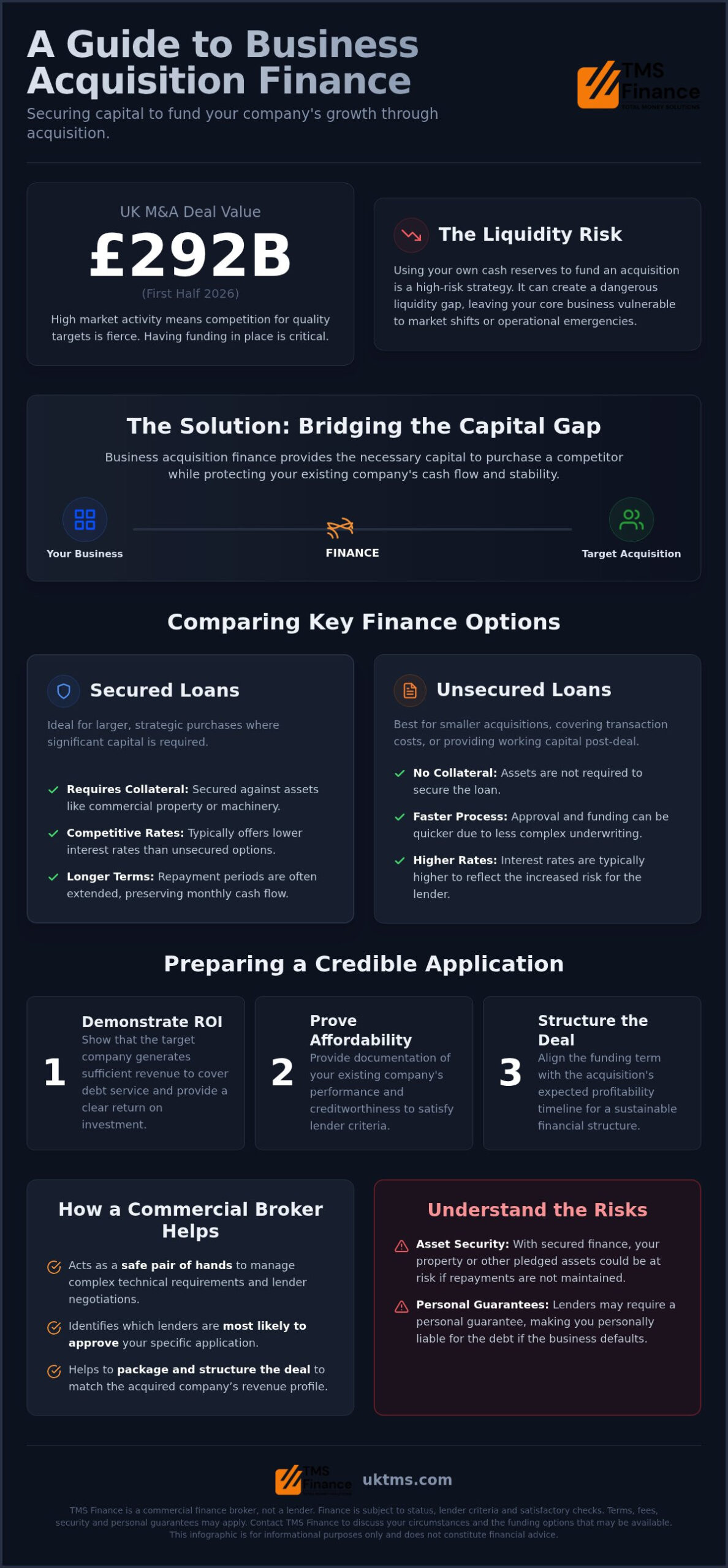
Understanding the Costs, Risks, and Security Requirements
Securing business acquisition finance is a significant commitment that requires a methodical approach to risk. It isn’t a risk-free solution. Every pound borrowed must be backed by a clear repayment strategy that accounts for potential market volatility and integration challenges. Before you approach a lender, you should improve business cash flow within your current operations. This demonstrates to lenders that your business is stable and capable of managing additional debt. If repayments aren’t maintained, any assets used as security, such as commercial property or machinery, are at risk of repossession.
The financial impact of a failed acquisition can be devastating for the parent company. If the target business does not perform as expected, the debt remains. This is why lenders scrutinise the combined entity’s ability to service the loan. You must ensure that the cost of capital doesn’t drain the liquidity needed for your day-to-day operations. A professional funding structure should act as a bridge to growth, not a weight that pulls down your existing firm.
Personal Guarantees and Security
Lenders usually require a “safe pair of hands” approach to security to protect their capital. This often involves a fixed or floating charge over the assets of both the acquiring and the target business. For many UK SMEs, a personal guarantee from the directors is a standard requirement. This guarantee makes you personally responsible for the loan if the business defaults. It is a significant legal obligation that links your personal wealth to the success of the deal. You should always obtain independent legal advice to understand how this affects your personal liability and assets before signing any agreements.
When Borrowing May Be Unsuitable
There are times when borrowing for an acquisition is counterproductive. If the target company’s revenue is erratic or its profit margins are too thin to cover the interest, the debt becomes a burden. Over-leveraging during periods of economic instability can lead to insolvency if cash flow tightens. If the financial impact of the loan threatens your core business, look at alternatives. Equity investment or vendor-deferred payments are often safer routes when traditional debt is too costly. Professional funding should only be used when the projected ROI clearly outweighs the total cost of the capital over the term of the loan.
TMS Finance is a commercial finance broker, not a lender. Contact TMS Finance to discuss your circumstances and the funding options that may be available.
How a Commercial Finance Broker Supports Your Acquisition
TMS Finance is a commercial finance broker, not a lender. We don’t provide the capital directly. Instead, we act as a strategic partner to help you identify the most suitable business acquisition finance from a wide range of professional options. In a market where high-street banks often focus solely on their own limited products, a broker provides an essential overview of the broader lending environment. This professional guidance is vital for packaging complex deals that involve multiple layers of debt, security, and personal guarantees.
The TMS Finance Process
Our approach begins with an initial discussion to understand your specific acquisition goals. We don’t just look at the numbers; we examine the strategic intent behind the purchase. Before presenting your case to lenders, we conduct a thorough review of your affordability and available security. This preparation ensures that your application is robust and credible from the first submission. We provide consistent support throughout the process, from the initial query to the final completion of the deal, ensuring that communication between all parties remains clear and methodical.
Why Use a Specialist Broker?
Acquiring a business is a high-stakes operation that leaves little room for error. Random outreach to unsuitable lenders often leads to frustration and unnecessary delays. A specialist broker helps you avoid these pitfalls by matching your requirements with lenders whose criteria align with your industry and deal size. We help you present complex requirements clearly, ensuring that funders understand the value of the target business and your ability to manage it. This includes guidance on the specific evidence needed, such as combined cash-flow forecasts and sector-specific trading history, which we discussed in previous sections.
We act as a “safe pair of hands” to ensure that all terms are explained clearly before you make a final decision. Our focus is on providing solutions that protect your existing company’s stability while facilitating growth through business acquisition finance. If you’re ready to explore your funding options, you can start the application process or view our full range of commercial products to see how we support UK SMEs. Our goal is to solve logistical and financial headaches, positioning ourselves as an extension of your own team during the acquisition process.
TMS Finance is a commercial finance broker, not a lender. Contact TMS Finance to discuss your circumstances and the funding options that may be available.
Securing Your Next Strategic Acquisition
Funding a purchase is a technical process that requires a methodical approach to risk and capital. You’ve seen how business acquisition finance allows you to bridge the capital gap while protecting your existing company’s liquidity. By matching the funding structure to the target’s revenue and leveraging professional brokerage, you ensure the deal is sustainable. TMS Finance provides specialist commercial finance expertise as a member of the National Association of Commercial Finance Brokers (NACFB). We offer FCA-regulated professional guidance to help you package complex applications for lender review.
If your business needs funding for an acquisition, expansion, or growth, contact TMS Finance. Explain how much you need, what it’ll be used for, and when it’s required. We’ll then assess which options are worth exploring for your specific circumstances.
Taking the right steps now ensures your business is positioned for a successful and stable transition. We look forward to helping you secure the capital needed for your next phase of growth.
TMS Finance is a commercial finance broker, not a lender. Contact TMS Finance to discuss your circumstances and the funding options that may be available.
Frequently Asked Questions
What is business acquisition finance?
This funding is specifically used to purchase another trading entity or its assets. It helps you bridge the gap between your existing capital and the total purchase price. By using professional facilities, you avoid draining the liquidity needed for your current operations. Options often include secured loans or asset-based structures that leverage the target’s balance sheet. A broker helps identify which of these facilities fits your specific deal structure.
Can I get finance for a management buy-out (MBO)?
Funding options may be available for management teams purchasing the business they currently run. Lenders usually assess the team’s sector experience and the company’s historical performance. Facilities such as invoice finance or asset-based lending are frequently used in MBOs to unlock capital from the company’s own assets. This approach allows the team to fund the transaction alongside their own equity while maintaining steady cash flow for the business.
How long does the funding process typically take?
Completion time depends on the case and lender. While some unsecured facilities are arranged quickly, complex business acquisition finance deals often take several weeks or months. This duration accounts for essential due diligence, property valuations, and legal checks required by the funder. You should start the application process as early as possible to ensure you have certain funding before the seller’s deadline or a competing bid.
What security is required for a business purchase loan?
Security requirements vary by lender and the facility type. For secured loans, lenders often take a charge over commercial property, land, or high-value machinery. In many cases, the assets of the company you are buying can serve as the primary security. If the loan is unsecured, physical collateral might not be required, though the lender’s criteria regarding credit and affordability will be stricter. Repayments must be maintained to avoid the risk of repossession.
Do I need a personal guarantee for acquisition finance?
Personal guarantees are a standard requirement for most UK SME funding. This legal commitment means that directors become personally responsible for the debt if the business defaults. Lenders require this to ensure the management team is fully committed to the success of the acquisition. You must seek independent legal advice to understand the risks to your personal assets before signing any guarantee. This ensures you are fully aware of your liability and the potential financial impact.
TMS Finance is a commercial finance broker, not a lender. Contact TMS Finance to discuss your circumstances and the funding options that may be available.