

UK landlords declared over £48 billion in rental income in the 2024-25 tax year, yet many still struggle to access the liquidity needed for their next acquisition. Property finance is a strategic tool for liquidity, not just a debt obligation that sits on your balance sheet. When capital is tied up in existing assets and lender criteria feel increasingly complex, securing the right buy-to-let mortgages or commercial loans becomes a matter of precision and planning. You need a reliable partner to ensure your project stays on schedule without draining the working capital required for your daily operations.
It’s frustrating when project delays occur because of funding gaps or confusion over which product fits a specific requirement. We agree that the current market requires a methodical approach to borrowing. This guide will show you how to identify and secure the right property finance to support your business growth or investment portfolio. You’ll learn how to meet lender expectations, understand available funding options, and see how working with a specialist broker like TMS Finance helps you package your application to meet strict professional standards.
Key Takeaways
- Understand how strategic property finance prevents capital from being tied up in assets, protecting your daily operational liquidity.
- Explore the differences between professional buy-to-let mortgages and specialist funding for complex assets like HMOs or multi-unit blocks.
- Learn the specific factors lenders use to assess applications and how to define a clear repayment route to support your investment case.
- Discover the essential financial records and business documentation required to package a professional application that meets strict lender criteria.
- See how working with a commercial finance broker helps identify suitable lenders for complex requirements while keeping your project on schedule.
The Financial Impact of Property Investment on Business Cash Flow
Property investment represents a significant milestone for UK businesses, yet it often creates a tension between growth and liquidity. Funding an acquisition requires substantial capital. If this capital comes directly from your company’s bank account, it can leave your daily operations exposed. Using short-term working capital to fund long-term property assets is a high-risk strategy. It reduces your ability to react to market changes or manage seasonal fluctuations. This mismatch between the asset’s lifespan and the funding source can lead to severe cash flow pressure.
Professional property finance provides a structured alternative. It allows you to secure an asset while keeping your cash reserves intact for core business activities. A buy-to-let mortgage or commercial facility ensures that the debt matches the lifespan of the asset, creating a more stable financial position. This approach protects your liquidity and ensures that your property projects support, rather than hinder, your overall business objectives.
Why Property Finance Matters for UK SMEs
Maintaining a healthy cash flow is vital for meeting payroll and supplier commitments. When you deplete your reserves for a property deposit or purchase, you lose your safety net. Strategic property finance enables you to expand your portfolio or secure a new premises without compromising your operational stability. Revenue-generating assets should contribute to your growth, not create a bottleneck in your cash flow. By using external funding, you protect your working capital for its intended purpose: running and growing your business. It’s about ensuring that your business remains resilient while you build long-term wealth through property. For business owners who also need to fund machinery, vehicles, or equipment without depleting cash reserves, exploring asset finance solutions can provide a similarly structured approach to protecting operational liquidity. For business owners interested in the technical side of financial modeling, you can learn more about digital transaction simulation systems and how they operate.
The Cost of Delay in Property Transactions
In the UK property market, timing is everything. A funding gap can lead to missed completion deadlines, which often results in the loss of a non-refundable deposit. Beyond the financial loss, project delays can damage your professional reputation with agents and vendors. Stalled development projects also incur holding costs, such as security and insurance, without providing a return. These costs accumulate quickly, turning a potentially profitable venture into a financial burden.
Having the right funding in place ensures you can complete transactions on schedule. It provides the certainty needed to negotiate from a position of strength. Options like bridging finance or specialist buy-to-let mortgages offer the necessary liquidity to bridge these gaps. This proactive approach protects your investment from the risks of a failed transaction and ensures your project remains viable from start to finish.
Understanding the Core Types of Property Finance
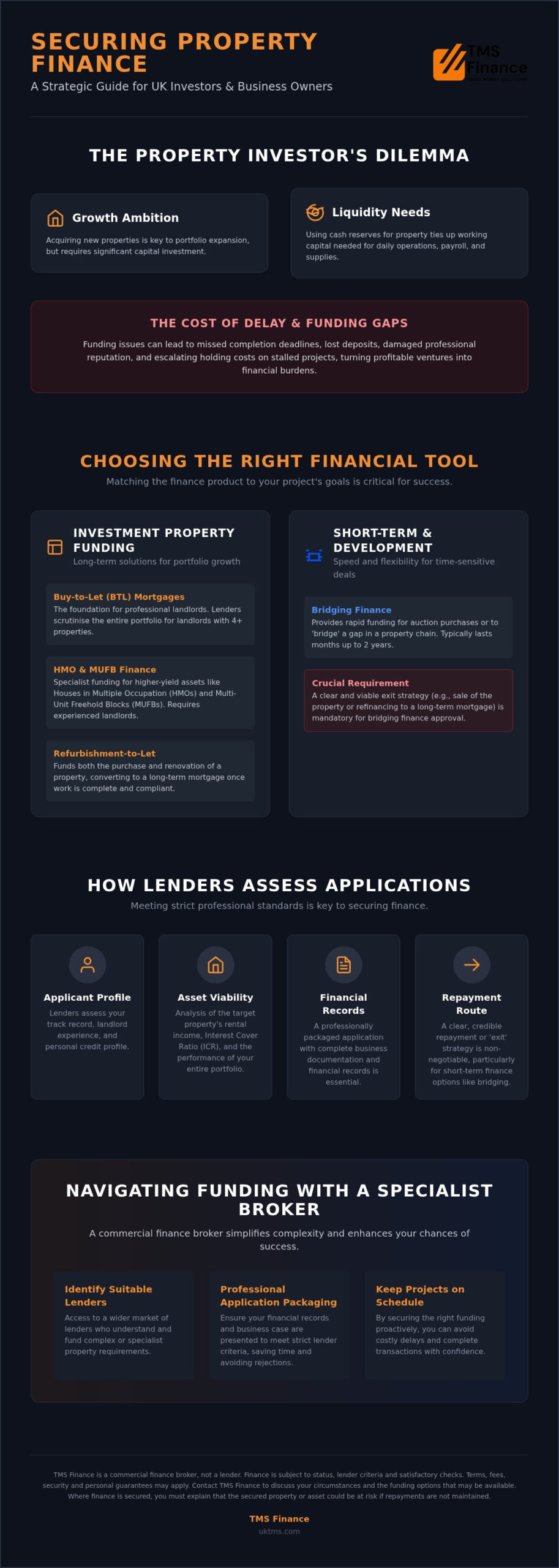
Selecting the correct finance product is a technical requirement that depends on your specific project goals and the nature of the asset. While high-street lenders often focus on standard residential products, commercial and investment projects require a more nuanced approach. Professional investors and business owners must distinguish between long-term security and short-term liquidity tools to ensure their projects remain viable and profitable.
Investment Property Funding: BTL and HMO
For professional landlords, buy-to-let mortgages are the foundation of a growing portfolio. There is a distinct difference between a single-property application and the requirements for a portfolio landlord with four or more properties. Lenders will often scrutinise the entire portfolio’s performance, not just the target asset. Understanding how buy-to-let mortgages work is essential for managing your tax liabilities and interest cover ratios (ICR).
Specialist assets like Houses in Multiple Occupation (HMOs) or multi-unit freehold blocks (MUFBs) demand higher levels of assessment. These properties often provide better yields but come with increased regulatory and management responsibilities. Lenders look for experienced landlords who understand local licensing and safety standards. For projects requiring work before they can be let, a “refurbishment-to-let” strategy provides the funding to purchase and renovate, before switching to a long-term mortgage once the property is habitable and compliant.
Short-Term and Development Solutions
Bridging finance provides the speed and flexibility required for time-sensitive deals, such as property auctions or broken chains. These loans are typically short-term, lasting from a few months up to two years. They require a clear exit strategy, such as a sale or a successful refinance. Because of the higher interest rates associated with bridging, it’s vital to have a methodical plan for repayment from the outset to protect your profit margins.
For ground-up construction or major structural refurbishments, property development finance is the appropriate tool. This funding is released in staged drawdowns based on a pre-agreed cost schedule and regular site inspections. It ensures that capital is available as the project progresses, protecting both the lender and the developer. This structured approach helps keep complex builds on track and ensures that funding gaps don’t cause costly site delays.
If you’re looking to secure the future of your business location, a commercial mortgage for owner-occupied premises is often the most stable choice. It moves your business from a rental model to asset ownership, providing long-term security and potential capital growth. You can start an application to explore which of these funding routes aligns with your current business performance and future growth plans.
How Lenders Assess Property Finance Applications
Commercial lenders follow a rigorous evaluation process that differs significantly from the automated systems used in residential markets. Each application is reviewed to determine the level of risk to the lender’s capital. This assessment focuses on your ability to service the debt and the quality of the property acting as security. Lenders don’t just look at your credit score; they examine the viability of the project and your professional track record as an operator.
A clear funding purpose is essential. You must demonstrate exactly how the capital will be used and, more importantly, how it will be repaid. For buy-to-let mortgages, the primary repayment route is typically the rental income generated by the property. Lenders use the Interest Cover Ratio (ICR) to ensure the rent comfortably exceeds the mortgage payments, even if interest rates rise. If you’re using bridging finance, the “exit strategy” must be documented, whether that’s a sale or a move to long-term finance.
Key Assessment Criteria for Borrowers
Your trading history and bank conduct provide a snapshot of your financial discipline. Lenders will review several months of bank statements to ensure there are no returned payments or excessive reliance on overdrafts. For established businesses, your latest sets of accounts will be scrutinised to assess profitability and debt-to-income ratios. Your credit profile remains a factor, but commercial lenders are often more interested in your experience with similar projects. If you’ve successfully managed a portfolio or completed a development before, it significantly strengthens your case.
Property-Specific Evaluation Factors
The asset itself undergoes a detailed review. An independent surveyor will provide a valuation to confirm the property’s worth and its suitability for the proposed use. For development projects, the planning status is a critical hurdle. Lenders rarely release funds for ground-up builds without full planning permission in place. They need to know the project is legally viable before committing capital.
The regulatory environment also shapes how lenders behave. The UK Government’s Financial Policy Committee monitors the market to ensure lending remains sustainable and doesn’t pose a systemic risk. This high-level oversight trickles down into the specific criteria lenders set for buy-to-let mortgages and commercial loans. Finally, expect to discuss security. Most commercial facilities require a first legal charge over the property. In many cases, lenders also require personal guarantees from the directors to ensure total alignment between the business and its obligations.
Preparing for a Property Finance Application
Preparation is the most effective way to mitigate the risk of project delays. A lender’s decision depends entirely on the quality and completeness of the information provided at the outset. When you present a well-organised case, you signal to the lender that you’re a professional and reliable borrower. An initial discussion with a specialist broker is the first step in this process. It helps define your desired outcome and ensures that your application is matched with the most appropriate funding facility. This methodical approach saves time and prevents the frustration of multiple rejected applications.
Standard Business and Personal Documents
Lenders require a clear view of your financial stability to assess risk. You’ll need to provide at least three to six months of recent business bank statements. These allow the lender to assess your bank conduct and daily liquidity. Filed accounts for the last two financial years are also standard requirements for established businesses. These documents prove your trading history and profitability over a sustained period.
Directors must provide valid identification and proof of address to comply with Anti-Money Laundering (AML) regulations. You should also prepare a summary of your existing borrowing and credit history. This transparency helps the lender understand your total commitments and affordability. You can explore our business loan application guide to see a more detailed breakdown of these core requirements.
Specialist Property Requirements
Property-specific documentation varies depending on the project type. For buy-to-let mortgages, you must provide evidence of projected or current rental income. This often includes existing tenancy agreements or a letter from a reputable letting agent. If you’re managing a portfolio, an up-to-date property schedule is mandatory to show how the new asset fits into your existing strategy.
Development projects require more technical detail. You’ll need to provide full planning permission documents and a detailed cost schedule for the works. Lenders will also want to see an aged debtor or creditor report if your business holds significant property assets. This ensures that your current liabilities won’t jeopardise the new project. Providing valuation reports and documented evidence of your exit route, such as a sale or a move to long-term finance, is critical for building a credible case. Businesses that also need to fund construction equipment or site machinery alongside a development project may find that asset finance solutions offer a complementary way to acquire revenue-generating tools without further straining project cash flow.
Navigating Funding Options with TMS Finance
TMS Finance is a commercial finance broker, not a lender. This distinction is critical for property investors who require certainty and speed. Applying directly to a lender often results in a generic assessment that may not account for the specific nuances of a complex project. We act as an extension of your team, identifying a possible lender fit from a range of available options. Our focus is on supporting customers through the technical complexities of property finance, from initial enquiry to final drawdown. We help package your application to present a credible, risk-mitigated case that meets the precise standards of professional funders.
The Practical Value of Using a Broker
Every funding structure carries a different impact on your operational cash flow. For instance, professional buy-to-let mortgages involve specific interest cover ratios that dictate how much you can borrow based on rental yields. We help you understand these calculations before you commit to a purchase. Our guidance ensures you have the correct information for a professional presentation, including detailed asset schedules and proof of experience. We provide a clear explanation of commercial terms, including arrangement fees, valuation costs, and legal obligations. This clarity allows you to protect your working capital and ensures that the finance facility supports your long-term business growth rather than creating a financial bottleneck.
Next Steps for Your Property Project
Successful funding begins with a clear definition of the amount, timing, and purpose of the capital required. Whether you’re refinancing an existing portfolio or funding a new acquisition, the first step is to establish a realistic cost schedule and exit route. You can see our full range of property finance products to identify the most suitable facility for your current project. After defining your needs, we assist in gathering the essential business and financial records required by modern lenders. This methodical preparation reduces the likelihood of project delays and ensures that your transaction stays on schedule.
TMS Finance is a commercial finance broker, not a lender. Finance is subject to status, lender criteria and satisfactory checks. Terms, fees, security and personal guarantees may apply. Contact TMS Finance to discuss your circumstances and the funding options that may be available.
Securing Your Next Property Investment
Securing the right funding is a strategic necessity for any growing property portfolio. By matching the correct finance product to your asset, you protect your working capital and ensure your business remains resilient. Whether you’re managing professional buy-to-let mortgages or complex development builds, a methodical approach to your application is essential for long-term success.
As a member of the National Association of Commercial Finance Brokers (NACFB), TMS Finance provides the specialist focus required to package your application for a professional presentation. This expert guidance helps you meet strict lender criteria and reduces the risk of project delays. We act as your dependable partner for complex property deals, identifying a possible lender fit from available options while you focus on your core operations.
We look forward to supporting your business goals with the precision and professionalism your projects demand.
TMS Finance is a commercial finance broker, not a lender. Finance is subject to status, lender criteria and satisfactory checks. Terms, fees, security and personal guarantees may apply. Contact TMS Finance to discuss your circumstances and the funding options that may be available.
Frequently Asked Questions
What is the difference between a commercial mortgage and a buy-to-let mortgage?
A buy-to-let mortgage is specifically for residential properties rented to tenants. Assessment usually focuses on the rental yield exceeding the mortgage interest. A commercial mortgage is for business premises like offices or retail units. Lenders assess these based on the trading performance and profitability of the business occupying the space. Both require a clear understanding of the asset’s purpose and the borrower’s long-term strategy for the property.
Can I get property finance if I am a new developer or investor?
Funding options may be available for those without a long track record, but lenders will scrutinise the project more closely. New investors often need to demonstrate a strong professional team, such as experienced contractors or project managers. Lenders look for a clear, risk-mitigated business plan and a robust exit strategy. TMS Finance helps package these applications to highlight the strengths of the proposal to suitable specialist lenders.
How long does it typically take to complete a property finance transaction?
Completion time depends on the case and lender. A bridging loan can sometimes complete in a few weeks if all documentation is ready. Standard commercial loans or buy-to-let mortgages often take between eight and twelve weeks. Delays frequently occur due to complex legal work or slow valuation reports. Providing a complete application at the outset is the most effective way to keep your transaction on schedule.
Why do lenders require personal guarantees for property finance?
Personal guarantees provide lenders with an additional layer of security beyond the property itself. They ensure that company directors remain committed to the repayment of the debt. If the business cannot meet its obligations, the lender has a secondary route to recover their capital. You should always seek independent legal advice before signing a personal guarantee, as your personal assets could be at risk if the business defaults.
What happens if my development project goes over budget?
Most development lenders require a contingency fund, typically 10% to 20% of the build costs, to cover unexpected expenses. If you exceed this, you must communicate with the lender immediately. You might need to provide additional capital to finish the project. Lenders will review the revised cost schedules and site inspections before releasing further staged drawdowns. Maintaining a transparent relationship with your funder helps manage these logistical challenges.
Is bridging finance suitable for long-term property investment?
Bridging finance is a short-term liquidity tool, not a long-term solution. It’s designed for time-sensitive deals or properties that aren’t yet suitable for a standard mortgage. Using bridging for more than 12 to 24 months is usually unsuitable because of the higher interest rates. Investors typically use bridging to purchase or refurbish an asset before switching to buy-to-let mortgages or selling the property to clear the debt.
What are the risks if I cannot maintain repayments on secured finance?
Property finance is almost always secured against the asset. If you cannot maintain repayments, the secured property could be at risk of repossession. If you’ve signed a personal guarantee, your personal assets may also be used to settle any remaining debt. Defaulting on a commercial facility will damage your credit profile and make it significantly harder to secure funding for future business growth or property projects.
TMS Finance is a commercial finance broker, not a lender. Contact TMS Finance to discuss your circumstances and the funding options that may be available.
2 responses