

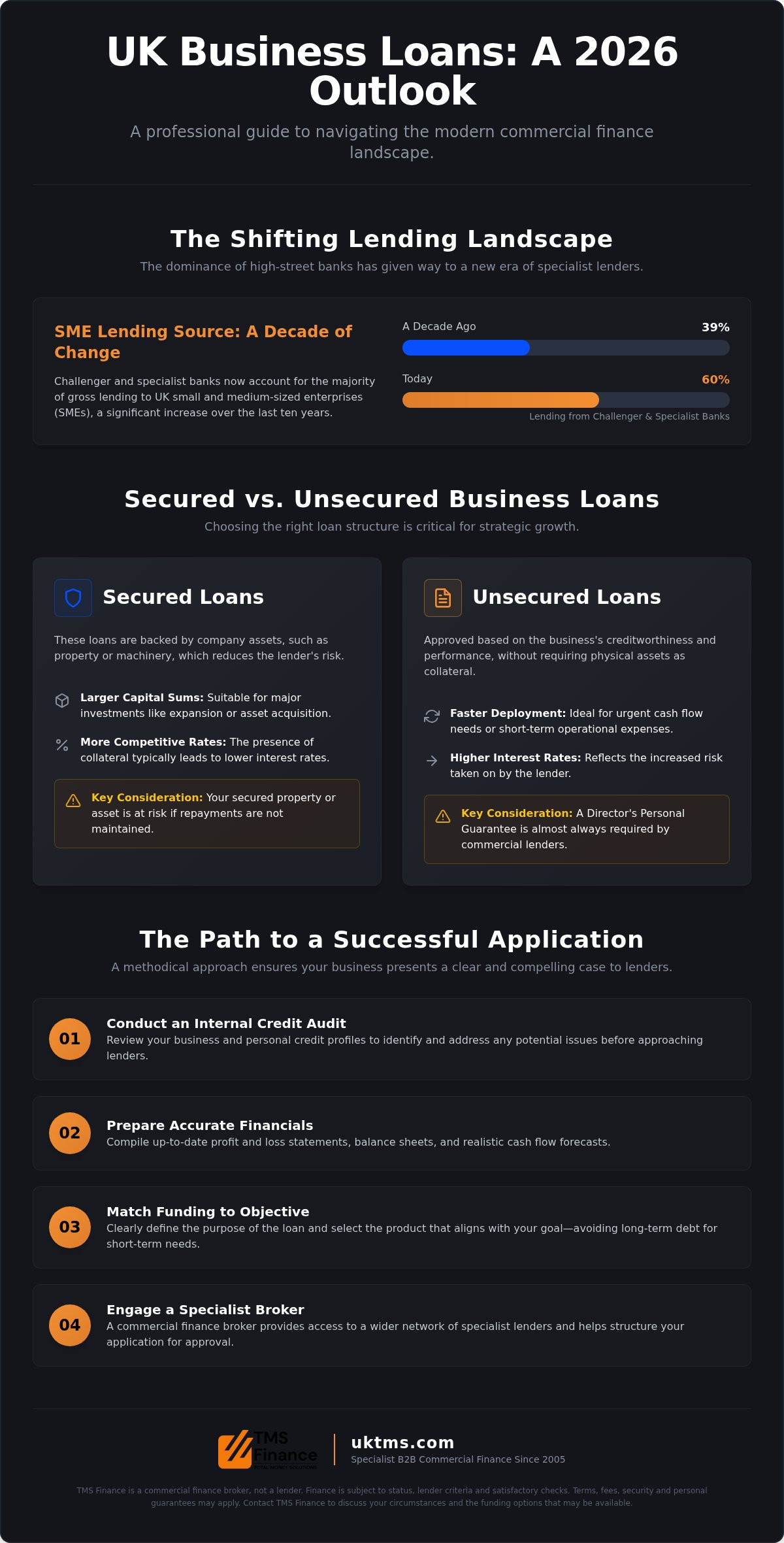
Challenger and specialist banks now account for 60% of gross lending to UK small businesses, a significant shift from just 39% a decade ago. For many directors, securing a business loan in 2026 requires looking beyond the traditional high street bank to a more diverse range of specialist providers. You likely recognize that capital is the lifeblood of your operations, yet the friction of high interest rates and opaque application processes can make growth feel like a secondary priority.
It’s frustrating when hidden fees and complex eligibility criteria stall your progress. This professional guide provides the clarity you need to move forward with confidence. We’ll outline the current lending environment, including the expanded Growth Guarantee Scheme and the critical differences between secured and unsecured options. You’ll learn how to structure your funding for sustainable cash flow and successful asset acquisition while meeting your regulatory obligations. This methodical approach ensures your business remains resilient in a changing market.
Key Takeaways
- Identify why the 2026 lending market shifts toward specialist banks and how a broker provides access to these national funding networks.
- Compare the mechanics of a secured and unsecured business loan to select the most appropriate structure for your specific growth phase.
- Break down the total cost of capital by evaluating fixed versus variable rates and identifying common legal or valuation fees.
- Streamline your application by conducting an internal credit audit and preparing accurate profit and loss statements and cash flow forecasts.
- Understand your repayment obligations and the risks associated with secured finance to ensure your business remains compliant and resilient.
Understanding the Business Loan Landscape in 2026
A business loan is a strategic capital injection designed to fuel commercial growth or stabilise cash flow. It isn’t merely debt; it’s a tool for acquiring assets, hiring staff, or managing seasonal fluctuations. Gaining a thorough understanding of business loans is essential for directors who need to distinguish between short-term liquidity and long-term capital investment. In 2026, the distinction between these funding types has become sharper as lenders refine their risk profiles and eligibility criteria.
The UK lending market has moved away from traditional high-street dominance. Recent data indicates that challenger and specialist banks now handle 60% of SME lending. With the Bank Rate held at 3.75% as of July 2026, firms face a more nuanced environment where interest costs must be balanced against growth projections. Securing a business loan in this climate often requires a specialised broker who can access these niche lenders. This shift emphasises the need for professional guidance to ensure that borrowing remains sustainable and compliant with current standards.
Professionalism and total compliance are non-negotiable in high-stakes borrowing. Relying on FCA-regulated guidance ensures that your application meets the necessary standards of transparency and safety. TMS Finance has operated as a specialist in B2B commercial finance since 2005. This longevity provides the experience needed to handle complex logistical and financial challenges, acting as a safe pair of hands for your firm’s capital needs.
The Role of Commercial Finance in SME Growth
External funding maintains liquidity during rapid expansion phases. Without it, a business might overstretch its cash reserves, leading to operational instability. Professional planning ensures you match the specific finance product to your objective. For example, using a long-term loan for a short-term cash flow gap can lead to unnecessary interest costs. Conversely, using short-term credit for major asset acquisition can create immediate repayment pressure that threatens your stability.
B2B Lending vs. Consumer Finance
This guide focuses exclusively on business-to-business lending. Commercial finance operates under different regulatory frameworks than consumer credit. While personal finance focuses on individual affordability, B2B lending evaluates business performance, balance sheet strength, and commercial viability. Our expertise covers commercial products like asset finance and invoice funding. We do not handle personal loans or residential mortgages, ensuring our focus remains on the professional needs of UK firms.
TMS Finance is a commercial finance broker, not a lender. Finance is subject to status, lender criteria and satisfactory checks. Terms, fees, security and personal guarantees may apply. Contact TMS Finance to discuss your circumstances and the funding options that may be available.
Secured vs. Unsecured Business Loans: A Strategic Comparison
Choosing the right structure for a business loan depends on your immediate needs versus your long-term stability. Unsecured loans are generally faster to deploy because they don’t require physical collateral. This makes them suitable for urgent cash flow gaps or minor operational expenses. However, because the lender takes on more risk, interest rates are typically higher. Early-stage firms might consider a government-backed Start Up Loan, which provides a fixed interest rate for founders who have been trading for up to five years.
Secured loans offer a different strategic advantage. By using business assets such as property or machinery as security, firms can often unlock larger capital sums at more competitive rates. This structure provides stability for significant projects like facility expansion or major equipment upgrades. You must understand that where a business loan is secured, your property or asset is at risk if repayments aren’t maintained. This risk requires a serious, professional assessment of your firm’s future affordability.
Most commercial lenders require a personal or directors guarantee, especially for unsecured facilities. This ensures that the leadership remains committed to the repayment schedule. It’s a standard industry practice designed to provide an extra layer of security for the lender. Before proceeding, it’s vital to conduct a thorough internal audit of your credit profile and obligations.
Asset-Backed Lending and Invoice Finance
These products provide a seamless way to maintain liquidity without relying on traditional bank debt. Asset finance allows you to spread the cost of new equipment over its working life, protecting your cash reserves. Invoice finance solves the headache of waiting for customer payments by advancing funds against your unpaid sales ledger. This keeps your cash flow steady and predictable, which is essential for managing daily operations. You can explore these bespoke funding options to see which aligns with your current budget.
Property and Development Funding
Property-based finance requires a high level of technical expertise and meticulous planning. Commercial mortgages and bridging finance are bespoke solutions tailored to the specific value and risk of a site. Development loans involve complex draw-down schedules and rigorous compliance checks. Choosing a partner that understands these logistical challenges ensures your project remains on track. For property developers specifically, using a bridging loan for property development can prevent cash-flow crises between construction phases and secure time-sensitive opportunities that traditional bank lending would miss. Unlike standard loans, property finance often involves valuation and legal fees that must be factored into your total cost of borrowing, and it is often beneficial to explore Mortgage Brokerage Fees and Commissions to understand the professional costs involved in property acquisitions. Landlords and investors expanding their portfolios should also consider how buy-to-let mortgages and commercial property finance can be structured to preserve working capital while funding their next acquisition.
TMS Finance is a commercial finance broker, not a lender. Finance is subject to status, lender criteria and satisfactory checks. Terms, fees, security and personal guarantees may apply. Contact TMS Finance to discuss your circumstances and the funding options that may be available.
Calculating the Real Cost of Borrowing
Understanding the full financial commitment of a business loan is critical for maintaining long-term liquidity. While interest rates are the most visible factor, they don’t represent the total cost of credit. Professional planning involves accounting for arrangement fees, valuation costs, and legal charges that can significantly alter the affordability of your funding. This guide to small business loans highlights how different structures impact your bottom line and why transparency is essential during the application process.
In July 2026, the Bank of England held the Bank Rate at 3.75%. This benchmark influences the commercial market, but your actual rate depends on your firm’s specific risk profile. Fixed-rate loans provide certainty for budgeting, protecting your business against future rate rises. Variable-rate options might offer lower initial costs but carry the risk of increased repayments if market conditions shift. A methodical ROI analysis is essential; the growth generated by the capital must exceed the total cost of borrowing to ensure the investment remains viable. If the cost of capital is 9% but the funded project only yields a 5% return, the loan becomes a burden rather than a tool for growth.
Common fees often include arrangement fees, which are typically calculated as a percentage of the total loan amount. When property or significant assets are used as security, valuation fees and legal costs for document preparation will apply. These aren’t hidden costs in a professional agreement, but they must be integrated into your initial cash flow forecasts to avoid unexpected pressure on your reserves. You can start a business loan application once you’ve accounted for these variables in your financial model.
Interest Rate Trends for UK Businesses
Your business credit score is the primary driver of the rate you’re offered in 2026. Lenders evaluate your repayment history, current debt levels, and sector-specific risks. A “Safe Pair of Hands” approach means avoiding predatory terms that mask high total costs with low headline rates. Challenger and specialist banks often provide more bespoke pricing than traditional high-street options, but they require a high level of compliance and accurate documentation to secure the best terms.
Repayment Terms and Flexibility
Repayments should mirror your operational rhythm to prevent liquidity crises. For firms with seasonal peaks, structured repayments can reduce the burden during quieter months. You should also check for early repayment charges in your contract. While paying off a business loan early can save interest, some lenders apply fees that negate the financial benefit. Clear, declarative planning at the start ensures that your repayment schedule supports, rather than hinders, your daily operations.
TMS Finance is a commercial finance broker, not a lender. Finance is subject to status, lender criteria and satisfactory checks. Terms, fees, security and personal guarantees may apply. Contact TMS Finance to discuss your circumstances and the funding options that may be available.
The Professional Path to a Successful Loan Application
Precision is the foundation of any successful commercial funding request. When you apply for a business loan, you aren’t just presenting numbers; you’re demonstrating the operational maturity of your firm. Lenders in 2026 require a high level of transparency and methodical reporting. This process starts with a comprehensive internal audit of your credit profile and compliance status. Any discrepancies in your records can lead to immediate delays or rejection, as underwriters prioritise reliability and professional precision.
You must gather at least two to three years of filed accounts, including profit and loss (P&L) statements and balance sheets. However, historical data isn’t enough on its own. Lenders also require detailed cash flow forecasts that project your ability to service the debt over the full term. Alongside these figures, a compelling “use of funds” statement is essential. This narrative should clearly explain how the capital will generate growth or improve efficiency, proving that the debt is a strategic tool rather than a survival measure.
What Lenders Look for in 2026
Underwriters now place primary importance on the Debt Service Coverage Ratio (DSCR). This metric measures your business’s available cash flow against its total debt obligations. A strong ratio indicates that you can comfortably manage repayments even if market conditions fluctuate. They also look for evidence of management expertise and a safety-first culture. Firms that demonstrate a commitment to total compliance and meticulous planning are viewed as lower-risk partners. This “Safe Pair of Hands” persona signals that your leadership team is proactive and prepared for logistical challenges.
Common Pitfalls to Avoid
Incomplete documentation is the most frequent cause of application failure. A missing balance sheet or an outdated P&L can halt a process and erode lender confidence. Another significant danger is under-capitalisation. Applying for the wrong amount often leaves a business without enough liquidity to execute its growth plan effectively. Finally, failing to proactively address historical credit issues can be fatal to an application. If you have past defaults or late payments, explain them transparently within your narrative rather than waiting for the lender to discover them during their checks. Working with an expert business loan broker UK can help you present these challenges in the most favourable light while ensuring your application meets lender expectations.
You can ensure your firm is fully prepared for the underwriting process by starting your business loan application with professional support.
TMS Finance is a commercial finance broker, not a lender. Finance is subject to status, lender criteria and satisfactory checks. Terms, fees, security and personal guarantees may apply. Contact TMS Finance to discuss your circumstances and the funding options that may be available.
Why Partnering with a Commercial Finance Broker is the Strategic Choice
Approaching a single high-street bank limits your options to their specific risk appetite and rigid product criteria. In the current 2026 market, where specialist banks handle 60% of SME lending, a market-wide perspective is a strategic necessity. A commercial finance broker acts as your representative, accessing a national network of both niche and traditional lenders. This ensures you aren’t forced into an off-the-shelf product that doesn’t align with your operational requirements.
Professional brokers provide the efficiency required to manage complex lender negotiations on your behalf. They understand the specific documentation and compliance standards each lender expects, reducing the friction that often stalls a direct business loan application. This methodical approach saves significant time for your leadership team, allowing you to focus on core operations while the funding structure is finalised. By matching your business objective to the right lender, a broker helps secure a bespoke solution that supports sustainable growth.
TMS Finance acts as a “Safe Pair of Hands” throughout this journey. We provide a steady, controlled flow of information, moving from high-level strategy to specific service details. This ensures you understand every repayment obligation and security requirement before committing to a facility. Our role is to solve the logistical headaches of commercial funding, positioning ourselves as an essential extension of your own team rather than a third-party contractor.
Expertise and Regulation
Total compliance is at the heart of our brokerage service. As an FCA-regulated appointed representative founded in 2005, we bring over two decades of experience to every consultation. This longevity means we’ve seen various economic cycles and have pre-prepared solutions for diverse funding challenges. Professional guidance in the commercial sector is an investment in your firm’s stability. It provides the peace of mind that comes from expert execution and total adherence to regulatory standards, protecting both your business and its directors.
Next Steps for Your Business
The process begins with an initial consultation to assess your specific operational needs and financial position. We conduct a thorough review of your requirements, whether you need asset finance, invoice funding, or a traditional business loan. Following this assessment, we manage the methodical path from enquiry to the deployment of funds, ensuring every stage is transparent and compliant. You can secure your business’s future with TMS Finance by reaching out to our professional team today.
TMS Finance is a commercial finance broker, not a lender. Finance is subject to status, lender criteria and satisfactory checks. Terms, fees, security and personal guarantees may apply. Contact TMS Finance to discuss your circumstances and the funding options that may be available.
Securing Your Commercial Growth in 2026
Sustainable expansion depends on selecting a financial structure that aligns with your specific operational objectives. Whether you choose a secured business loan to unlock significant capital or opt for the rapid liquidity of unsecured funding, precision in your application is essential. By conducting a thorough internal audit and preparing transparent cash flow forecasts, you position your firm as a reliable partner for specialist lenders.
TMS Finance acts as a dependable extension of your team, providing the peace of mind that comes from total compliance and expert execution. With over 20 years of commercial finance expertise and national UK coverage, we ensure your funding journey is methodical and secure. Our status as an FCA-regulated appointed representative guarantees that every recommendation meets the highest professional standards.
Discuss your bespoke funding requirements with TMS Finance today to ensure your next capital injection is managed with the precision your business deserves.
TMS Finance is a commercial finance broker, not a lender. Finance is subject to status, lender criteria and satisfactory checks. Terms, fees, security and personal guarantees may apply. Contact TMS Finance to discuss your circumstances and the funding options that may be available.
Frequently Asked Questions
What is the difference between a business loan and asset finance?
A business loan provides a lump sum for general purposes, while asset finance is specifically for purchasing or refinancing physical equipment. With asset finance, the lender takes a charge over the equipment itself, which acts as the primary security. This structure can be more tax-efficient and protects your working capital, allowing you to invest in operational improvements like fleet security or audio upgrades from Safe & Sound Mobile. A general loan is more flexible but often requires broader security or a personal guarantee to mitigate the lender’s risk.
How long does the business loan application process typically take?
Approval times vary significantly based on the facility’s complexity and the type of security involved. Unsecured loans can sometimes be processed within a few working days if your documentation is complete and accurate. Secured funding or property-based finance typically takes longer due to the requirement for professional valuations and legal checks. Preparing your profit and loss statements and cash flow forecasts in advance is the most effective way to ensure a methodical and efficient process.
Can I get a business loan if I have a less-than-perfect credit score?
Yes, funding is often available for businesses with credit challenges, though it may influence the interest rate and security requirements. Specialist lenders in the 2026 market look beyond headline scores to evaluate your firm’s current cash flow and operational performance. They may require additional security or a personal guarantee to offset the risk. A business loan broker UK helps present a transparent narrative that highlights your business’s current stability and future growth potential.
What is a personal guarantee and when is it required for a commercial loan?
A personal guarantee is a legal commitment from a director to repay the debt if the business defaults. It is a standard requirement for many unsecured facilities and some specialist lending products. This agreement makes the individual personally liable for the outstanding balance. Before signing, you should understand that your personal assets could be at risk if repayments are not maintained. It ensures the leadership team remains fully committed to the firm’s repayment obligations.
Why should I use a finance broker instead of going directly to my bank?
A broker provides access to a national network of specialist lenders that you cannot reach through a high-street bank. Banks only offer their own products, whereas a broker compares multiple facilities to find a bespoke fit for your specific operational needs. This methodical approach ensures you don’t settle for a one-size-fits-all solution. A broker also manages complex negotiations and documentation, acting as a safe pair of hands throughout the entire funding journey. For those with property assets or investment portfolios, understanding the full range of commercial and investment property finance options, including buy-to-let mortgages, is an important part of building a comprehensive funding strategy.
TMS Finance is a commercial finance broker, not a lender. Finance is subject to status, lender criteria and satisfactory checks. Terms, fees, security and personal guarantees may apply. Contact TMS Finance to discuss your circumstances and the funding options that may be available.