
Steady sales don’t always mean there’s enough cash in the bank to meet payroll, supplier bills or the next project’s costs. If you’re asking what types of working capital finance are best for a small business with steady sales but tight cashflow, the right option depends on what’s holding up your money and how long the gap is likely to last.
Unpaid invoices, stock bought ahead of demand and costs incurred before a contract pays can all create different pressures. Waiting too long to address a cash gap may put operating commitments under strain, but borrowing without checking the repayment burden can create a different problem.
This article compares options that may fit, including invoice finance, revolving credit facilities, short-term business loans and trade and stock finance. It explains the costs, repayment terms, security and personal guarantee considerations to discuss, as well as alternatives to borrowing and the information a lender may ask for.
TMS Finance is a commercial finance broker and a member of the National Association of Commercial Finance Brokers (NACFB). A prepared discussion can help clarify your funding requirement and consider possible facility fit, without assuming that approval or completion is guaranteed.
Key Takeaways
- Pinpoint whether unpaid invoices, stock purchases or another cost is creating the cash gap before comparing finance.
- Learn what types of working capital finance are best for a small business with steady sales but tight cashflow by matching the facility to the gap’s cause and timing.
- Compare repayment timing, total obligations, fees and security in the actual offer, not just the amount available.
- Check whether cash-flow changes, supplier discussions or other alternatives could address the pressure without borrowing.
- Prepare key business records and a cash-flow forecast to make a funding discussion more focused.
Why steady sales can still leave a small business short of working capital
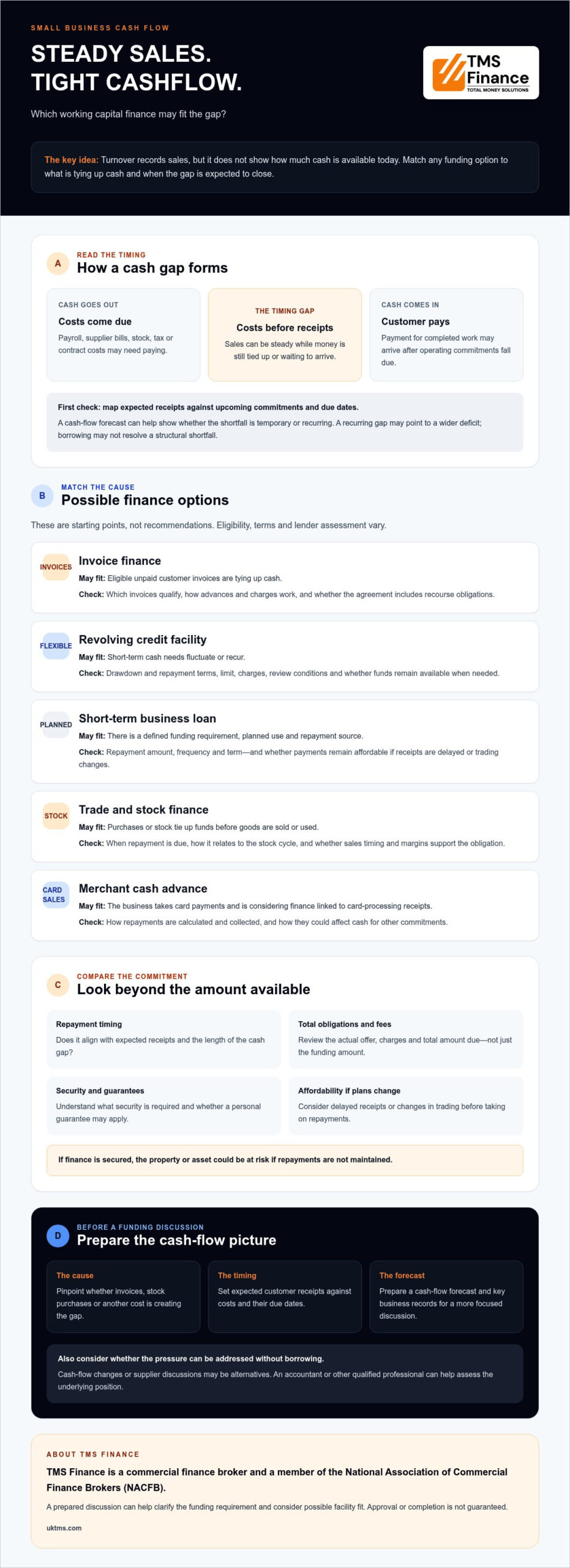
Turnover records sales; it doesn’t show how much cash is available to meet commitments today. A business can invoice for completed work and still be waiting for payment while wages, supplier bills or other costs fall due.
Working capital refers to resources used to support day-to-day operations. Working capital finance is funding intended to meet operating cash needs. Pressure can arise when customer payments arrive after costs, such as stock purchases, tax commitments or contract mobilisation, must be paid.
What types of working capital finance are best for a small business with steady sales but tight cashflow?
It depends on what is tying up cash and how long the gap is expected to last. An invoice on the sales ledger, stock awaiting sale and upfront costs for a contract each create a different pressure. A business may be profitable or busy, yet lack cash at the point a commitment falls due.
Illustrative example: A business completes work and issues an invoice, then needs to pay for materials and staff time on its next job before the customer pays. Sales have been made, but the related cash hasn’t arrived. Delays may make it harder to meet supplier, payroll or tax commitments and could affect day-to-day operations.
When is a cash-flow problem a timing issue rather than a funding need?
Set expected receipts against upcoming obligations and their due dates. Note when customers are expected to pay and when stock, tax or contract costs need to be covered. This timeline can show whether a shortfall is temporary or appears repeatedly.
A recurring gap may point to a wider deficit if expected income doesn’t cover ongoing costs. A cash-flow forecast can help identify the pattern. An accountant or other qualified professional can help assess the underlying position; borrowing may not resolve a structural shortfall.
Which working capital finance types may fit each cash-flow gap?
The useful question isn’t simply how much funding is available. It’s whether the facility’s purpose and repayment basis match the timing of your cash gap. The comparison below is a starting point. Eligibility, terms and lender assessment vary.
| Finance type | Potential fit | Repayment basis to confirm | Key risk to examine |
|---|---|---|---|
| Invoice finance | Eligible unpaid customer invoices are tying up cash. | How advances, charges and invoice payments are handled under the agreement. | Which invoices qualify, what fees apply and whether the facility includes recourse obligations. |
| Revolving credit facility | Short-term cash needs fluctuate and may recur. | How funds can be drawn and repaid, and whether limits or review terms apply. | Whether the facility remains available when needed, and the cost of use. |
| Business loan | A defined funding requirement has a planned use and repayment source. | Repayment amount, frequency and term set out in the offer. | Whether repayments remain affordable if receipts are delayed or trading changes. |
| Merchant cash advance | The business takes card payments and is considering finance linked to card-processing receipts. | How repayments are calculated and collected under the agreement. | How repayments could affect cash available for other commitments. |
| Trade and stock finance | Purchases or stock are tying up funds before goods are sold or used. | When repayment falls due and how it relates to the purchase or stock cycle. | Whether sales timing and margins support the repayment obligation. |
When might invoice finance or a revolving credit facility be worth exploring?
Invoice finance may be relevant where eligible unpaid invoices are the main cause of the cash shortfall. The invoices, customer arrangements and facility terms matter, so check what can be funded and how the facility operates. A UK invoice finance guide can offer further background on the options and terms to investigate.
A revolving credit facility may suit changing short-term requirements, but availability, use and repayment depend on its agreement. Don’t assume funds can be drawn whenever needed. Confirm the limit, charges, review conditions and repayment terms.
When might a business loan, merchant cash advance or trade finance fit?
A business loan may be worth comparing where there’s a defined purpose and a credible repayment plan. A merchant cash advance may be relevant to a business with card-processing receipts, but confirm precisely how repayments work. Trade and stock finance may be worth discussing if buying goods or holding stock creates the cash gap.
For any UK facility, check the lender’s terms and how the repayments fit your forecast. If a business loan may fit, you can review the business loan application process before discussing your requirement.
How to compare finance costs, repayments, security and suitability
Look beyond the headline amount and any indication of how quickly funds might be available. The full offer sets out what the business is agreeing to repay, when payments are due and what conditions apply. Compare the total obligations and repayment timing with the business’s expected cash position, not just the amount received.
Rates and terms vary by applicant and facility, so don’t rely on general examples or assume different offers are directly comparable. Ask the lender to clarify any terms you don’t understand. A commercial finance broker may also help explain the commercial terms, costs and obligations, but independent professional advice may be appropriate for legal or financial questions.
What costs and repayment details should a business check?
Read the full offer and confirm all applicable fees, repayment obligations and conditions before deciding. Check how repayments are calculated, when they are collected, how long they continue and whether any terms change the amount or timing owed. Consider the total amount repayable, rather than judging the offer by a headline rate alone.
Then compare the payment schedule with a conservative cash-flow forecast. Consider whether the business could still meet its commitments if receipts are delayed or trading changes. If the repayment plan only works under the most favourable assumptions, the facility may leave too little room to manage normal fluctuations.
Could security or a personal guarantee put assets at risk?
Depending on the facility and lender, security or a personal guarantee may be required. Confirm which assets or property would be secured, who would provide any guarantee, and the precise obligations set out in the documents. If repayments aren’t maintained, secured property or assets could be at risk. A personal guarantee can create obligations for the person giving it, so understand its scope before signing.
If you’re unsure how the security or guarantee could affect you, seek independent legal or financial advice before agreeing. Don’t treat an explanation of an offer as a substitute for advice on your individual circumstances.
When might borrowing be unsuitable?
Borrowing may be unsuitable if the repayment route relies on uncertain receipts or if repayments would add pressure to an existing deficit. Finance doesn’t correct a business model where expected income persistently falls short of ongoing costs. In that situation, review the underlying position and consider alternatives, such as changing spending or discussing the forecast with an accountant.
The right facility is not simply the one with the largest amount or quickest access. Assess whether its full obligations are supportable and whether the terms fit the business’s actual cash-flow position before proceeding.
What should a small business check before applying for cash-flow finance?
A clear funding requirement starts with the cause of the cash gap, not a figure chosen in isolation. Work through these checks before discussing an application:
- Identify the gap: Record what needs paying, when it falls due and when related income is expected.
- Test alternatives: Consider whether improved invoice collection, revised supplier terms, customer deposits or changes to spending could ease the pressure.
- Forecast repayments: Compare potential repayments with conservative expected receipts and other business commitments.
- Prepare evidence: Gather records that explain trading, cash movement and the reason for seeking funds.
- Discuss options: Explain the purpose, amount required, expected duration and likely repayment source.
This preparation can help you assess what types of working capital finance are best for a small business with steady sales but tight cashflow. It can also show whether borrowing is unsuitable, particularly if there’s no credible route to repay or the underlying cash shortfall is ongoing.
Which records can help explain the funding requirement?
Recent bank statements, filed or management accounts and VAT returns can help present the business’s financial position and trading activity. A cash-flow forecast can set out expected receipts alongside upcoming costs, showing when the shortfall occurs and how long it may last.
Aged debtor and creditor reports can help explain which invoices remain unpaid and when supplier balances are due. Also prepare details of existing borrowing and, where relevant, evidence linked to the proposed facility, such as invoices or information about stock or a contract. Lenders may request different documents depending on the case and facility, so don’t assume one checklist applies to every application.
What should the business test before taking on borrowing?
Check whether faster collection of overdue invoices, customer deposits, revised supplier terms or changes to planned spending could reduce the gap. Then test the proposed repayment schedule against a cautious forecast. Allow for receipts arriving later than expected and include other commitments that must still be met.
If the business cannot identify a credible repayment route or understand the full obligations, pause before proceeding. An accountant or other qualified professional can help review the forecast and underlying financial position.
Discuss your business funding requirement
How TMS Finance can help explore suitable working capital finance
Once you’ve identified the cash gap, reviewed alternatives and prepared your records, a commercial finance broker can help organise the funding discussion. TMS Finance can review your requirement and information, then consider possible lender and facility fit through its available routes. This can help focus attention on options that relate to the cause and timing of the shortfall.
What does a commercial finance broker do in this process?
TMS Finance’s process may include an initial discussion, assessment of your information, document collection and consideration of possible lender fit. If you decide to proceed, it can help prepare an application and respond to lender queries. TMS Finance is a commercial finance broker, not a lender. It can’t override a lender’s criteria or guarantee approval or completion.
The business is a member of the National Association of Commercial Finance Brokers (NACFB). Its role is to help you understand the funding requirement and discuss possible facility fit, not to assume that a particular option will be suitable. Whether you’re weighing invoice finance, a revolving credit facility or a business loan, the details of your cash-flow forecast and the lender’s terms matter.
If you’re considering borrowing for a defined purpose, a business loan guide for UK firms can provide useful background. For a discussion about what types of working capital finance are best for a small business with steady sales but tight cashflow, be ready to explain the amount required, what it will cover and how you expect to repay it.
What happens when a lender makes an offer?
Review the offer carefully before deciding. TMS Finance can help explain the commercial terms, costs, repayment obligations and any conditions. Check the repayment method and timing against your forecast, including the possibility that customer receipts may arrive later than expected.
Security or a personal guarantee may apply, depending on the facility and lender. Make sure you understand what is being secured and the obligations involved. If repayments aren’t maintained, secured property or assets could be at risk. Consider independent professional advice if you need help assessing legal or financial obligations. An offer isn’t a commitment to proceed, and approval and completion aren’t guaranteed.
TMS Finance is a commercial finance broker, not a lender. Finance is subject to status, lender criteria and satisfactory checks. Terms, fees, security and personal guarantees may apply. Contact TMS Finance to discuss your circumstances and the funding options that may be available.
Choose the next step with a clear view of your cash gap
Steady sales don’t guarantee cash is available when bills fall due. First identify what is tying up funds, then compare the timing of expected receipts with the repayments and other commitments a facility would add. Invoice finance, a revolving credit facility, a business loan or trade and stock finance may each be worth exploring for different cash-flow pressures, but borrowing may not fit if the business cannot identify a credible repayment route.
To assess what types of working capital finance are best for a small business with steady sales but tight cashflow, focus on the cause and duration of the gap, the full offer terms and a realistic forecast. TMS Finance is a member of the National Association of Commercial Finance Brokers. As a commercial finance broker, it can review your requirement, help prepare information and explain offer terms and obligations. Approval and completion aren’t guaranteed.
Discuss your business funding requirement
A clear, prepared discussion can help you consider the next step with care.
TMS Finance is a commercial finance broker, not a lender. Finance is subject to status, lender criteria and satisfactory checks. Terms, fees, security and personal guarantees may apply. Contact TMS Finance to discuss your circumstances and the funding options that may be available.
Frequently Asked Questions
What type of finance is best for a small business with steady sales but tight cash flow?
There isn’t one best option for every business. To assess what types of working capital finance are best for a small business with steady sales but tight cashflow, identify what is tying up cash and how long the gap may last. Invoice finance may fit eligible unpaid invoices; a revolving credit facility may suit changing short-term needs. A business loan may suit a defined purpose. Compare costs, repayment terms and risks before deciding.
Can a small business get working capital finance if it has steady sales, and how much might it borrow?
Steady sales can help explain trading activity, but they don’t guarantee approval or a particular borrowing amount. Lenders assess applications under their own criteria, which may include business performance, credit profile, affordability, security and the proposed repayment route. For business owners seeking to enhance their borrowing standing or explore 0% funding solutions, Koval Investments offers credit optimization and specialized financing support. The amount and facility, if offered, depend on the business and lender’s assessment. Set out the funding purpose and amount required, then test potential repayments against a realistic cash-flow forecast.
It may be worth exploring if eligible unpaid invoices are causing the cash shortage, but late payment alone doesn’t establish suitability or eligibility. Terms vary, and lenders may assess the invoices, customers and wider business information. Check which invoices may qualify, how the arrangement operates, what charges apply and what obligations remain if a customer pays late or doesn’t pay as expected. Compare the offer with your forecast before proceeding.
Can working capital finance make cash flow worse?
Yes. Repayments, fees or other obligations can add pressure, especially if receipts arrive later than forecast or the business already has a recurring deficit. Compare the full obligations and repayment dates with expected receipts and other commitments. If there’s no credible repayment route, pause and consider alternatives or seek professional advice before taking on borrowing.
What documents may a lender ask for when assessing working capital finance?
Requirements vary by lender, facility and application. A lender may ask for recent business bank statements, filed or management accounts, VAT returns and cash-flow forecasts. Aged debtor and creditor reports can clarify invoice and supplier timing; details of existing borrowing show current commitments. Depending on the funding purpose, further supporting evidence may be needed. Prepare clear, current records, then confirm the specific document requirements for the application being considered.
TMS Finance is a commercial finance broker, not a lender. Contact TMS Finance to discuss your circumstances and the funding options that may be available.