

What happens when payroll, tax or supplier bills fall due before customers pay? For service businesses, the delay can put pressure on day-to-day operations, even when work is booked and invoices are expected. Working capital for service businesses starts with understanding when cash leaves the business, when it comes in and what is causing the shortfall.
It’s understandable to look for funding when a contract requires staff or equipment before revenue begins. But the right route depends on the size and duration of the gap, the business’s ability to meet repayments and the source of money that would repay the borrowing. A facility that doesn’t fit those factors could add pressure rather than ease it.
This guide explains common causes of working-capital gaps and compares options such as invoice finance, revolving credit, working-capital finance, business loans and merchant cash advances. It also covers costs, security and repayment considerations, when borrowing may not be suitable, and what information to prepare before speaking with a broker. TMS Finance can help clarify your funding requirement, consider possible lender and facility fit, and explain key commercial terms.
Key Takeaways
- Separate a short-term payment delay from recurring losses before deciding whether borrowing is appropriate.
- For working capital for service businesses, match the facility to the cash-flow pattern and expected repayment source.
- Compare business loans, revolving credit, invoice finance and merchant cash advances by how repayments work, not just by the amount available.
- Prepare a clear funding purpose, cash-flow forecast and relevant business records before discussing possible options with a broker.
- Check the full costs, any security and the impact of repayments. If the business cannot afford repayments, consider alternatives to borrowing.
Why working capital matters when service-business cash flow is uneven
Payroll, tax bills and supplier invoices can fall due before customer payments arrive. A business may have work underway and revenue expected, but still need funds to meet commitments in the meantime. That’s why working capital for service businesses is about more than whether the business is profitable on paper.
In plain English, working capital is the money available to cover day-to-day business needs. The term can also refer to a balance-sheet measure, commonly calculated using current assets and current liabilities. For a neutral overview of the concept, see Working capital.
A cash-flow timing gap is a mismatch between when money must be paid and when customer income is expected. It is not, by itself, proof that borrowing is needed. First establish the size, timing and cause of the shortfall. It may be temporary, recurring or part of a wider financial problem.
How payment timing can create a cash-flow gap
Work completed, invoices issued and payments received are separate events. A business might pay staff and suppliers to deliver a contract, invoice the customer afterwards, then wait for payment under the agreed terms. During that interval, money leaves the business before the related income arrives.
Illustrative scenario: a service firm wins a new contract and needs to recruit staff and buy supplies before work begins. It completes the work and invoices the customer, but payment arrives after payroll and supplier bills are due. The contract may be expected to generate a profit overall, yet its early costs can create short-term pressure. The key question is whether this is a temporary mismatch and how the business will cover it.
Working capital needs vary across service businesses
Different trading cycles create different pressures. A trades business may need to pay for materials and labour before receiving payment for a job. A hospitality business may have staffing and supplier costs before customer takings arrive. In construction, mobilisation, subcontractor and materials commitments may come before project payments reach the business.
Recruitment can also mean paying wages before a new contract generates income. Tax deadlines may coincide with other commitments, while supplier terms affect when cash must leave the account. These pressures do not automatically point to the same funding route, or to borrowing at all. Identify what the funds would cover, when they are needed and what income is expected to meet the cost. Then distinguish a manageable timing gap from a recurring shortfall that may need a broader response.
How to diagnose the working-capital need before comparing finance
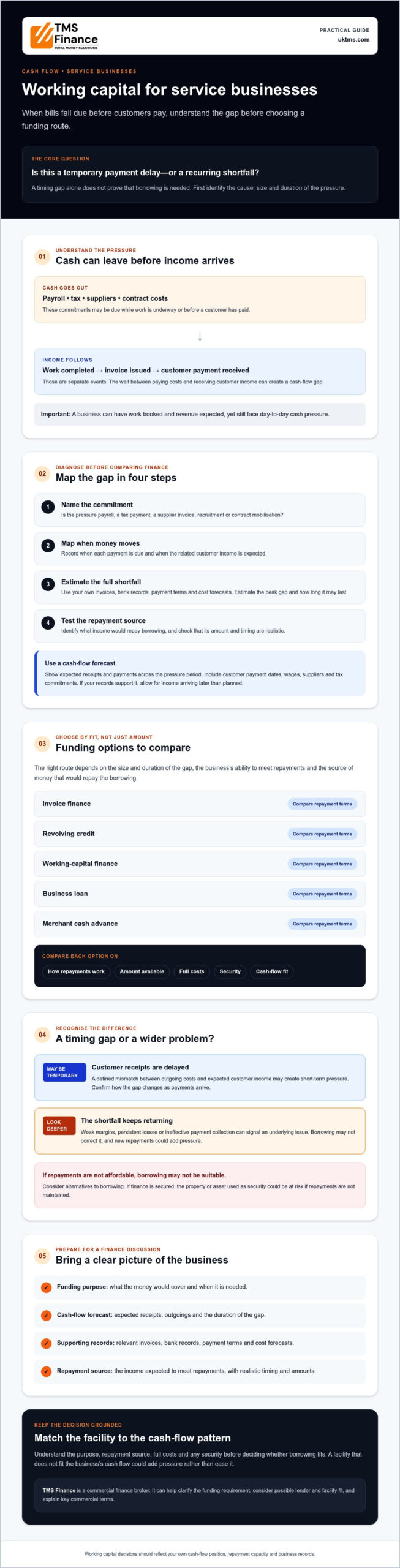
Before considering funding, establish what is creating the shortfall and whether borrowing could address it. A clear assessment of working capital for service businesses starts with four steps: identify the pressure, map its timing, estimate the gap and test how any borrowing would be repaid.
Start with the specific commitment. Is it payroll, a VAT or tax payment, a supplier invoice, recruitment or contract mobilisation? Record when the payment is due and when the related customer income is expected. Then estimate the amount needed and how long the gap may last. Use the business’s own invoices, bank records, payment terms and cost forecasts rather than generic assumptions.
Map the cash-flow pressure and its duration
Build a cash-flow forecast showing expected receipts and payments across the period of pressure. Include customer payment dates, wages, suppliers and tax commitments. If your trading records support it, allow for income arriving later than planned. This can help distinguish a short, defined gap from a longer period when outgoings repeatedly exceed receipts.
Estimate the peak shortfall, not just the next bill. A forecast can show how the gap changes as customer payments arrive, and whether another set of commitments falls due before the first is covered. If you need senior financial expertise to model projections and guide cash strategy, visit PCFO to see how fractional Finance Director and CFO services can support your business.
Delayed customer receipts may create a temporary mismatch. But weak margins, persistent losses or ineffective payment collection can cause a recurring shortfall. Borrowing may provide funds, but it won’t necessarily correct those underlying issues. New repayments could add pressure if the business cannot generate enough cash to meet them.
Ask what specific income would repay the borrowing. It might be payment for an invoiced contract or future trading receipts, but the amount and timing need to be realistic. If repayment depends on uncertain work or receipts already committed elsewhere, reconsider the plan before taking on finance.
- Temporary timing gap: expected income is sufficient, but arrives after a defined business commitment falls due.
- Recurring shortfall: the forecast continues to show a deficit, or normal trading does not appear to cover costs and repayments.
Keep the forecast and assumptions together. They can help a broker understand the requirement and consider possible lender and facility fit. For wider borrowing context, see Business Loan Guide 2026: Strategic Funding for UK Firms. If you’re preparing to discuss a potential application, review the business loan application information. Seek appropriate professional advice for accounting, tax or financial decisions.
Compare working-capital finance options for service businesses
The right facility depends on what the cash must cover, how long it is needed and where repayment will come from. For working capital for service businesses, compare the repayment pattern and total obligations, not just the amount offered. Rates, fees, terms, security and availability vary by applicant and facility.
| Option | Cash-flow need it may suit | Points to check |
|---|---|---|
| Business loan | A defined requirement, such as funding contract mobilisation or recruitment costs before income arrives. | Repayments are set out in the offer. Check their amount and timing against forecast cash flow and existing borrowing. Security or a personal guarantee may be required, depending on the facility. |
| Revolving credit facility | Changing or recurring short-term needs where the business may need to draw funds at different times. | Understand how drawings, repayments, charges and any review or renewal arrangements work. Don’t assume funds will remain available on the same terms indefinitely. |
| Invoice finance | A business with eligible unpaid invoices that needs to address the wait between invoicing and customer payment. | Check which invoices qualify, how the facility operates as customers pay, and all fees and obligations. Read an invoice finance guide for more on finance linked to unpaid invoices. |
| Merchant cash advance | A business that receives card-processing income and is exploring funding connected with those receipts. | Review how repayments relate to card income, what costs apply and how the arrangement may affect cash available from future card sales. |
Match the facility to the repayment route
A business loan may suit a one-off, defined cost if forecast income can support its repayments. A revolving facility works differently: the business can draw and repay funds under the agreed terms, so check the conditions for using it again. In either case, include existing borrowing and normal operating costs in the cash-flow assessment.
Invoice finance is linked to invoices, so consider whether the business’s customer collection cycle and invoices fit the facility’s terms. For a merchant cash advance, provide relevant card-processing information and understand how the agreed repayment mechanics affect future receipts. Availability and terms depend on the facility and lender’s assessment.
Consider alternatives before committing
Improving invoice follow-up, agreeing different payment timings with customers or suppliers, or reviewing discretionary spending may reduce the gap without borrowing. If the need is specifically to buy equipment, asset or equipment finance may be worth considering instead of general working-capital finance. Borrowing may be unsuitable if repayment relies on uncertain income or would deepen persistent losses.
Read the offer carefully. Confirm the total amount repayable, all fees, repayment arrangements and whether security or a personal guarantee applies. If finance is secured against property or another asset, that asset could be at risk if repayments aren’t maintained. A broker can help compare possible facility fit and explain key terms, but approval depends on the applicant and lender criteria.
Assess eligibility, documents, costs and risks before applying
Preparing a clear picture of the business can help a lender assess the request. Depending on the lender and facility, possible considerations include the purpose of the funds, trading history, bank conduct, credit profile, affordability and any security available. These are not universal requirements, and meeting them doesn’t guarantee approval.
What information may help a lender assess the requirement
Gather records that show how the business trades and how it expects to repay. Depending on the case, useful documents may include recent business bank statements, filed or management accounts and a cash-flow forecast. VAT returns, aged debtor and creditor reports, and details of existing borrowing may also be relevant.
Keep figures consistent and explain unusual movements in income or costs. Requirements vary by case, facility and lender, so confirm which documents are needed rather than assuming every application follows the same checklist.
Understand the costs, security and repayment exposure
Compare the full obligations, not just the amount advanced. Review interest, fees, repayment frequency, term and any other charges in the offer. Test repayments against a realistic forecast that includes existing borrowing, operating costs and the possibility that customer receipts arrive later than expected. Rates and terms vary by applicant and facility.
Some facilities may require security or a personal guarantee. Check exactly what is being offered and what you may be responsible for before agreeing. If finance is secured against property or another asset, that property or asset could be at risk if repayments aren’t maintained. A personal guarantee may also create obligations beyond the business, so seek appropriate professional advice if you’re unsure about its implications.
Borrowing may not be suitable if the forecast shows repayments cannot be met from realistic business income, or if the funding would only cover continuing losses without addressing their cause. Consider whether changes to costs, payment collection or customer and supplier terms could help first. For accounting, tax or financial decisions, consult an appropriate professional.
For working capital for service businesses, organised records help explain both the cash-flow pressure and the proposed repayment route. TMS Finance can review your funding requirement, help prepare an application and explain key commercial terms. A lender makes its own assessment, and approval depends on the applicant, business performance, credit profile, affordability, security and that lender’s criteria.
How TMS Finance can help you explore working capital options
Once you’ve identified the cash-flow pressure, the next step is to explain it clearly and consider which funding routes may fit. TMS Finance is a commercial finance broker, not a lender. It can review your requirement, consider possible lender and facility fit through routes available to it, help prepare an application and explain key commercial terms.
What to prepare for an initial discussion
Be ready to explain what is causing the shortfall, what the funds would cover, how much you may need and when you need it. A cash-flow forecast can show when payments are due and when customer receipts are expected. Relevant business records and details of existing borrowing can put the request in context.
The information needed depends on the case and the facility being considered. TMS Finance can help clarify which records may be useful. Clear, consistent information matters: a broker can help present the requirement, but cannot make weak figures stronger through wording alone.
What working with a broker involves
The process starts by understanding the business’s circumstances and funding purpose. Relevant documents are then reviewed to help consider possible lender fit. If you decide to proceed, TMS Finance can support document preparation, respond to lender queries and help you review an offer. The lender makes its own assessment and sets its own requirements.
There’s no guaranteed outcome or completion time. Timing depends on the application, the information provided and the lender’s process. A broker cannot override lender criteria or promise that finance will be approved or completed.
Take a measured next step
Before accepting an offer, compare the full costs, repayment schedule, security and any personal guarantee against a realistic cash-flow forecast. If repayments depend on uncertain income, or borrowing could deepen persistent losses, pause and consider whether another approach is more appropriate. Seek professional advice for accounting, tax or financial decisions.
If you’re ready to discuss a business loan application, share the purpose, amount and timing of the funding need, along with the records you have available. TMS Finance can help you understand the next steps and possible options, while you assess the terms carefully.
TMS Finance is a commercial finance broker, not a lender. Finance is subject to status, lender criteria and satisfactory checks. Terms, fees, security and personal guarantees may apply. Contact TMS Finance to discuss your circumstances and the funding options that may be available.
Choose your next step with a clear cash-flow plan
Working capital for service businesses should start with a clear diagnosis, not a product choice. Identify what’s causing the gap, when the money is needed and what income could repay borrowing. Then compare possible options, including business loans, revolving credit, invoice finance and merchant cash advances, against the business’s forecast and existing commitments.
Borrowing may not address persistent losses or weak payment collection. Before proceeding, review the full costs, repayment terms and any security or personal guarantee. TMS Finance is a commercial finance broker, not a lender. It can help clarify your requirement, consider possible lender fit and support your application. TMS Finance is a member of the National Association of Commercial Finance Brokers.
Before discussing your circumstances, prepare a clear summary of the funding purpose, amount and timing. A measured next step can help you assess options with care.
TMS Finance is a commercial finance broker, not a lender. Finance is subject to status, lender criteria and satisfactory checks. Terms, fees, security and personal guarantees may apply.
Frequently Asked Questions
What is working capital for a service business?
Working capital is the money a business has available for day-to-day costs, such as wages, suppliers and tax commitments. For a service firm, a gap can arise when these costs are due before customers pay for work delivered. This timing mismatch doesn’t automatically mean borrowing is needed. First check the size and duration of the shortfall, expected customer receipts and whether the business can meet its commitments without finance.
What types of working-capital finance can a UK service business consider?
Possible options include a business loan for a defined funding need, a revolving credit facility for changing cash requirements, invoice finance linked to eligible unpaid invoices, or a merchant cash advance linked to card-processing income. Each has different costs, repayment mechanics and possible security requirements. Compare the total obligations with your forecast and repayment source. Availability and terms depend on the applicant, facility and lender’s criteria.
Can a service business get working-capital finance with irregular cash flow?
Irregular cash flow doesn’t automatically rule out finance, but it can affect how a lender assesses affordability and repayment. Be prepared to explain the reason for fluctuations, when customer income is expected and how repayments could be met during quieter periods. Lenders may consider factors such as trading history, bank conduct, credit profile and existing borrowing. Assessment varies, and a broker or lender can’t guarantee approval.
What documents may a lender request for working-capital finance?
A lender may ask for recent business bank statements, filed accounts or management accounts, and a cash-flow forecast. VAT returns, aged debtor or creditor reports and details of existing borrowing may also help explain the business’s position. A merchant cash advance application may involve card-processing statements. The documents required depend on the case, facility and lender, so check what’s relevant before preparing an application.
When might working-capital borrowing be unsuitable for a service business?
Borrowing may be unsuitable if repayments rely on uncertain income, or if the business is repeatedly spending more than it earns. Finance can bridge a timing gap, but it may not fix persistent losses, weak margins or poor payment collection. Consider whether improved invoice follow-up, revised payment timing or a review of discretionary costs could help. If affordability remains unclear, seek appropriate professional advice before taking on further commitments.