

A healthy order book can rapidly strain operational cash flow when customer payments lag behind upfront supplier commitments and fixed monthly payroll. Taking on rigid term borrowing often adds unnecessary overhead when your funding needs fluctuate from month to month. To manage these cash-flow gaps, a revolving credit facility UK lenders provide acts as a flexible liquidity buffer, allowing you to draw capital, repay it, and draw again while only paying interest on the active balance.
Waiting sixty days for invoices to clear while suppliers demand immediate payment slows down growth and risks contract delivery. This guide explains how revolving credit arrangements work in practice, what lenders look for during underwriting, and how facility fees and security requirements compare. You will discover how to evaluate costs, assess whether revolving debt fits your working capital cycle, and review alternative commercial finance structures without putting your equity at risk.
Key Takeaways
- Discover how establishing a revolving credit facility UK lenders provide can protect operational liquidity against delayed customer receipts and fixed payroll commitments.
- Compare flexible revolving credit lines against fixed-term commercial loans, overdrafts, and merchant cash advances to determine the right fit for your working capital cycle.
- Examine the complete cost structure funders apply, including arrangement fees, non-utilisation fees, and interest charged strictly on drawn balances.
- Follow a structured four-step preparation framework covering historical trading data, cash-flow forecasts, and security considerations to strengthen your application.
- Learn how professional commercial packaging helps present your business profile clearly to lenders while avoiding funding structures that do not match your trading needs.
Managing Operational Cash-Flow Gaps in Growing UK Businesses
Profitable trading does not automatically safeguard a company from acute cash shortfalls. Even businesses with robust order books face sudden liquidity pressures when significant commitments coincide. Monthly payroll, quarterly VAT liabilities to HMRC, and contract mobilisation costs must be settled on precise dates, regardless of whether client accounts have cleared. When cash remains tied up in unpaid trade debts, operational momentum stalls.
Relying solely on static cash reserves often proves impractical during expansion or seasonal peaks. A sudden surge in trade requires upfront capital to purchase stock and deploy staff long before revenues arrive. Without flexible liquidity, the commercial cost of delays can be severe: suppliers withhold credit terms, projects miss key milestones, and lucrative contracts must be turned down.
The Working Capital Challenge: Timing Mismatches and Supply Pressures
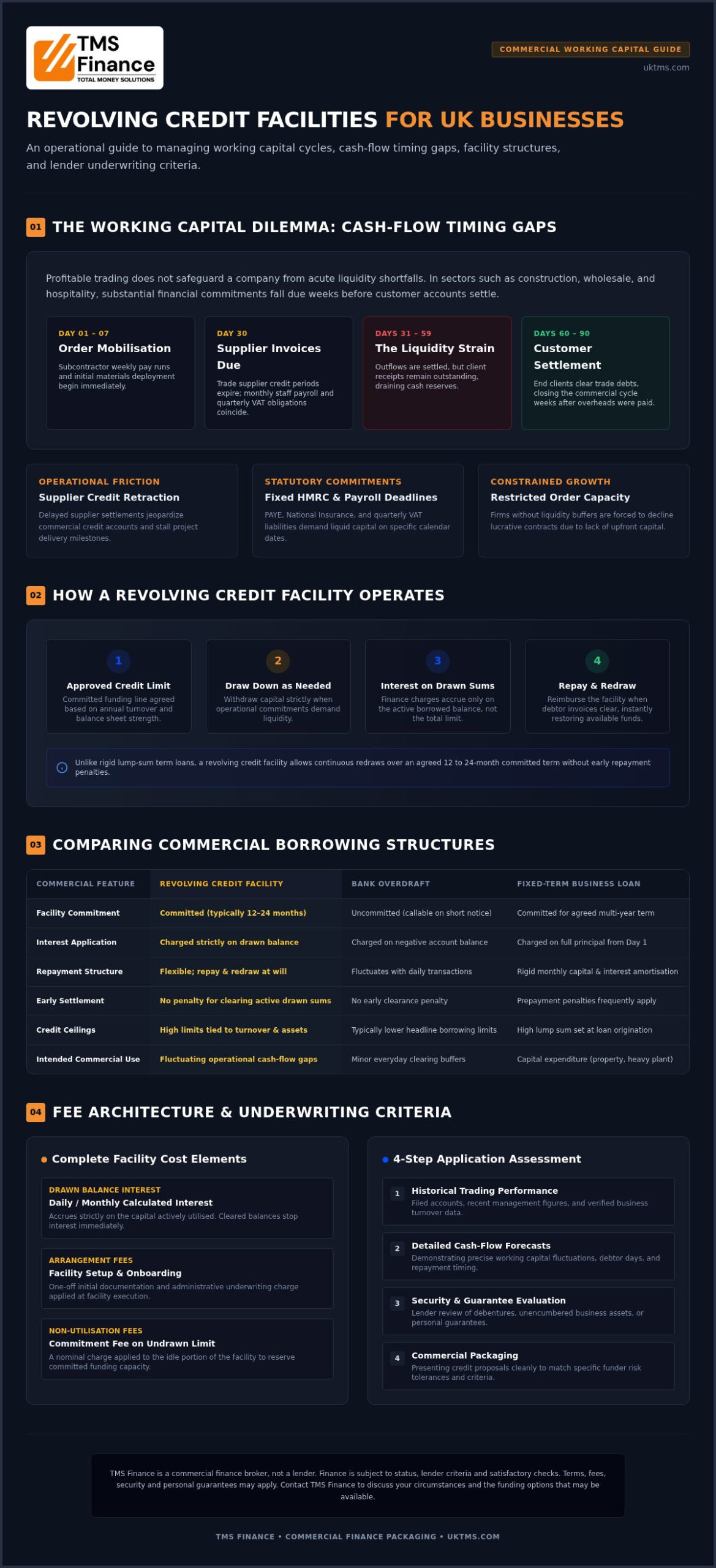
A persistent working capital gap occurs when supplier invoices fall due within 30 days, but end clients take 60 to 90 days to settle accounts. Sectors such as construction, wholesale, and hospitality feel this strain most acutely. Construction firms must pay subcontractors weekly, while wholesalers must commit capital to seasonal inventory months ahead. As operational overheads rise, waiting for payment cycles to align can threaten day-to-day solvency.
What Is a Revolving Credit Facility and How Does It Operate?
As an ongoing funding line, a revolving credit facility allows a company to borrow against an approved limit, repay the drawn balance, and draw down capital again as operational demands dictate. Unlike fixed-term commercial loans that deliver a lump sum with rigid monthly amortisation, a revolving structure charges interest only on the capital actively drawn.
Funded on a continuous basis, revolving credit operates as a committed commercial buffer. Lenders establish a pre-agreed ceiling based on turnover and trading health. You draw capital to bridge short-term cash gaps, repay upon collecting customer receivables, and roll over the available credit across the facility term. For trading firms assessing commercial finance products, establishing a revolving credit facility UK lenders approve provides liquidity without locking the business into unnecessary long-term debt.
Comparing Revolving Credit Facilities with Traditional Business Funding
Selecting the wrong borrowing model creates unnecessary expense and operational friction. While businesses often default to standard overdrafts or term debt, these facilities serve distinctly different capital needs. Borrowing is not always the correct remedy; tightening supplier terms and improving credit control must be evaluated first. When external liquidity is necessary, comparing structures ensures you don’t overpay for surplus funds.
A revolving line provides ongoing flexibility that amortising debt cannot match. You draw capital during cash crunches and clear the balance when revenue arrives, avoiding continuous interest accrual. For firms reviewing funding routes, the TMS Finance products directory outlines where short-term working capital options sit alongside longer-term financing arrangements.
Revolving Credit Facility vs Business Bank Overdraft
Traditional business overdrafts offer convenience, but they are typically uncommitted. This means a high-street bank can reduce your limit or demand repayment on short notice if market conditions shift. A structured revolving credit facility UK commercial lenders provide is typically a committed agreement. The lender contracts to provide the funding pool for an agreed term, usually 12 to 24 months, giving your management team greater operational certainty.
Overdrafts also tend to feature lower headline limits. For larger working capital requirements, commercial credit lines provide higher funding ceilings tied directly to your balance sheet strength and turnover.
Revolving Credit vs Fixed Term Business Loans
Fixed-term loans suit long-term capital expenditure, such as buying plant equipment or acquiring property, where a lump sum amortises over years. Using term debt for fluid payroll or material purchases proves inefficient. You pay interest on the entire borrowed amount from day one, whether you deploy the funds immediately or not. Many term loans also charge prepayment penalties if you clear debt ahead of schedule.
In contrast, revolving lines let you repay without penalty as debtor receipts arrive, significantly reducing total interest expense. As highlighted in the British Business Bank guide, revolving credit acts as a continuous safety cushion, aligning finance costs directly with operational usage.
Alternative structures may suit specific business models better. For ledger-heavy businesses waiting on high-value corporate invoices, an invoice finance facility can unlock up to 90% of outstanding debtor value immediately without relying on separate credit lines. If you want to assess your capital requirements and evaluate suitable lending routes, complete an initial business loan application with TMS Finance to review your options.
Costs, Security, and Lending Criteria for UK Credit Facilities
Securing an active credit line requires a clear appraisal of contractual fees and legal obligations. A revolving credit facility is not suitable for every circumstance, particularly when a business faces structural insolvency or requires long-term capital for speculative projects. Lenders conduct comprehensive credit evaluations to determine risk before setting facility limits. When considering a revolving credit facility UK lenders offer, directors must evaluate the full commercial expense rather than looking solely at the headline interest rate.
Understanding Total Facility Costs and Fee Structures
Commercial credit lines carry several distinct cost components beyond the borrowing rate. Understanding these charges helps businesses calculate the true cost of their working capital:
- Arrangement fees: An upfront charge covering underwriting, due diligence, and legal onboarding when opening the facility.
- Interest margins: Commercial borrowing margins are priced as an agreed percentage spread above the Bank of England base rate, meaning total interest costs fluctuate whenever official rates move.
- Non-utilisation fees: A recurring commitment charge applied to the undrawn portion of your facility to reserve the lender’s capital.
- Drawdown and renewal fees: Administrative charges applied each time funds are transferred or when the credit line undergoes its scheduled annual review.
According to the legal definition of a revolving credit facility, the agreement forms a binding promise to provide credit up to a specified limit. Any indicative pricing examples remain strictly illustrative, as final terms depend on applicant performance, trading stability, and risk profiling.
Security Requirements, Debentures, and Personal Guarantees
Commercial funders routinely require collateral before committing capital. For limited companies, lenders often register a debenture with Companies House, establishing a fixed and floating charge over business assets, stock, and trade receivables. This charge gives the lender priority repayment status if the business defaults.
For facilities where company assets provide insufficient cover, funders frequently request personal guarantees from company directors. Signing a personal guarantee makes directors personally liable for outstanding corporate debt if the firm cannot meet its obligations. Where finance is secured, your property or business assets could be at risk if repayments are not maintained. Taking on revolving debt carries genuine financial exposure, making rigorous cash-flow planning essential before signing any facility agreement.
Lender Eligibility Assessment and Preparing Your Application
Securing credit approval requires methodical preparation rather than reactive borrowing. Commercial underwriters assess operational cash management before sanctioning any standby line. Because lending guidelines vary across the market, applications never receive guaranteed acceptance. Funder approval depends entirely on trading performance, balance sheet health, and credit profiling.
To present your trading profile effectively, follow a sequential four-step preparation process:
- Records audit: Reconcile internal management figures, address balance sheet anomalies, and update Companies House filings.
- Cash forecasting: Build a forward-looking cash projection mapping out expected drawdown requirements and debtor collection milestones.
- Security review: Assess what unencumbered assets the company holds and confirm whether directors are willing to provide personal guarantees.
- Requirement scoping: Quantify your precise capital gap to avoid requesting excessive limits that generate unnecessary non-utilisation charges.
Key Financial Records and Documentation Required
Underwriters require comprehensive evidence of financial discipline. Incomplete records slow down the assessment and raise doubts about management control. When assessing an application for a revolving credit facility UK funders inspect:
- Certified business bank statements covering the past 3 to 6 months
- Latest filed statutory accounts alongside up-to-date year-to-date management figures
- Detailed aged debtor and aged creditor ledgers
- Recent VAT returns submitted to HMRC
Lenders scrutinise bank conduct closely. Repeated unpaid direct debits, unauthorised overdraft usage, or overdue HMRC liabilities signal underlying distress. Clean bank conduct and tight creditor management demonstrate that your business can service standby credit responsibly.
Commercial Assessment Factors Lenders Consider
Underwriters look beyond historical profitability to evaluate wider operating risks. They analyse debtor concentration to establish whether reliance on a single major client presents solvency exposure. Credit teams also weigh sector stability, trading tenure, and existing borrowing obligations, including hire purchase or term debt, to ensure total gearing remains within affordable margins. Demonstrating realistic trading margins and dependable customer payment cycles directly supports your approved credit ceiling.
Structuring Your Facility Through a Specialist Commercial Broker
Approaching commercial funders directly without thorough packaging often results in administrative friction, restrictive covenants, or outright declines. Lenders maintain strict underwriting parameters and limited time to interpret unorganised financial statements. When seeking a revolving credit facility uk enterprises frequently encounter unsuitable terms simply because their initial presentation failed to clarify the underlying cash conversion cycle.
As an established commercial finance broker operating since 2005 and a member of the National Association of Commercial Finance Brokers (NACFB), TMS Finance helps directors identify possible lender fit across accessible lending routes. A commercial broker is not a lender, cannot change credit criteria, and does not represent the entire market. The role focuses on evaluating your balance sheet and packaging the application to reflect operational performance accurately.
The Role of TMS Finance in Packaging Commercial Applications
The packaging process begins with an initial consultation to examine the specific cash-flow bottleneck, drawdown timing, and realistic debt serviceability. Rather than submitting raw accounting exports, TMS Finance reviews management accounts, debtor books, and cash forecasts to build a clear commercial credit file. This structured presentation assists underwriters in understanding the commercial strength of your business from the outset.
From Initial Assessment to Facility Completion
Securing a facility follows a structured seven-step process designed to progress an application systematically:
- Initial discussion: Clarifying working-capital requirements and operational goals.
- Document audit: Reviewing bank statements, statutory filings, and ledgers.
- Route identification: Assessing options across accessible funders.
- Application packaging: Submitting a structured credit proposal.
- Underwriter management: Addressing lender queries and clarifying specific items.
- Offer evaluation: Reviewing proposed terms, covenants, and legal charges.
- Completion coordination: Finalising legal documentation to operational sign-off.
Carefully evaluating terms ensures your business avoids restrictive debentures or unworkable covenants before execution. To evaluate your commercial options, complete an online business loan application to discuss your requirements with TMS Finance.
Strengthening Your Cash Flow With Flexible Working Capital
Managing uneven cash conversion cycles requires funding that mirrors your trading realities. Setting up a revolving credit facility uk lenders provide allows you to protect operational liquidity against customer payment delays without bearing the continuous overhead of fixed-term borrowing. Aligning your facility with genuine working capital needs and preparing verified financial accounts keeps borrowing costs controlled and prevents disruptions to ongoing contracts.
Established in 2005 and a member of the National Association of Commercial Finance Brokers (NACFB), TMS Finance delivers structured commercial guidance focused on practical cash-flow solutions across accessible lending routes.
TMS Finance is a commercial finance broker, not a lender. Finance is subject to status, lender criteria and satisfactory checks. Terms, fees, security and personal guarantees may apply. Contact TMS Finance to discuss your circumstances and the funding options that may be available.
Frequently Asked Questions
What is the main difference between a revolving credit facility and a standard business loan?
The primary difference lies in capital deployment and repayment mechanics. A standard business loan delivers a single lump sum that amortises over an agreed term with fixed monthly payments. With a revolving credit facility uk companies establish, capital can be drawn, repaid, and drawn down repeatedly up to an approved limit, meaning interest applies only to active balances rather than the full facility value.
How is interest calculated and charged on a revolving credit facility in the UK?
Interest accrues daily on the amount drawn and is billed monthly. Commercial lenders charge a variable interest margin set above the Bank of England base rate. If you draw £40,000 against a £100,000 facility for three weeks and repay it, you pay interest only on that £40,000 for twenty-one days, alongside any contractual non-utilisation charges on the unborrowed £60,000.
Can a UK business secure a revolving credit facility without offering personal guarantees?
Unsecured credit lines exist, but lenders typically limit them to well-established businesses with exceptional balance sheets, strong net assets, and sustained trading profitability. For many SME applications, lenders require personal guarantees from company directors alongside corporate debentures. Directors should remember that personal guarantees create direct individual liability if the business defaults on its repayments.
What financial documents must a company prepare before applying for a credit facility?
Underwriters require verified operational records to determine facility limits. Businesses must provide their latest filed statutory accounts, recent year-to-date management figures, and certified business bank statements covering three to six months. Lenders also review detailed aged debtor and creditor reports, recent VAT submissions, and evidence of any existing asset finance or loan liabilities.
Can a revolving credit facility be used alongside existing asset finance or invoice finance?
Yes, many businesses run complementary facilities to manage different balance sheet needs. A firm might use asset finance for heavy plant machinery while operating a revolving facility for payroll or material purchases. However, existing invoice discounting arrangements or debentures held by other lenders require coordination, as funders must agree on security priorities and intercreditor terms.