
A bank refusal can leave a business facing a cash-flow gap, a delayed purchase or a growth plan without funding. Before approaching another lender, understand how to get business finance when banks say no by reviewing the reason for the decision and checking whether borrowing still suits the business.
A lender may consider factors such as credit profile, time trading, cash flow, existing borrowing or information missing from an application. These are possible considerations, not universal rules. Read the decision and ask the bank what it can explain. Applying elsewhere without addressing an identified issue may waste time or lead to another refusal.
This article explains how to review a decision, prepare a clearer request and compare possible routes, including business loans, working-capital finance, invoice finance and asset finance. It also covers costs, security and personal guarantees, and when borrowing may not be suitable.
TMS Finance is a commercial finance broker, not a lender. It can review the funding requirement, help prepare an application, consider possible lender fit through its available routes and support the customer through offer review. A broker cannot override lender criteria or guarantee approval.
Key Takeaways
- Ask the bank to clarify its decision before submitting another application. Then check whether the funding purpose and repayment plan still make sense.
- To understand how to get business finance when banks say no, compare facilities by what they fund, how repayments work and whether security may be required.
- Prepare relevant bank statements, accounts, forecasts, details of existing borrowing and evidence supporting the funding request.
- Test whether repayments remain affordable if trading or cash flow changes. If borrowing could deepen financial pressure, consider alternatives and seek professional advice.
- A commercial finance broker can help organise an application and consider possible lender fit through its available routes, but cannot guarantee approval.
Bank Says No to Business Finance? Understand the Cash-Flow Consequences First
A declined application can leave a business without the funds it planned to use for supplier commitments, payroll, contract mobilisation or growth. First identify what the refusal means for the underlying business need. A decision on one application does not automatically close every possible funding route.
A bank refusal applies to a particular applicant and funding request. It is not a universal rejection of that business by every lender or finance provider. This distinction matters when considering how to get business finance when banks say no. Another provider may assess a different facility or application differently, but approval is never assured.
What can a bank refusal mean for a business?
Separate the decision from the reason you applied. The business may still need to manage a cash-flow gap, buy equipment or fund a planned expansion. Ask whether the refusal relates to the amount, timing, facility type or another part of the application.
Read the decision and ask the bank for any explanation it can provide. If the concern is unclear, submitting another application without resolving it may simply repeat the problem. Keep the original funding purpose in view, but check whether the amount or timing needs to change. Any revision should still meet the business need and be affordable.
Why the same refusal may not answer every funding question
Lenders assess applications against their own criteria, and alternative finance options sit outside traditional banking. A different route is not automatically suitable. The facility needs to fit the purpose, repayment capacity and business circumstances. Depending on the request, a lender may consider factors such as financial performance, credit profile, existing borrowing, security and the proposed repayment route.
Repeated applications without a clear plan may waste time while leaving the cash-flow problem unresolved. Write down what the funds are for, when they are needed and how repayments could be supported. Test the repayment plan against realistic cash flow, including the possibility of delayed customer payments or higher costs. If expected income cannot reasonably cover borrowing costs and repayments, finance may add pressure rather than solve the problem. Consider whether spending can be deferred, reduced or met from existing business resources, and seek professional advice if the financial position is uncertain.
How to Get Business Finance When Banks Say No: Review the Application
Before approaching another lender, review the declined request. The aim is to identify what needs clarification or adjustment, not to change figures simply to secure an offer. A clear account of the funding purpose, business position and repayment route can help you decide whether to revise the request, consider a different facility or pause borrowing.
Review the decision in a clear order
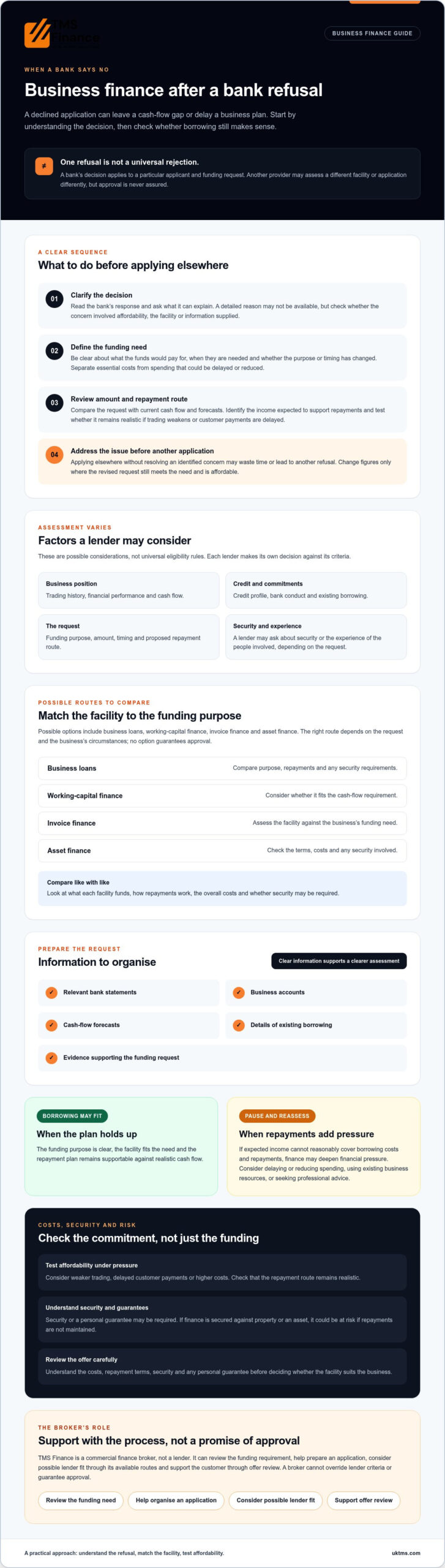
- Clarify the lender’s explanation. Read the decision and ask what details the bank can share. Check whether it raised a concern about affordability, the facility or the information supplied. A lender may not provide a detailed explanation, but it is worth asking.
- Confirm the purpose. State what the funds would pay for and whether that need has changed. Separate essential costs from spending that could be delayed or reduced.
- Check the amount and timing. Compare the request with current cash flow and forecasts. A lower amount or later date may change the proposal, but only revise it if the result still meets the need and repayments appear supportable.
- Map the repayment route. Identify the income or cash flow expected to meet repayments. Check whether that plan remains realistic if trading is weaker than forecast or payments arrive later than expected.
Which factors might a lender consider?
Assessment varies by lender and facility. Possible considerations include the funding purpose, trading history, bank conduct, credit profile, existing borrowing and repayment route. A lender may also ask about security or the experience of the people involved, depending on the request. These are potential factors, not universal eligibility rules. The lender makes its own decision based on the case and its criteria.
For more information about preparing a request, TMS Finance has a business loan application page. The US Small Business Administration also outlines SBA loan programmes, but these are US-focused and should not be treated as guidance on UK lending or eligibility.
What information can help clarify the next step?
Keep the bank’s decision with current business financial information. Use a cash-flow forecast to compare expected income and outgoings with proposed repayments. Test realistic assumptions, including possible delays in customer payments or changes in costs, rather than relying only on an optimistic forecast.
Then decide whether to revise the request, consider another facility or wait before borrowing. Depending on the case and facility, useful documents may include recent business bank statements, filed accounts or recent management accounts, VAT returns, cash-flow forecasts and details of existing borrowing. A lender may request additional information. If you are unsure how to present the requirement, reviewing the application process can help you understand what information may be needed. This review is a practical first step in how to get business finance when banks say no, but it cannot guarantee a different lending decision.
Compare Business Finance Options After a Bank Decline
To work out how to get business finance when banks say no, match the facility to the reason funds are needed. A route designed for a short-term cash-flow gap may not suit an equipment purchase or a longer-term growth plan. Compare how repayments work and what obligations apply, not just whether an offer might be possible.
| Finance route | Possible purpose | Repayment basis | Potential security | Questions to ask |
|---|---|---|---|---|
| Business loan | A defined operational or growth requirement | As set out in the lender’s offer | Depends on the facility and lender | What is the total repayable amount and how often are repayments due? |
| Working-capital finance or revolving credit | Managing eligible business cash-flow needs | Varies by facility; check how use and repayment work | May be required, depending on the offer | Can the business manage repayments as cash flow changes? |
| Invoice finance | Releasing funds against eligible unpaid invoices | Depends on the facility and invoice payments | Terms may relate to invoices and other security | Which invoices qualify, and what fees or conditions apply? |
| Asset finance | Acquiring eligible equipment or machinery | Set by the facility terms | The financed asset may be security | What happens if repayments stop or the asset is no longer needed? |
Choose a route that fits the requirement
For an operating or growth need, compare a business loan with working-capital finance. A revolving credit facility may be worth considering when the amount needed varies over time, but check how drawing funds and repayments work under the actual terms. If cash is tied up in unpaid invoices, ask whether invoice finance could fit the business. TMS Finance offers business loans and working-capital finance, revolving credit facilities, invoice finance and asset and equipment finance. Whether a particular option is suitable depends on the business and lender criteria.
For an equipment purchase, asset finance may link the borrowing to the item being acquired. Check the obligations, including what happens if repayments are not maintained. If acquiring commercial vehicles, businesses can also explore Fleet Management and leasing structures that help preserve working capital without relying on traditional bank loans. For general post-rejection considerations, the US Chamber of Commerce offers steps to take after a loan rejection. It is US-focused, so do not treat it as guidance on UK lender criteria.
Compare the full commitment
Review the lender’s actual terms, including total cost, fees, repayment frequency and duration. Ask whether security or a personal guarantee is required and understand the obligations for the business and anyone providing a guarantee. If property or an asset is used as security, it could be at risk if repayments are not maintained. A broker can help consider facility fit through its available routes, but cannot promise approval. If you are preparing a business loan request, you can review the application process before deciding what to do next.
Prepare a Stronger Finance Request, and Know When Not to Borrow
A clear finance request helps a lender understand the business need and assess the information provided. It cannot make an unaffordable proposal viable or fix a weak application through better wording alone. Be specific, accurate and ready to explain how the business expects to meet its commitments.
Set out the requirement and repayment plan
Explain the problem, the amount requested, when the funds are needed and what they would pay for. Link the repayment plan to realistic expected cash flow. For example, if repayments depend on a new contract, explain what supports that expectation and allow for possible delays. Do not rely on income that is uncertain or already committed elsewhere.
Give a complete picture of existing borrowing and material financial commitments. Omissions or inconsistent figures can make the request harder to assess. Check that the amount and timing still match the underlying need, rather than seeking more than the business can reasonably use or repay.
Organise relevant supporting information
Gather current business bank statements, accounts, cash-flow forecasts, details of existing borrowing and evidence supporting the funding purpose. Depending on the facility, useful documents may also include VAT returns, aged debtor or creditor reports, asset quotations or supplier invoices, or property details and cost schedules. The information requested varies by lender and case, so check what is relevant before applying. Keep figures consistent across documents and explain material changes in trading or expected income.
Use the forecast to test repayments against realistic trading assumptions, including a less favourable scenario. A well-organised application can help a lender assess the case, but approval depends on the applicant’s circumstances and the lender’s criteria. Security, affordability, credit profile and repayment plans may also be considered.
Know when borrowing could add pressure
Pause if forecast cash flow cannot support the proposed repayments, the repayment source is uncertain or a new loan would only postpone an unresolved shortfall. Consider whether spending can be reduced, a commitment deferred, payment timing discussed with suppliers or customers, or existing business cash used prudently. These options will not suit every business, but they are worth reviewing before taking on more debt.
Understand the consequences of an offer before accepting it. If finance is secured against property or an asset, that security could be at risk if repayments are not maintained. A personal guarantee may create obligations for the person providing it, so check the terms carefully and seek independent professional advice where needed. Speak to an accountant, solicitor or other suitably qualified professional about tax, legal, accounting or personalised financial questions.
How a Commercial Finance Broker Can Help After Banks Say No
A commercial finance broker can help structure the next steps after a bank refusal. TMS Finance starts by understanding the funding requirement, reviewing the information available and considering whether a facility may fit. This can help bring focus to how to get business finance when banks say no, but it does not guarantee that a lender will approve an application.
What happens when you discuss a declined application?
The initial discussion covers the amount needed, what the funds are for, when they are required and the outcome the business is seeking. Bring the bank’s explanation, if available, and current financial information. This helps TMS Finance understand the request and identify points that may need clarification before an application is prepared.
The process can include an initial assessment, document collection and consideration of possible lender fit through options available via TMS Finance’s routes. This is not an assessment of the entire market. A suitable route may not be available, and the lender makes its own decision based on the case and its criteria.
Support through the application and offer review
If proceeding appears appropriate, a broker can help organise the application and support the business in responding to lender queries. If an offer is made, review the terms and obligations carefully, including repayments, fees, security and any personal guarantee. Check what the offer requires before accepting it. If finance is secured against property or an asset, it could be at risk if repayments are not maintained.
TMS Finance’s process includes application support, offer review and completion support. Requirements depend on the lender and the details of the case. TMS Finance is a member of the National Association of Commercial Finance Brokers and acts as a broker, not the lender providing finance.
What should you do next?
Gather the refusal explanation and current business financial information. Be ready to explain the amount required, its purpose and timing, and how the business expects to repay it. If repayments do not look supportable, pause and consider alternatives before borrowing. A discussion can help clarify possible next steps.
TMS Finance is a commercial finance broker, not a lender. Finance is subject to status, lender criteria and satisfactory checks. Terms, fees, security and personal guarantees may apply. Contact TMS Finance to discuss your circumstances and the funding options that may be available.
Take a Clear Next Step After a Bank Refusal
A bank’s decision applies to a specific request. Before applying elsewhere, clarify the reason for the refusal, check the amount and purpose you need, and test whether forecast cash flow can support repayments. Then compare facilities by how they work, their full costs and any security or personal guarantee required.
Understanding how to get business finance when banks say no starts with an informed choice, not simply making more applications. If borrowing could deepen an unaffordable shortfall, consider whether spending can be reduced, payment timing changed or a commitment deferred.
TMS Finance is a commercial finance broker and a member of the National Association of Commercial Finance Brokers. It can support application preparation and offer-term review, and consider possible lender fit through its available routes. It cannot guarantee an outcome.
A refusal need not end your search. A careful review can help you choose a practical next step, including whether to wait before borrowing.
Finance is subject to status, lender criteria and satisfactory checks. Terms, fees, security and personal guarantees may apply. Contact TMS Finance to discuss your circumstances and the funding options that may be available.
Frequently Asked Questions
Can I get business finance after a bank says no?
Possibly, but another lender or facility may also decline the request. A bank refusal applies to a specific application, not automatically to every finance route. To understand how to get business finance when banks say no, ask the bank what it can explain about its decision. Then review the funding purpose, amount and repayment plan before considering whether another facility may fit.
Why would a bank refuse a business loan?
A lender may consider factors such as trading history, bank conduct, credit profile, existing borrowing, security and the proposed repayment route. It may also review the funding purpose and information provided. These are possible factors, not universal rules. Ask the bank whether it can clarify its decision, then check whether the application has gaps or assumptions that need addressing.
What finance options can a business consider after a bank decline?
Possible routes include business loans, working-capital finance or a revolving credit facility for suitable cash-flow needs. Invoice finance may be relevant where the business has eligible unpaid invoices. Asset finance may suit an equipment purchase. Each facility works differently, and terms, costs, security and repayment obligations vary. Compare the options against the business requirement rather than choosing a facility simply because it is available.
Will applying to more lenders improve my chances of getting business finance?
Not necessarily. Submitting applications without understanding the first refusal may repeat the same issue or waste time. Start by clarifying the decision, checking that the amount and purpose are accurate, and testing whether forecast cash flow could support repayments. Then consider whether a different facility or lender may fit. More applications do not guarantee a different outcome.
Should I borrow if my business is struggling to meet repayments?
Be cautious. If forecast cash flow cannot support existing and proposed repayments, further borrowing may increase pressure rather than resolve it. Review whether spending can be reduced, payment timing renegotiated or a commitment deferred, and seek professional advice about your circumstances. If finance is secured against property or an asset, that security could be at risk if repayments are not maintained. Check any personal guarantee obligations carefully before agreeing to them.