

Could the finance that seems quickest leave your company with repayments it can’t sustain? When payroll, a tax bill, a supplier payment, stock or contract mobilisation is due, a cash gap can put operations under pressure. Finding emergency business funding for limited company owners starts with identifying what the money needs to cover and when it’s required, not choosing a product by name alone.
You may be weighing a business loan, revolving credit, invoice finance, asset finance or trade and stock finance. Each works differently, and eligibility, application requirements and timing depend on the business and lender. A delay can make a shortfall harder to manage, but borrowing without checking the full cost, repayment schedule, security and any personal guarantee can create a longer-term problem.
This guide explains which options may suit different urgent needs, what information lenders may request and what to check before committing. It also covers when borrowing may not be suitable and alternatives to consider. TMS Finance is a UK commercial finance broker and a member of the National Association of Commercial Finance Brokers. It can help clarify the funding requirement and present an application, but can’t guarantee approval or completion.
Key Takeaways
- Start by defining the size and timing of the cash gap, then match the facility to what the funds need to cover.
- Compare business loans, working-capital finance, invoice finance and other options by their purpose and repayment basis.
- Before committing to emergency business funding for limited company needs, check the total obligations, repayment frequency, term, fees and any security.
- Prepare clear evidence of the funding requirement and check whether repayments remain affordable if cash flow changes.
- TMS Finance can help clarify the requirement and present an application, but lender decisions and completion aren’t guaranteed.
Emergency business funding for a limited company: identify the cash gap first
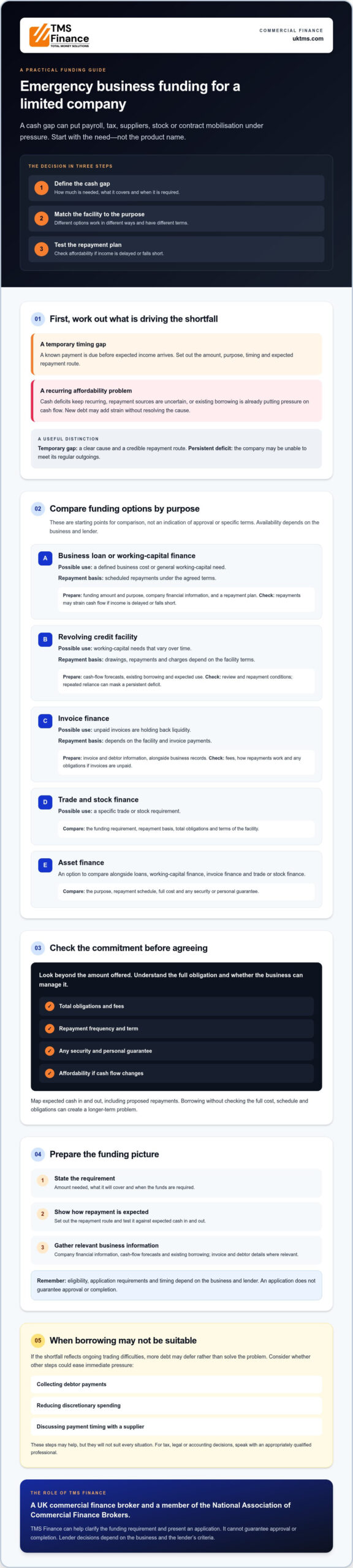
An urgent payment can disrupt trading or delay planned work. Payroll, a VAT bill, a supplier commitment or the cost of mobilising a contract may fall due before expected income arrives. In that situation, emergency business funding for limited company owners may be one option. First establish whether the problem is a short-term timing gap or a deeper affordability issue.
Emergency business funding refers to finance considered for a pressing, specific business cash need. Start by estimating the amount required, what it will pay for, when the funds are needed and how the company expects to repay them. This helps clarify whether borrowing fits the need or whether a facility might leave the underlying cause unresolved.
That assessment is part of corporate finance, which includes working capital management and funding decisions. For a limited company, defining the cash gap can help identify which options are worth discussing and what information a lender may need.
Which business commitments create an urgent funding gap?
A timing mismatch can arise when an expected customer payment arrives after payroll or a supplier invoice is due. Contract mobilisation may also require spending before the related income comes in. Set out the amount, purpose, required timing and expected repayment route. A defined gap with a credible repayment source is different from a business that regularly can’t cover its normal outgoings.
When could borrowing make the position worse?
Pause if cash deficits keep recurring, the repayment source is uncertain or existing borrowing is already putting pressure on cash flow. A new commitment may add strain without resolving the cause. Consider whether collecting debtor payments, reducing discretionary spending or discussing payment timing with a supplier could ease the immediate pressure. These steps may help, but they won’t suit every situation.
A temporary cash gap has a clear cause and a credible repayment route. A persistent affordability problem means the business may be unable to meet its regular outgoings.
Before applying, map expected cash in and out, including proposed repayments, to test whether the company can manage them. If the shortfall reflects ongoing trading difficulties, additional debt may defer rather than solve the problem. If the issue involves tax, legal or accounting decisions, speak with an appropriately qualified professional before acting. Defining the need can support a more informed funding discussion, but no application guarantees approval or completion.
Emergency funding options for a limited company: compare facilities by purpose
The facility should fit the reason for the shortfall. A business loan or working-capital facility may suit a defined requirement, while other options are linked to unpaid invoices, purchases or card receipts. Suitability and availability depend on your company’s circumstances and the lender’s criteria. Use the comparison below as a starting point, not as an indication of approval or specific terms.
| Facility | Possible use | Repayment basis | Information to prepare | Key risks to check |
|---|---|---|---|---|
| Business loan or working-capital finance | A defined business cost or general working-capital need | Scheduled repayments under the agreed terms | Funding amount and purpose, company financial information and repayment plan | Repayments may strain cash flow if income is delayed or falls short |
| Revolving credit facility | Working-capital needs that vary over time | Drawings, repayments and charges depend on the facility terms | Cash-flow forecasts, existing borrowing and expected use | Repeated reliance can mask a persistent deficit. Check review and repayment conditions |
| Invoice finance | Unpaid invoices are holding back liquidity | Depends on the facility and invoice payments | Invoice and debtor information, alongside business records | Check fees, how repayments work and any obligations if invoices are unpaid |
| Trade and stock finance or asset finance | A specific stock, trade or equipment purchase | Set by the agreement and may be linked to the purchase | Details and cost of the purchase, business finances and proposed repayment source | Confirm the finance matches the item and check any security or asset risk |
| Merchant cash advance | A business with card-processing receipts considering funding linked to them | Review the agreement’s collection method and obligations | Card-processing information and business cash flow | Understand how collections may affect available trading income |
Match the facility to cash flow, invoices, stock or equipment
A revolving credit facility may be worth considering if working-capital needs rise and fall. Check how drawings are repaid and whether the facility can be reviewed. Invoice finance may suit a company whose funds are tied up in unpaid invoices. For more detail, see the existing invoice finance guide. Trade and stock finance or asset finance is most relevant when the purchase itself matches the funding need. The “Business Loan Guide 2026: Strategic Funding for UK Firms” also covers business loans in more depth.
Keep specialist finance tied to its purpose
Assess a merchant cash advance using card-processing information and the full repayment obligations, not just the amount offered. Property finance is relevant when the requirement relates to a property purchase, refurbishment or development. Property or assets used as security could be at risk if repayments aren’t maintained.
The SBA disaster loans page describes US government support, so it isn’t a UK funding route for a limited company. For UK options, compare facilities against your specific cash need. You can review the business loan application information as one step in preparing to discuss possible lender fit.
Compare emergency business finance costs, repayment risks, and security
The headline rate alone won’t show what a facility will cost your company or how it will affect day-to-day cash flow. Before accepting an offer for emergency business funding for limited company needs, review the total amount repayable, repayment frequency, term and any fees. Rates and terms vary by applicant and facility, so compare actual offers available to your business rather than relying on general examples.
Check when repayments start and whether they are fixed or may change under the agreement. Consider the total commitment alongside existing borrowing, not in isolation. A repayment schedule that appears manageable in an average month could create pressure if customer payments arrive late or trading income falls. Make sure you understand any conditions that could affect the amount or timing of payments.
How can a company test whether repayments are affordable?
Compare proposed repayments with a cash-flow forecast that includes existing commitments and the expected timing of income and outgoings. Test the forecast against plausible changes, such as delayed customer payments or lower-than-expected sales. There’s no single affordability calculation that applies to every lender or facility. Lenders may consider the company’s performance, credit profile, affordability and security, alongside their own criteria.
Use current company information to assess the offer. If repayments depend on uncertain income, or the forecast only works under optimistic assumptions, pause before proceeding. A broker can help you review commercial terms but cannot override a lender’s assessment or guarantee approval.
What should directors understand about security and guarantees?
Read the offer to identify whether the facility is secured, which company assets or property may be included, and what obligations apply. A personal guarantee is a separate commitment by the guarantor. Understand its scope, duration and the circumstances in which it may be called on. Don’t assume that a company borrowing facility carries no personal exposure.
If repayments aren’t maintained, property or assets used as security could be at risk. If any security terms or potential consequences are unclear, seek independent professional advice before signing. The same applies to a personal guarantee: get appropriate advice so you understand the obligations you may be taking on.
Compare offers on their full cost, repayment demands and risks. Then consider whether the facility remains manageable if trading changes. A careful review can help directors make a considered decision without treating an urgent need as a reason to overlook the terms.
Prepare a limited-company emergency funding application without delaying decisions
A clear, well-supported request can help a lender understand the company’s position, but it can’t guarantee approval or speed up every stage. For emergency business funding for limited company needs, prepare the essentials in order: define the shortfall, gather relevant evidence, check affordability, then discuss which facilities and lender criteria may fit. Completion time depends on the case and lender.
What information may help explain the funding request?
Keep the information focused on the amount, purpose, timing and expected repayment route. Depending on the facility and circumstances, relevant evidence may include:
- Recent business bank statements, filed accounts or management accounts.
- A cash-flow forecast showing expected income, outgoings and existing borrowing commitments.
- Documents linked to the use of funds, such as supplier invoices, an asset quotation or property documents.
Check that figures and dates agree across the information you provide. If a customer payment or contract income is expected to support repayment, explain when it is due and provide relevant evidence where available. Don’t present uncertain income as guaranteed. A lender may request further information, and requirements vary by facility and case.
What happens when a broker reviews the case?
TMS Finance can begin by discussing the funding need and relevant business information. It can help identify possible lender fit from options available through its routes, collect documents and present the application accurately. A lender may then ask questions or request further evidence. If an offer is made, TMS Finance can support your review of the commercial terms and explain completion requirements. It cannot override lender criteria or guarantee approval, timing or completion.
Before applying, compare proposed repayments with the company’s forecast cash flow and existing commitments. If the figures suggest repayments may not be sustainable, consider whether borrowing is appropriate. A complete, accurate application can help reduce avoidable follow-up, but it doesn’t remove the lender’s checks.
For a step-by-step overview, read the Business Loan Application: Step-by-Step Process.
Speak to TMS Finance about emergency business funding for your limited company
Choosing emergency business funding for limited company needs starts with a clear sequence: confirm the cash shortfall and its purpose, compare facilities that may fit, then assess affordability, security and repayment risk. A facility should address a defined requirement without putting regular business commitments under further strain.
TMS Finance is a UK commercial finance broker, not a lender. It can help clarify the requirement, review possible lender fit through the options available via its routes, and support information gathering, application presentation, offer review and completion requirements. The lender makes its own decision. Approval and completion aren’t guaranteed.
What to explain when you make an enquiry
Set out the amount the company needs, what it will fund and when the money is required. Explain the expected repayment route and how it relates to forecast cash flow. Be ready to discuss current borrowing, any security that may be available, and constraints such as delayed customer receipts or other significant outgoings. Clear, consistent information helps frame the funding discussion.
What to expect before accepting a finance offer
Review the full commercial terms before deciding. Check the total repayment obligation, repayment frequency, term and fees, along with any security or personal guarantee requirements. If property or an asset is secured, understand that it could be at risk if repayments aren’t maintained. Consider whether repayments remain affordable alongside existing commitments and whether the facility is still manageable if trading changes.
Compare the offer with other relevant funding options and non-borrowing alternatives. If you’re unsure about legal, tax or accounting implications, seek appropriate professional advice before committing. TMS Finance is a member of the National Association of Commercial Finance Brokers (NACFB) and can support the process, but cannot change a lender’s criteria or promise an outcome.
To start a discussion, explain the company’s cash requirement and the information you have available. Applying doesn’t guarantee an offer. The aim is to establish whether an option may be available and whether its obligations fit the business.
TMS Finance is a commercial finance broker, not a lender. Finance is subject to status, lender criteria and satisfactory checks. Terms, fees, security and personal guarantees may apply. Contact TMS Finance to discuss your circumstances and the funding options that may be available.
Make your next funding decision with confidence
Start with a clear picture of the cash gap: how much the company needs, what it will cover and how repayment is expected to work. Then compare facilities suited to that purpose and check the full cost, repayment schedule, security and any personal guarantee. Emergency business funding for limited company owners may help with a defined shortfall, but borrowing may not be right if the business can’t sustain further repayments.
TMS Finance is a commercial finance broker and a member of the National Association of Commercial Finance Brokers. It can help explain application information, consider possible lender fit through its available routes, and review key offer terms. The lender makes the decision, so approval and completion aren’t guaranteed.
If you’re ready to discuss your company’s requirement, share the amount, purpose, timing and expected repayment route. A clear starting point can help you assess the options carefully and decide what to do next.
TMS Finance is a commercial finance broker, not a lender. Finance is subject to status, lender criteria and satisfactory checks. Terms, fees, security and personal guarantees may apply. Contact TMS Finance to discuss your circumstances and the funding options that may be available.
Frequently Asked Questions
Can a limited company get emergency business funding?
Yes, a limited company may be able to apply for finance for a pressing business need, but approval isn’t guaranteed. The lender will assess the company and application against its criteria. Emergency business funding for limited company owners could include a business loan, working-capital finance or another facility suited to the purpose. First define the amount, what it will cover and how the company expects to repay it.
What types of emergency funding can a limited company consider?
Possible options include business loans or working-capital finance for a defined requirement, a revolving credit facility for changing cash needs, or invoice finance if unpaid invoices are affecting liquidity. Asset finance may suit an equipment purchase, while trade and stock finance may relate to a specific stock requirement. Suitability depends on the purpose, company circumstances and lender criteria. Compare repayment terms, costs and risks before deciding.
How quickly can a limited company receive emergency business funding?
There’s no guaranteed turnaround. Completion time depends on the case and lender, including the information required, the assessment and any outstanding conditions. An urgent need doesn’t mean an application will be approved or completed by a particular date. Clear, accurate information may help the process proceed, but it can’t remove lender checks. If a payment deadline is approaching, consider discussing practical alternatives with the relevant supplier or creditor.
What documents may a lender ask for when a company needs urgent finance?
Requirements vary by facility and lender. A lender may ask for recent business bank statements, filed accounts or management accounts, cash-flow forecasts and details of existing borrowing. Evidence should fit the funding purpose: an invoice or aged debtor report for invoice finance, an asset quotation for equipment finance, or card-processing statements for a merchant cash advance. Prepare a clear explanation of the amount, use, timing and expected repayment route.
Can a limited company get emergency funding with poor cash flow or existing borrowing?
It may be possible to apply, but weak cash flow or existing borrowing can affect affordability and lender assessment. Set out current commitments and test proposed repayments against a realistic cash-flow forecast. If the company has recurring deficits or no clear repayment route, further borrowing could increase pressure rather than solve it. Consider debtor collection, discretionary spending or supplier discussions, and seek professional advice if tax, legal or accounting decisions are involved.
TMS Finance is a commercial finance broker, not a lender. Contact TMS Finance to discuss your circumstances and the funding options that may be available.