
A business purchase can look affordable on paper and still leave the buyer short of working capital after completion. Acquisition funding support should help you plan for the purchase price, the deal timetable and the cash the business needs to keep trading.
Focusing only on raising enough to complete the purchase can overlook the longer-term effect of repayments, security and any personal guarantee. Starting the funding plan late can also leave less time to prepare information and coordinate finance with the transaction.
This guide explains how business loans and other funding routes may fit different purchases, what a lender may consider and which documents can help present a clear case. It also covers how to compare costs and obligations, test repayments against realistic forecasts and recognise when borrowing may not be suitable. TMS Finance is a UK commercial finance broker and a member of the National Association of Commercial Finance Brokers. It can review your requirement, help prepare an application and consider possible lender fit, without promising an outcome.
Key Takeaways
- Compare business loans, revolving credit, asset finance and invoice finance against the purchase structure and the business’s ability to repay.
- Use acquisition funding support to define the requirement and present a clear case, without assuming that finance will be approved.
- Prepare relevant evidence, such as accounts, bank statements, forecasts, existing borrowing details and information about the acquisition.
- Review the full cost, security and repayment obligations before accepting an offer. Secured assets or property could be at risk if repayments aren’t maintained.
- Consider whether borrowing is suitable and weigh alternatives if repayments could put post-completion cash flow under pressure.
Acquisition funding support: start with the purchase and its financial impact
Misjudging the amount needed for a business purchase can disrupt the transaction timetable and leave too little cash to run the business after completion. Starting the funding discussion late may also limit the time available to gather information, consider possible facilities and coordinate finance with the purchase process.
Acquisition funding support means help defining the funding requirement and preparing information for potential lenders. It does not mean the broker lends money or can guarantee an offer. A broker helps present the case and consider possible lender fit; the lender makes its own lending decision.
The funding requirement depends on the deal, how the money will be used, the buyer’s contribution and the wider funding plan. A purchase may involve a leveraged buyout (LBO), where borrowed funds form part of the acquisition financing. The appropriate structure depends on the transaction and the business’s ability to meet repayments.
Which parts of a business acquisition might need funding?
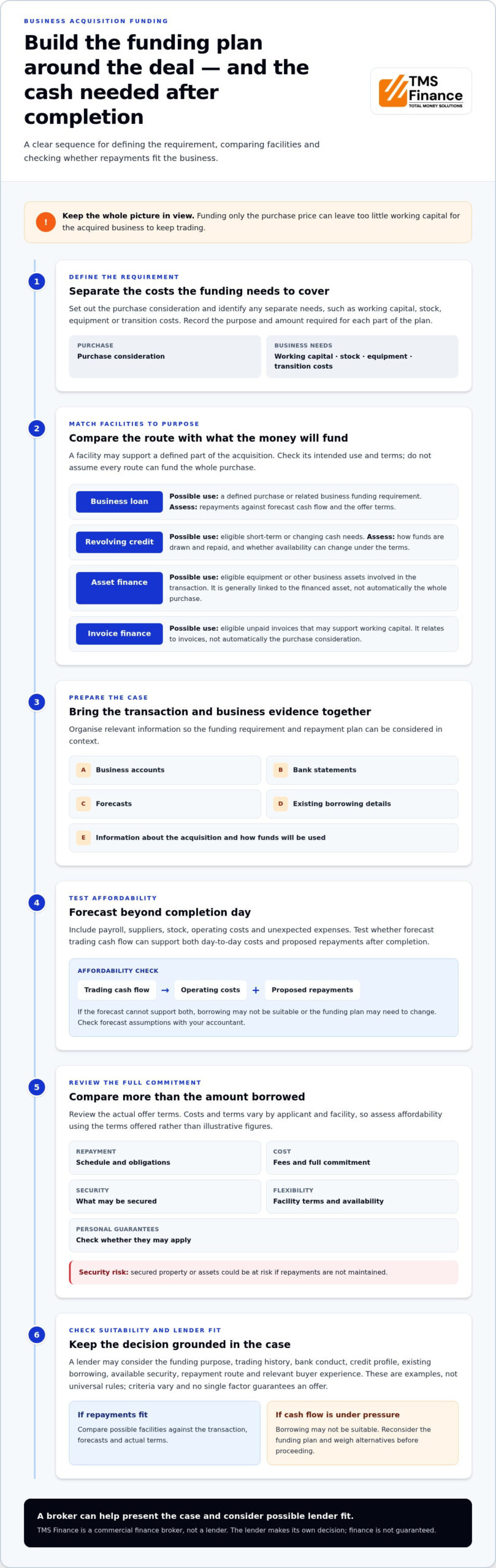
Set out what the money is intended to cover before comparing facilities. Depending on the deal, this might include the purchase consideration, working capital, stock, equipment or transition costs. Separate these needs so the amount and purpose of each part of the funding requirement are clear.
Keep the funding case separate from decisions about the legal, tax or accounting structure. Take those questions to qualified professional advisers. Clear information about the transaction and use of funds helps a broker consider possible finance routes in context.
Why the post-completion cash position matters
Completion is only one part of the funding plan. The acquired business may still need cash for payroll, suppliers, stock and other operating costs, as well as unexpected expenses. Include these requirements in the forecasts instead of treating the purchase price as the only funding need.
Repayments reduce the cash available for day-to-day operations. If forecast trading cash flow cannot support both operating costs and the proposed obligations, borrowing may not be suitable or the funding plan may need to change. Check the assumptions and discuss forecasts with your accountant before proceeding.
Compare acquisition funding routes against the deal and repayment plan
The right facility depends on what the money will fund and how repayments are expected to be made. A business loan may be considered for an acquisition, depending on the case and lender criteria. Other facilities can help with particular costs, but should not be assumed to cover the entire purchase.
| Funding route | Possible use in an acquisition | Key point to assess |
|---|---|---|
| Business loan | A defined purchase or related business funding requirement. | Compare the repayment profile with forecast cash flow and the terms of any offer. |
| Revolving credit facility | Eligible short-term or changing cash needs, depending on the facility. | Understand how funds can be drawn and repaid, and whether availability can change under the terms. |
| Asset finance | Eligible equipment or other business assets involved in the transaction. | It is generally linked to the financed asset, not automatically to the whole business purchase. |
| Invoice finance | Eligible unpaid invoices that may support working capital. | It relates to invoices, not automatically to the purchase consideration. |
Match each facility to its purpose
Separate the purchase price from equipment, stock and working capital needs. Asset finance may be relevant when eligible equipment is being acquired. Invoice finance may help release funds against eligible unpaid invoices. Neither should be treated as general acquisition funding without reviewing the facility terms.
For general background on business borrowing, TMS Finance’s Business Loan Guide 2026 can help explain common loan considerations. The US SBA 7(a) loan program lists changes of ownership as an eligible use under that programme. It applies in the United States, so it is not a UK funding route or an indication of UK lender criteria.
Compare the full commitment
Compare the full commitment, not just the amount borrowed. Each facility has its own costs, security and repayment obligations. Review any offer for its repayment schedule, fees, security, personal guarantees and flexibility. Rates and terms vary by applicant and facility, so assess affordability using the actual terms offered rather than illustrative figures.
If you’re considering a business loan, you can review the business loan application process and organise the information needed to discuss your requirement.
Assess affordability, lender fit, security, and acquisition risks
A lender’s assessment depends on the applicant, business and proposed transaction. Possible factors include the funding purpose, trading history, bank conduct, credit profile, existing borrowing, available security, repayment route and the buyer’s relevant experience. These are examples, not universal lender rules. Criteria vary, and strength in one area does not guarantee an offer.
If borrowing will fund part of an acquisition, forecasts should show how the business could meet repayments from trading after completion. A leveraged buyout model can help explain how borrowed funds and business cash flow interact. Your forecasts should reflect the actual business and transaction. Discuss the assumptions with your accountant.
Stress-test affordability before progressing
Assess projected cash flow alongside existing commitments and proposed repayments. Include operating costs such as wages and supplier payments, then consider how the business would cope if income were lower or costs higher than forecast. Look at when cash is expected to come in, not only the total projected income.
If cash flow is uncertain or the forecast leaves too little room for repayments and operating costs, borrowing may not be suitable. Reassess the purchase, funding amount or repayment plan before taking on obligations. Acquisition funding support should help you consider whether the borrowing fits the case, not push you towards a particular outcome.
Understand costs, security, and obligations in any offer
Read the offer carefully. Compare the repayment schedule, fees, interest rate, security and conditions with the funding purpose and expected cash flow. Check whether a personal guarantee is required and understand the obligations before deciding. If finance is secured against property or an asset, that property or asset could be at risk if repayments aren’t maintained.
A broker can help explain commercial terms and support communication with a potential lender, but cannot change the lender’s criteria or make its lending decision. TMS Finance can review the requirement and information, then consider possible lender fit through routes available to the brokerage. Seek independent legal, tax or accounting advice on an offer’s implications before proceeding.
Prepare an acquisition funding case and compare sensible alternatives
A clear application starts with a defined requirement, not a general request to borrow. Explain what the purchase involves, what the funding will cover and when it may be needed. Then assess affordability, gather evidence, consider possible lender fit and compare any offer with the business’s needs before deciding how to proceed.
Good preparation can show how the acquisition is structured and how repayments are expected to be met. It cannot guarantee approval. Document requirements vary according to the facility, business, transaction and lender’s assessment.
What information can support an acquisition application?
Gather relevant evidence to give a clear picture of the buyer’s position and the business being acquired. This may include:
- Recent business bank statements, filed accounts or management information.
- Cash-flow forecasts showing the expected position after completion and the proposed repayment route.
- Details of existing borrowing and other financial commitments.
- Information about the acquisition, including purchase details, funding purpose and anticipated timing.
Use consistent figures across the documents and explain the assumptions behind forecasts. If there are gaps or unusual items, provide a clear explanation rather than leaving a funder to draw its own conclusions. A broker can review the information, help organise the funding case and consider possible lender fit. Further evidence may be requested depending on the circumstances.
When another route or a pause may be more suitable
Borrowing is not the only way to approach a purchase. Consider whether available business funds could reduce the amount required while leaving enough cash for trading. You could also explore whether the transaction can be staged or its timing adjusted, if the parties agree.
Deferred consideration may be another possibility, with part of the purchase price paid later under agreed terms. This requires agreement between buyer and seller, and qualified professional advisers should review the legal, tax and accounting implications. If forecasts do not support the repayments, pausing to revisit the price, timing or funding plan may be more prudent than taking on unaffordable debt.
TMS Finance can review your acquisition funding requirement and available information, help prepare an application and support communication through the process. The lender assesses the application and sets any offer terms.
How TMS Finance provides acquisition funding support
TMS Finance helps business buyers define their acquisition funding requirement, review relevant information and consider possible lender fit through routes available to the brokerage. As a commercial finance broker, it supports the application and communication process. The lender assesses the case and makes the lending decision.
The process does not guarantee an offer, funding speed or completion date. TMS Finance is a member of the National Association of Commercial Finance Brokers (NACFB). Membership does not mean a particular lender will accept an application or that finance will be available.
What to expect when discussing an acquisition
The initial discussion covers the purchase, amount required, anticipated timing and what you want the funding to achieve. TMS Finance reviews the information provided and helps prepare documents for presenting the case clearly. If a potential lender asks further questions, the brokerage can support communication through the process.
The process may involve these stages:
- Initial discussion: Set out the acquisition and funding requirement.
- Assessment: Review the available business and transaction information.
- Document preparation: Organise relevant information for an application.
- Lender fit: Consider possible routes available to the brokerage.
- Application: Support the application and related communication.
- Offer review: Help review commercial terms, costs, security, guarantees and repayment obligations.
- Completion support: Support communication as the transaction progresses, without guaranteeing completion.
Understand the finance terms before accepting an offer. TMS Finance can help clarify commercial information, but cannot override lender criteria or replace independent legal, tax or accounting advice. If security is offered, consider the consequences carefully: the secured property or asset could be at risk if repayments aren’t maintained. A personal guarantee also creates obligations that you should understand before deciding.
Decide whether to take the next step
To start a discussion, prepare a summary of the purchase, intended use of funds, estimated amount required, expected timing and available business information. This gives TMS Finance a practical starting point to review the case and consider possible options. Proceed only when you understand the proposed obligations and have taken any professional advice you need.
Plan your next acquisition funding step with care
Good acquisition funding support starts with a clear view of what the purchase requires and what the business can afford after completion. Compare facilities by purpose, repayment terms, costs and security. Prepare relevant financial information and forecasts, and pause if projected cash flow cannot support the borrowing.
TMS Finance helps UK businesses prepare applications and review offers, while the lender makes the final decision. Its National Association of Commercial Finance Brokers (NACFB) membership is not a guarantee of funding or lender acceptance. Seek independent advice on legal, tax and accounting questions before committing.
To explore funding that may fit your requirement, set out the purchase, amount needed, intended use and available information. Contact TMS Finance to discuss your acquisition funding support and the next steps.
Frequently Asked Questions
What is acquisition funding support?
Acquisition funding support is help assessing the finance needed to buy a business and preparing information for potential lenders. A commercial finance broker can review the requirement, consider possible lender fit and support an application. The broker does not lend the money or decide whether finance is approved. The amount and suitable route depend on the transaction, buyer’s contribution, affordability and lender criteria.
Can a business loan be used to buy an existing business?
A business loan may be considered for the purchase of an existing business, depending on the case and lender criteria. Explain how much funding is needed, what it will cover and how repayments are expected to be made. A lender may consider the applicant, business information, credit profile, affordability and security. An offer is not guaranteed, and its terms should be checked against post-completion cash flow.
What will a lender consider for business acquisition finance?
Possible assessment factors include the funding purpose, trading history, bank conduct, credit profile, existing borrowing, security, repayment route and the buyer’s relevant experience. These are not universal lender rules; each case is assessed against the lender’s criteria. Supporting information may include bank statements, accounts, forecasts and acquisition details. A clear application should explain the purchase and how the proposed borrowing may be repaid.
Can acquisition finance require security or a personal guarantee?
Yes. Depending on the facility and lender’s requirements, finance may involve security over property or assets, or a personal guarantee. Review the offer to understand what is secured, who is giving any guarantee and what obligations apply. If repayments aren’t maintained, secured property or assets could be at risk. Consider independent professional advice before agreeing to security or guarantee terms.
What alternatives should I consider before borrowing to buy a business?
Consider whether available business funds could reduce the amount borrowed while leaving enough cash for trading. You could also explore staging the purchase or adjusting its timing, if the parties agree. Deferred consideration may be possible by agreement, but qualified legal, tax and accounting advisers should review its terms and implications. If forecasts do not support repayments, pausing to reassess the purchase or funding plan may be prudent.
TMS Finance is a commercial finance broker, not a lender. Finance is subject to status, lender criteria and satisfactory checks. Terms, fees, security and personal guarantees may apply. Contact TMS Finance to discuss your circumstances and the funding options that may be available.