

The land may fit your business plans, but using too much cash to secure it could put day-to-day operations under pressure. Commercial land finance UK may help bridge the gap between a purchase deadline and available funds. The right route depends on why you’re buying, how you’ll repay and what security you’re prepared to offer.
It’s understandable to want to move quickly when a suitable site comes up. However, an unclear planning position or future use can complicate lender discussions, while borrowing costs and repayment obligations affect cash flow after completion. Delaying without checking your options could also mean missing an opportunity. Before committing, assess the figures, uncertainties and risks together.
This guide explains how commercial mortgages, bridging finance and property development finance may fit different land purchases, what information a lender may request, and what costs, security and personal guarantees to consider. It also covers when borrowing may not be suitable and which alternatives could be worth reviewing. TMS Finance is a commercial finance broker that can help organise your case information and consider possible lender fit. A lender makes the decision, and approval or completion is not guaranteed.
Key Takeaways
- Set out the land’s intended use, purchase timing and impact on working cash before deciding how much to borrow.
- Commercial land finance UK could involve a commercial mortgage, bridging finance or property development finance, depending on the purchase purpose and repayment plan.
- Compare each possible route by its repayment source, security requirements and uncertainties, not just by the facility name.
- Prepare clear information on the purchase, business finances, credit profile, available security and repayment plan for lender assessment.
- A commercial finance broker can help organise your case and consider possible lender fit, but approval and completion are not guaranteed.
Buying commercial land in the UK: protect cash flow before committing
A land opportunity can arise before your business has enough spare cash to complete the purchase comfortably. Using working funds may leave less available for wages, suppliers, tax or other commitments. Commercial land finance UK may help manage that gap, but borrowing brings repayment and security obligations. Start by testing the purchase against your business’s cash-flow needs, not just the land price.
Timing matters. Check when funds are needed, what other payments fall due and whether the business could meet its commitments if income is lower than expected. Clarify the intended use as well: land for business operations, investment or a development plan can raise different questions. A seller may move on if you delay, but that possibility alone is not a reason to borrow before the purpose and figures are clear.
What makes a commercial land purchase different from buying premises?
An existing commercial property may have buildings, occupiers or rental income. A land purchase may have none of these, so the buyer’s intended use and the site’s characteristics can be important to the assessment. Be ready to explain whether the site is for your own operations, an investment or part of a development plan.
Details such as access, services, planning position and proposed use may shape funding discussions. They don’t determine an outcome on their own, and lender requirements vary. A Commercial mortgage is one form of property borrowing, but a land purchase may need a different funding route depending on its purpose and repayment plan.
When could delaying or not borrowing be the safer choice?
Pause if repayments would be difficult to manage when trading is weaker, or if the business would have too little cash left for normal operations. The same applies when the purchase purpose, repayment source or project viability is uncertain. Borrowing against property or other security carries risk: the secured asset could be at risk if repayments aren’t maintained.
Consider whether using available funds, revisiting the purchase timetable or waiting for clearer information would leave the business in a stronger position. Discuss the options with relevant financial, legal and property advisers before taking on debt. Finance can help address a funding gap, but it isn’t automatically the right answer for every land purchase.
Commercial land finance UK: understand the main funding routes
Commercial land finance UK can refer to different ways of funding a business land purchase. It isn’t one standard product, and a facility’s name alone won’t tell you whether it fits your plans. Commercial mortgages, bridging finance and property development finance may each be considered, depending on the purchase purpose, repayment plan, security and lender criteria.
Purchase funding helps acquire the land; development finance may fund a defined project to build or improve property on it. These needs can overlap, but they aren’t interchangeable. Be clear about whether you need funds to complete the purchase, carry out development, or both, and identify the intended repayment source.
The British Business Bank’s UK business finance options provides general information to help businesses understand finance routes. For a land purchase, assessment depends on the applicant and transaction. No route guarantees approval or standard terms.
Could a commercial mortgage fit a land purchase?
A commercial mortgage may be explored if the funding purpose, proposed security and repayment structure align with a lender’s requirements. Don’t assume that every lender accepts land-only purchases or offers the same terms. Consider how the borrowing would be repaid and whether payments would remain manageable alongside the business’s other commitments. For wider property funding context, compare the proposal with a commercial property finance guide.
When might bridging or development finance be explored?
Bridging finance may be considered when a short-term funding need is shaped by transaction timing or structure. The proposed repayment or exit route needs careful assessment. Understand the borrowing period, costs and what could happen if the expected repayment is delayed before proceeding.
Property development finance may be relevant when the land purchase forms part of a defined development requirement. Be prepared to explain the project, its viability and how the finance is intended to be repaid. The lender assesses each case against its own criteria; neither the route nor a proposed exit guarantees an offer or completion.
Before comparing options, set out the purchase purpose, amount required, timing and repayment plan. To organise the information for a funding discussion, you can outline your business finance requirement.
Compare land finance options by purpose, repayment and risk
Compare each route against what the funding needs to cover, when the money is needed and how it will be repaid. Commercial land finance UK has no single standard structure. Rates, terms, fees, security and personal guarantee requirements vary by applicant, facility and lender, so assess the full obligations of any proposal rather than focusing only on the headline rate.
| Possible route | Purpose and potential structure | Repayment route | Security and key uncertainties |
|---|---|---|---|
| Commercial mortgage | May be considered to fund a commercial land purchase, if the lender accepts the case and proposed security. | As set out in the lender’s offer and agreed repayment structure. | Security may be required. Whether land-only purchases fit, and on what terms, depends on lender assessment. |
| Bridging finance | May suit a short-term requirement where transaction timing or structure is a factor. | A defined repayment or exit route needs to be considered before borrowing. | Security and costs depend on the offer. Delays or changes to the exit plan may affect the ability to repay as expected. |
| Property development finance | May be relevant to a defined development requirement involving the land. | Repayment depends on the proposed project and the facility agreed with the lender. | Project viability, assumptions and security require assessment. Funding is not assured. |
| Non-borrowing alternatives | Use available business funds, negotiate the purchase timing, or delay while key information is clarified. | No new borrowing repayment, but using cash may reduce working capital or delaying may affect the opportunity. | Check the effect on operating funds and existing commitments before deciding. |
How should a business compare possible finance routes?
Start with the purchase purpose and the date funds are required. Then compare the full repayment obligations, fees, security and whether a personal guarantee may be required. Test the effect on cash available for wages, suppliers, tax and other commitments. The UK Parliament briefing on commercial property investment discusses local authority investment, a public-sector context rather than a guide to business land finance.
What could make borrowing unsuitable for this purchase?
Borrowing may be unsuitable if the repayment route is unclear, project assumptions remain uncertain or cash flow cannot support repayments alongside normal business costs. If finance is secured, the property or other secured asset could be at risk if repayments aren’t maintained. Seek legal, tax, accounting or planning advice from relevant professionals where those questions affect the purchase. Don’t proceed on the basis of funding that hasn’t been confirmed.
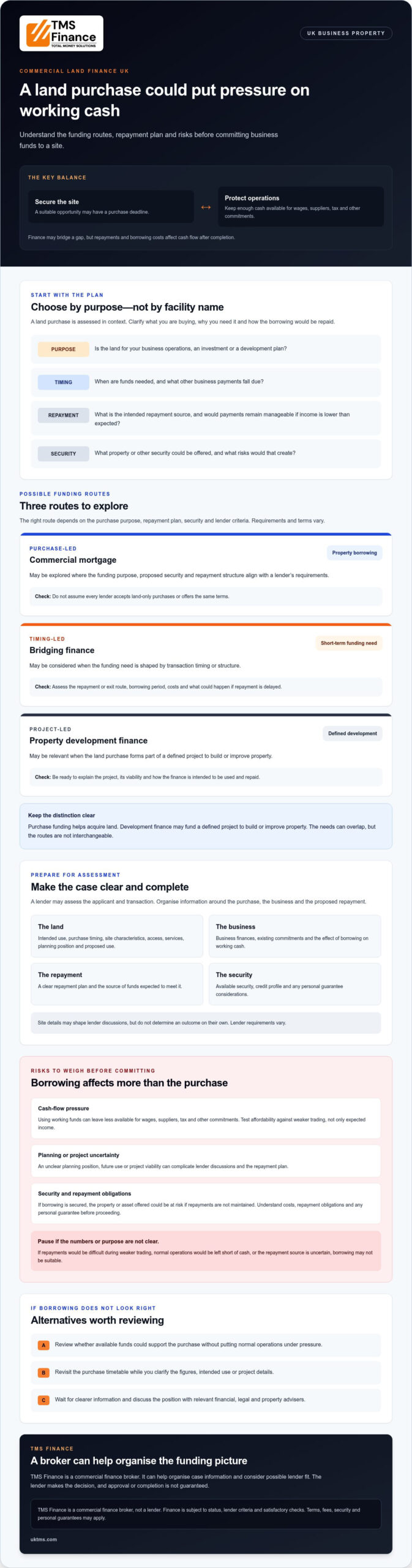
Prepare a commercial land finance application and assess the risks
A well-organised application explains what the business wants to buy, why it needs funding and how it expects to repay it. For commercial land finance UK, prepare the case in a clear sequence before approaching a lender. Requirements differ, and lenders may consider the applicant, business performance, credit profile, affordability, security and repayment plan when assessing a case.
- Clarify the purpose. Explain whether the land is for business operations, investment or a development project.
- Set out the timing and amount. Identify when funds are needed and how much the business intends to borrow.
- State the repayment plan. Explain the expected repayment source or, where relevant, the proposed exit route and the assumptions behind it.
- Gather supporting evidence. Organise business and property information, and note any uncertainties that could affect the purchase or repayment.
What information may a lender ask for?
Depending on the case, a lender may request recent business bank statements, filed or management accounts, cash-flow forecasts and details of existing borrowing. These documents provide context on trading and financial commitments. Bank conduct, credit profile and relevant experience may also be considered, but requirements vary between lenders and transactions.
Property evidence could include details of the site, valuation information, planning documents and cost schedules where a development is proposed. Provide information that supports the stated purpose. If planning or project details are still uncertain, identify that clearly rather than presenting assumptions as confirmed.
How can a buyer test the repayment plan and transaction risks?
Check whether the proposed repayment route would still be workable if income falls, costs rise or a project takes longer than planned. Consider the effect of repayments on working capital and the business’s ability to meet existing commitments. Ask the lender or broker to explain the facility’s fees, repayment obligations, security and any personal guarantee requirements before deciding.
If borrowing is secured, the property or other secured asset could be at risk if repayments aren’t maintained. A personal guarantee may also create obligations for the guarantor. Review the full offer, and don’t rely on an uncertain sale, refinancing or development outcome as the repayment plan without considering what happens if it’s delayed or doesn’t proceed.
Seek appropriate legal, tax, accounting or property advice where those matters affect the transaction. A commercial finance broker can help organise the case and respond to lender queries, but can’t override lender criteria or guarantee funding.
Work with a commercial finance broker on your UK land purchase
A broker can help organise the funding requirement and explain possible routes, but can’t make a lender approve an application or ensure a purchase completes. For commercial land finance UK, TMS Finance starts by understanding the intended use, funding amount and timing. It then reviews the information available and considers possible lender fit from the routes available to it.
What does TMS Finance do during a funding enquiry?
After an initial discussion and assessment, TMS Finance can help identify documents relevant to the case and prepare an application for lender consideration. You may be asked to respond to lender questions or provide further details. If an offer is made, TMS Finance can help explain its commercial terms, costs, security, guarantees and repayment obligations so you can review them before deciding whether to proceed.
TMS Finance is a commercial finance broker and a member of the National Association of Commercial Finance Brokers. It supports customers with lender queries and offer review, and provides completion support where an offer proceeds. The lender makes its own decision under its criteria. TMS Finance can’t override those criteria, guarantee funding or guarantee a completion date.
What should you do before discussing your land purchase?
Prepare a concise outline of:
- What the land is intended for, including whether development forms part of the plan.
- The amount of funding required and when it would be needed.
- Your proposed repayment route, including key assumptions or uncertainties.
- The business and property documents already available.
You don’t need to assume every document will be required. The information requested depends on the case and lender. If development is part of the purchase, property development finance may be a route to discuss alongside other possible options. Check that any funding proposal fits the business’s cash flow and obligations before committing.
If you’d like to outline the purpose, amount and timing of your land purchase, you can start with the business finance application page. Explain your circumstances and discuss whether a funding enquiry is appropriate, without assuming that borrowing is the right answer.
Make your land purchase decision with a clear funding plan
The right commercial land finance UK route depends on the purchase purpose, the business’s cash-flow capacity and a credible repayment plan. A commercial mortgage, bridging finance or development finance may be worth considering, but borrowing isn’t automatically the best choice. Using available funds, negotiating timing or delaying may be more appropriate if the project or repayment route remains uncertain.
Before committing, confirm the amount and timing required, review the full costs and security obligations, and check how repayments would affect existing commitments. If finance is secured, remember that the property or other secured asset could be at risk if repayments aren’t maintained.
TMS Finance is a member of the National Association of Commercial Finance Brokers. Its process includes application preparation, support with lender queries and offer review. As a commercial finance broker, TMS Finance can help present the case and consider possible lender fit, but the lender makes the decision and funding or completion can’t be guaranteed.
With the purpose, amount and timing clearly set out, you can make the next decision with a clearer view of the obligations and uncertainties.
TMS Finance is a commercial finance broker, not a lender. Finance depends on status, lender criteria and satisfactory checks. Terms, fees, security and personal guarantees may apply. Contact TMS Finance to discuss your circumstances and possible funding options.
If your business needs funding for a land purchase, contact TMS Finance to outline the amount, purpose and timing and discuss which options may be worth exploring.
Frequently Asked Questions
Can I get finance to buy commercial land in the UK?
Finance may be available, but approval isn’t guaranteed. Commercial land finance UK depends on the purchase purpose, your business’s financial position, credit profile, affordability, proposed security and the lender’s assessment. Lenders may also consider the land and your repayment plan. A commercial finance broker can review the information and consider possible lender fit, but only a lender can decide whether to make an offer.
What types of finance can be used to buy commercial land?
Possible routes include a commercial mortgage, bridging finance or property development finance. A commercial mortgage may be considered for a purchase where the security and repayment structure fit the lender’s requirements. Bridging finance may suit some short-term needs, while development finance relates to a defined development project. Options, costs, terms and security requirements vary. Compare each route with the intended use and a credible repayment plan.
Will I need planning permission to finance commercial land?
Don’t assume that planning permission is always required or unnecessary for finance. The answer depends on the land, proposed use and project. A lender may ask about the site’s planning position or request relevant planning documents, particularly if development forms part of the proposal. Check the position with an appropriate planning or property professional, and explain any uncertainty to your broker and lender rather than relying on an unconfirmed assumption.
What documents may be needed for commercial land finance?
Depending on the case, a lender may ask for recent business bank statements, filed or management accounts, cash-flow forecasts and details of existing borrowing. Property information could include land details, valuation information, planning documents and development cost schedules. Other evidence may also be requested. Requirements vary, so organise what’s available and confirm what is needed for the specific application instead of assuming every item on a general checklist will apply.
Can commercial land finance put my business or property at risk?
Yes. Repayments can put pressure on working capital, particularly if trading weakens or a project is delayed. If borrowing is secured, the property or other secured asset could be at risk if repayments aren’t maintained. A personal guarantee may also create obligations for the guarantor. Before proceeding, review the repayment plan, costs, security and guarantee terms, and seek appropriate professional advice on legal, tax or accounting questions.