

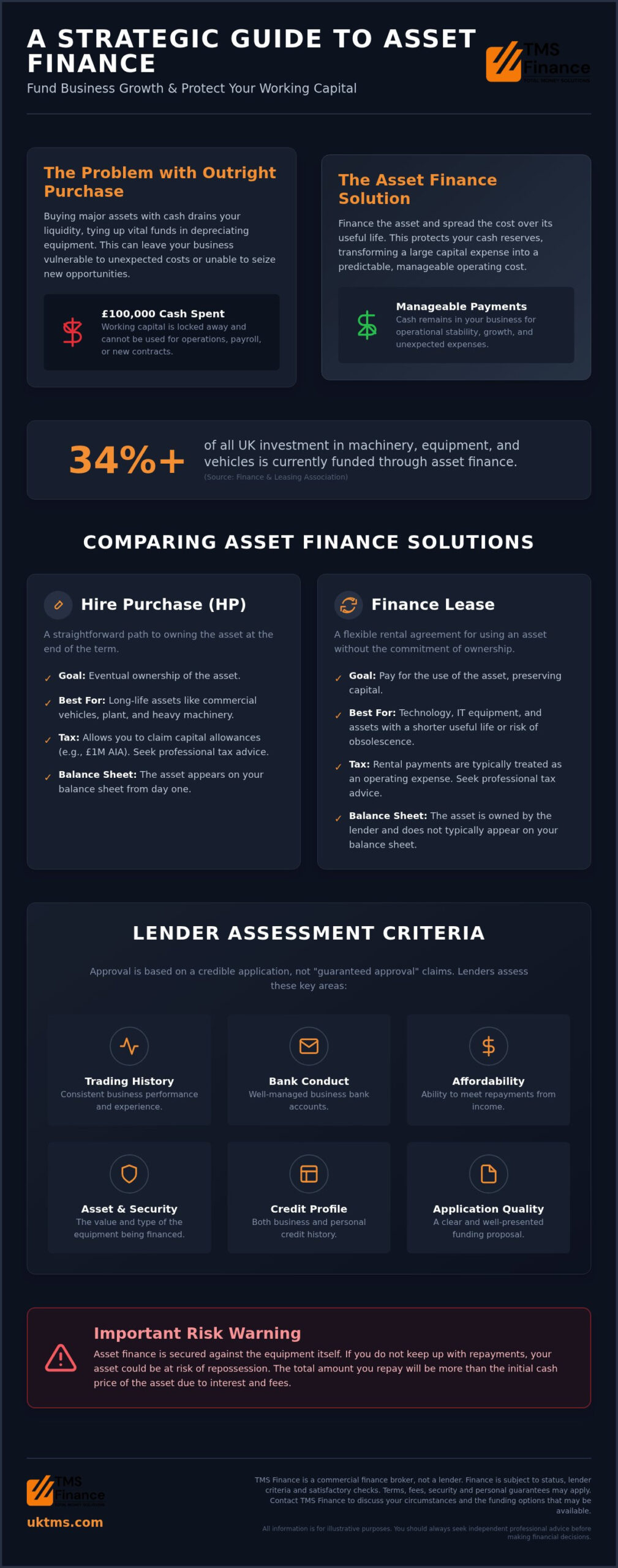
More than 34% of all UK investment in machinery, equipment, and vehicles is currently funded through asset finance, according to the Finance & Leasing Association. For many business owners, the decision to use asset finance solutions is a strategic move to avoid draining vital cash reserves on a single purchase. You probably understand that having the right tools is essential for growth, but the fear of high-street bank rejection or the confusion between hire purchase and leasing can often stall your progress.
Acquiring revenue-generating equipment shouldn’t compromise your financial stability. By matching your repayment structure to the useful life of the asset, you can protect your working capital and maintain a predictable monthly budget. This guide provides a direct, professional overview of how to fund your next project. We’ll examine the different types of funding available, the impact of current tax incentives like the £1 million Annual Investment Allowance, and the steps required to build a credible application that lenders can approve with confidence.
Key Takeaways
- Understand how protecting your cash reserves through asset finance solutions prevents operational crises during contract mobilisation or unexpected equipment failure.
- Compare the benefits of Hire Purchase for eventual ownership against the flexibility of Finance Leasing to determine the most effective structure for your balance sheet.
- Learn the specific criteria UK lenders use to assess applications, including why trading history and bank conduct are more critical than “guaranteed approval” claims.
- Identify the full costs of borrowing, including interest and arrangement fees, while acknowledging that secured assets remain at risk if repayments are not maintained.
- Discover how working with a commercial broker helps identify suitable lenders and packages your application to avoid the pitfalls of random, untargeted outreach.
The Financial Impact of Capital Expenditure on UK SMEs
Buying equipment outright is often a high-risk strategy for UK SMEs. While it avoids interest, it removes liquidity that is vital for survival. If you spend £100,000 on a new fleet, you’ve essentially locked that cash into a depreciating asset. This money cannot be retrieved quickly if your business faces a sudden downturn or a large, unexpected tax bill.
The concept of Asset-based lending allows you to use the value of the equipment itself to secure the funding you need. By choosing asset finance solutions, you maintain a cash buffer. This buffer is critical when you win a new contract and face high mobilisation costs. You might need to hire new staff, buy fuel, and pay for insurance before the project generates its first pound of profit. Without liquid cash, you can’t start the work, even if you have the best equipment in the world.
Delaying essential upgrades also carries a heavy price. Old machinery is prone to breakdown, leading to expensive repairs and project delays. These “hidden” costs often exceed the interest paid on a finance agreement. By securing modern equipment now, you protect your reputation for reliability and safety.
Preserving Working Capital for Operations
Operational stability depends on having cash ready for VAT, payroll, and supplier commitments. When you tie up capital in hardware, you lose the ability to respond to market opportunities. Asset finance keeps your cash available for day-to-day trading, acting as a “safe pair of hands” for your balance sheet. It transforms a massive upfront expense into a manageable operational cost. This ensures that your business remains resilient against the unpredictable nature of the UK economy.
Matching Repayments to Revenue Generation
A primary advantage of finance is the ability to align costs with income. If a new machine increases your output by 20%, the extra profit should ideally cover the finance repayments. This creates a self-funding model where the equipment pays for itself over its useful life. For businesses with seasonal peaks, such as agriculture or retail, some lenders can even structure payments to be higher when revenue is strong and lower during quiet periods. If your requirements extend beyond equipment into site development, exploring Property Finance can provide a more integrated approach to your long-term funding strategy.
Comparing Asset Finance Solutions: HP vs. Leasing
In the realm of real estate, property investors often seek similar speed and flexibility. Specialist private money brokers like JGL Capital LLC can assist with fast, asset-backed commercial loans, providing the capital necessary to move quickly on investment opportunities.
Choosing the right funding structure depends on your long term goals for the equipment. Some businesses want eventual ownership, while others prefer to pay only for the use of the asset. Selecting the wrong facility can lead to tax inefficiencies or technical obsolescence. Data from 2025 indicates that 68% of all SME lending came from challenger banks and specialist non-bank lenders. This shift highlights why exploring a variety of asset finance solutions through a broker is often more productive than approaching a single high-street bank.
For a broader perspective on how these facilities differ, the British Business Bank’s guide to asset finance offers a detailed breakdown of market standards and regulatory expectations. It’s vital to remember that TMS Finance is a commercial finance broker, not a lender. We help you identify which of these structures aligns with your operational requirements. If you are ready to evaluate your options for specific equipment, you can begin a business loan application to see which lenders may be a fit for your circumstances.
Hire Purchase for Long-Term Assets
Hire Purchase (HP) is a straightforward path to ownership. You typically pay an initial deposit and the full VAT amount upfront. The remaining balance is paid in fixed monthly instalments over a set term, usually between two and five years. Once the final payment and an “option to purchase” fee are settled, you own the asset outright. This makes HP suitable for heavy machinery, commercial vehicles, or plant equipment with long lifespans.
From a balance sheet perspective, the asset appears as a company resource from day one. This allows you to claim capital allowances, such as the £1 million Annual Investment Allowance (AIA) or Full Expensing for qualifying plant and machinery. You should always seek professional tax and accounting advice to confirm how these allowances apply to your specific business. Because the finance is secured against the equipment, your assets are at risk if repayments are not maintained.
Leasing for Flexibility and Technology
Leasing is often the preferred choice for IT and technology finance where equipment dates quickly. A Finance Lease allows you to use the asset for a set period while the lender retains ownership. You pay for the depreciation of the asset rather than the full purchase price. At the end of the term, you can often choose to extend the lease, return the equipment, or sell it to a third party and keep a portion of the proceeds.
Operating leases are even more flexible. These are common for high-value assets like aircraft or specialist medical tools. The lender takes a “residual value” risk, meaning your payments only cover a fraction of the asset’s total cost. This manages the risk of obsolescence, as you can regularly upgrade to the latest technology without the burden of disposing of old hardware. If you already own equipment, asset refinancing can also be used to release capital for other business needs.
Lender Assessment and Eligibility Criteria
Every lender operates with a specific appetite for risk. This is why “guaranteed approval” doesn’t exist in professional commercial lending. When you apply for asset finance solutions, the lender’s primary goal is to ensure you can meet the repayment schedule without putting your business under undue stress. They look for evidence of stability, reliability, and a clear repayment route. If your bank conduct shows frequent unauthorised overdrafts or returned direct debits, it signals a lack of control that most lenders will find difficult to overlook.
The credit profile of both the business and its directors plays a central role. Lenders want to see how you’ve handled credit in the past. They’ll also assess the business’s trading history, typically looking for at least two years of accounts. However, newer firms aren’t necessarily excluded if they can provide strong management information. Industry standards for these assessments are often guided by the Finance & Leasing Association, which ensures that the process remains transparent and fair for business customers.
Key Documents for a Credible Application
A well packaged application is more likely to receive a prompt decision. You’ll generally need to provide the last three to six months of business bank statements, your most recent sets of filed accounts, and a formal quotation for the asset you intend to fund. For fast growing firms, management accounts are vital. These show your current performance rather than data that might be 12 or 18 months old. TMS Finance acts as a “safe pair of hands” by helping you organise these documents into a format that lenders prefer. You can find a detailed checklist within our business loan application portal.
Sector-Specific Funding Considerations
Different sectors require different repayment structures. In agriculture, for example, income is often seasonal. Lenders in this space can sometimes offer “seasonal repayments” that align with harvest or livestock sales. This ensures you aren’t struggling with high monthly costs during lean periods. In construction, the focus is often on heavy plant and commercial fleets. Lenders look for the durability and resale value of the machinery, as this serves as their security. For hospitality, the requirements often involve fit outs and kitchen equipment. These assets depreciate faster, so the finance terms are typically shorter to reflect the useful life of the equipment. Regardless of the sector, it’s important to remember that the secured asset is at risk if you don’t maintain your repayments.
Understanding Costs, Risks and Security Requirements
Securing the right asset finance solutions requires a clear understanding of the total cost of ownership. While the monthly repayment is the most visible figure, it’s composed of several distinct elements. Interest rates are determined by the lender’s assessment of risk and the current Bank of England base rate, which was held at 3.75% in July 2026. Beyond interest, you should account for arrangement fees. These cover the lender’s administrative costs for setting up the facility. If you choose a hire purchase agreement, an “option to purchase” fee is typically charged at the very end of the term to transfer legal ownership to your business.
Finance is a commitment that relies on steady, predictable cash flow. If your business experiences highly volatile revenue or lacks a clear financial forecast, fixed repayments can become a significant burden. Borrowing is not suitable for every situation. In some cases, using existing surplus cash or waiting until the business has more stable earnings may be the safer route. It’s essential to remember that since the finance is secured against the equipment, your assets are at risk if repayments are not maintained.
The Role of Personal Guarantees
Lenders often require a secondary layer of security when funding SMEs. A personal guarantee is a legal promise from a company director to personally settle the debt if the business cannot. This effectively pierces the veil of limited liability. Lenders use this to ensure directors remain fully committed to the repayment schedule. Because this carries significant personal risk, you must seek independent legal advice before signing any guarantee. This ensures you fully understand your obligations and the potential impact on your personal assets if the business defaults.
Asset Repossession and Financial Defaults
Missing payments leads to more than just late fees. If a default occurs, the lender has the legal right to repossess the equipment to recover their funds. This can cripple operations, especially if the asset is a primary revenue generator like a delivery vehicle or production line machinery. A default will also be recorded on your business credit file. This makes it significantly harder and more expensive to secure funding in the future. If you are concerned about meeting future commitments, you should explore alternatives like equity investment or internal restructuring before taking on new debt.
TMS Finance is a commercial finance broker, not a lender. Finance is subject to status, lender criteria and satisfactory checks. Terms, fees, security and personal guarantees may apply. Contact TMS Finance to discuss your circumstances and the funding options that may be available.
How TMS Finance Supports Your Funding Requirement
Finding the right lender requires more than just a list of names. It requires a methodical approach to identifying which funder has the specific appetite for your sector and asset type. TMS Finance operates as a commercial broker, not a lender. We act as a “safe pair of hands” for your business, ensuring that your request for asset finance solutions is presented to the most suitable parties. This targeted strategy is far more effective than the random outreach common in the market, which can lead to unnecessary credit footprint marks and repeated rejections.
Our role is to provide a clear explanation of commercial terms before you commit to any agreement. This includes a transparent breakdown of interest, fees, and the specific security requirements mentioned earlier. We maintain a constant flow of communication between your business and the lender, managing the technical service requirements from the initial discussion through to completion. This integrated approach ensures that the funding process is as seamless as possible, allowing you to focus on your core operations.
A Professional Approach to Complex Funding
Every business objective is different. A construction firm needing heavy plant requires a different funding structure than a retail business upgrading its IT infrastructure. As a member of the National Association of Commercial Finance Brokers (NACFB), TMS Finance brings a high level of technical expertise to every case. We take the time to understand the logistical challenges you face and present your case clearly to funders who understand those specific risks. This bespoke packaging is especially vital for younger firms or those in high-risk environments where precision is non-negotiable.
We don’t just facilitate a transaction; we act as an extension of your own team. By maintaining rigorous safety and compliance standards in our documentation, we instill immediate confidence in lenders. This professional alignment helps in securing terms that reflect the true strength of your business performance rather than just a credit score. We focus on providing solutions rather than just services, ensuring your application is compliant with lender expectations from the start.
Next Steps for Your Business
The first step is a clear evaluation of the amount you need and the specific revenue-generating potential of the asset. You should consider how the equipment fits into your long-term growth plans and whether the projected income will comfortably cover the repayments. Once you have a clear objective, you can explore our products to see the range of facilities we support. Speaking to a broker early in the process allows for a preliminary assessment of lender fit, helping you avoid the consequences of delay or poorly structured finance.
TMS Finance is a commercial finance broker, not a lender. Finance is subject to status, lender criteria and satisfactory checks. Terms, fees, security and personal guarantees may apply. Contact TMS Finance to discuss your circumstances and the funding options that may be available.
Strategic Funding for Long-Term Operational Stability
Acquiring essential equipment shouldn’t mean risking your company’s liquidity. Matching a finance structure to the useful life of your assets ensures the machinery pays for itself through the revenue it generates. This protects your cash reserves for day-to-day trading and unexpected operational costs.
As an NACFB member, TMS Finance provides no-nonsense professional guidance to help UK SMEs identify a suitable lender fit. We focus on packaging your application to meet specific criteria, helping you avoid untargeted outreach. Choosing the right asset finance solutions is a strategic move that allows you to scale safely while maintaining control over your financial commitments.
Evaluating your funding options now prevents cash flow crises during your next growth phase. We are ready to act as your safe pair of hands in the commercial finance market, helping you move forward with confidence and clarity.
TMS Finance is a commercial finance broker, not a lender. Contact TMS Finance to discuss your circumstances and the funding options that may be available.
Frequently Asked Questions
Can I get asset finance for used machinery or vehicles?
Yes, asset finance solutions are frequently used to fund second-hand machinery, commercial vehicles, and plant equipment. Lenders will assess the age, condition, and remaining useful life of the asset to ensure it provides sufficient security for the duration of the finance term. While new equipment often qualifies for different rates, funding used assets is a practical way for many businesses to acquire high-quality hardware while protecting their working capital.
How much deposit is typically required for asset finance?
Most lenders typically require an initial deposit of 10% to 20% of the asset’s purchase price, along with the full VAT amount upfront. The exact figure depends on your business’s credit profile, the type of equipment being funded, and the lender’s specific assessment. In some cases, established businesses with strong financial performance may be eligible for lower deposit requirements, while younger firms might need to provide a larger initial contribution to secure the facility.
How long does the asset finance application process take?
The time it takes to complete an application depends entirely on the complexity of the case and the specific lender’s internal processes. Some straightforward applications for standard vehicles can be approved within 24 to 48 hours if all documents are ready. However, complex requests for specialist machinery may take several weeks. Providing a complete set of bank statements, accounts, and asset quotations at the start is the most effective way to prevent unnecessary delays.
Can a new business with limited trading history apply?
Funding options may be available for younger companies, though the assessment process is often more rigorous. Lenders may look for director experience in the industry or request additional security, such as personal guarantees, to mitigate the risk of limited trading history. Providing detailed management accounts and a clear business plan can help demonstrate affordability and a reliable repayment route, making it easier for lenders to consider the application despite a shorter track record.
What is the difference between a broker and a lender?
A lender provides the actual capital and manages the repayment schedule, whereas TMS Finance is a commercial finance broker. Our role is to understand your specific funding requirement and identify a possible lender fit from the options available to us. We help package your application and support you through the process, ensuring your case is presented clearly to funders who have a specific appetite for your sector and asset type.
TMS Finance is a commercial finance broker, not a lender. Contact TMS Finance to discuss your circumstances and the funding options that may be available.