

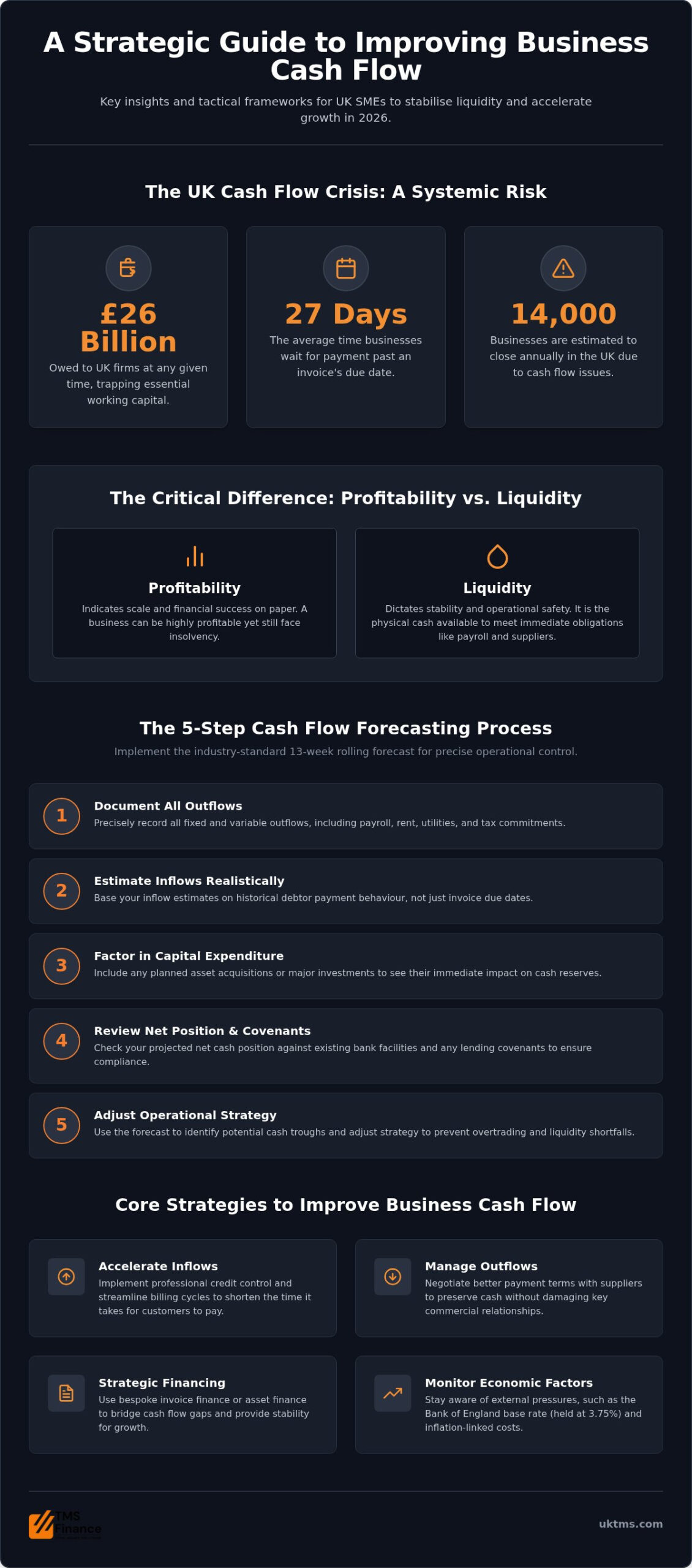
Nearly half of all SME invoices in the UK are currently overdue, with businesses waiting an average of 27 days past their due dates to receive payment. This delay isn’t just an administrative hurdle; it’s a systemic risk that contributes to the closure of approximately 14,000 businesses every year. When £26 billion is owed to UK firms at any given time, the ability to improve business cash flow becomes a matter of survival rather than just accounting.
You likely recognise the stress of a growing order book that doesn’t reflect in your bank balance. It’s difficult to meet payroll or satisfy supplier obligations when your working capital is trapped in unpaid invoices. This lack of financial clarity makes it hard to plan for the future with any certainty. Delaying a fix to your payment cycles often leads to missed growth opportunities or, in the worst cases, technical insolvency despite your business being profitable on paper.
This 2026 guide provides the tactical framework you need to stabilise liquidity and accelerate inflows. We’ll examine the impact of the Commercial Payments Bill, explore how asset and invoice finance can bridge gaps, and outline a methodical approach to managing debtors. You’ll gain a clear strategy to secure the bespoke funding your business needs to thrive.
Key Takeaways
- Establish a 13-week rolling forecast to gain immediate operational clarity and predict future liquidity requirements with precision.
- Implement professional credit control and streamlined billing cycles to improve business cash flow by accelerating customer payments.
- Learn how to manage supplier relationships and negotiate payment terms to preserve cash without damaging your commercial reputation.
- Discover how bespoke invoice finance and asset finance can provide the stability needed to support business growth and meet obligations.
- Identify the critical difference between profitability and liquidity to ensure your business remains resilient during periods of rapid expansion.
Understanding the Dynamics of UK Business Cash Flow
Cash flow is the continuous movement of money into and out of your business. It tracks the physical availability of pounds sterling to meet immediate obligations. While turnover indicates scale, liquidity dictates stability. For UK SMEs, maintaining a positive flow is the foundation of operational safety. It ensures you can deploy resources and protect your workforce without the distraction of financial instability.
Identifying bottlenecks is the first step to improve business cash flow. Common hurdles include late payments from customers, rising overhead costs, and seasonal fluctuations in demand. In 2026, many firms still struggle with the lag between completing work and receiving funds. This delay creates a logistical headache that requires methodical planning and proactive management. For medical professionals running their own practices, it is also important to explore Specialist Mortgage Advice to ensure their personal property goals are supported by their professional income structure.
The Profit vs. Liquidity Gap
Many business owners fall into the growth trap by focusing solely on profitability. You can have a record-breaking month of sales but still lack the funds to pay your suppliers or staff. The liquidity gap occurs when the timing of cash outflows for operational expenses precedes the receipt of cash from sales, often intensified during rapid business expansion.
Timing is everything. Quarterly VAT bills and Corporation Tax deadlines can significantly deplete your reserves if they aren’t anticipated. Effective Cash flow forecasting allows you to see these obligations coming. It provides the clarity needed to manage your sales ledger and ensure you have sufficient working capital to remain compliant with HMRC requirements.
External Economic Factors in 2026
The current economic environment presents specific challenges for UK businesses. With the Bank of England base rate held at 3.75%, the cost of commercial debt servicing remains a significant factor in your monthly outgoings. Inflation-linked costs for materials and energy also mean your working capital must stretch further than in previous years.
Maintaining professional standards during volatility requires a safe pair of hands approach. You must monitor how shifts in interest rates affect your existing finance arrangements. A strategic partner can help you evaluate how to improve business cash flow by finding more efficient ways to manage these external pressures. Precision in your financial planning is just as important as precision on a project site, and for those managing diverse financial assets, TradingPRO provides the specialized infrastructure needed to maintain that level of control.
A 13-week rolling forecast is the industry standard for maintaining operational control. It provides a three-month window that’s long enough to spot trends but short enough to remain accurate. By integrating real-time data from cloud accounting software, you remove the guesswork associated with manual spreadsheets. This precision allows you to identify “Red Flag” trends, such as a creeping increase in debtor days, before they escalate into a liquidity crisis.
Professional monitoring requires a dual-speed approach. Weekly reviews allow for tactical adjustments to payments and collections. In contrast, monthly audits provide a strategic overview of your financial health. This methodical structure ensures that you’re always operating from a position of clarity rather than reacting to unforeseen shortages. To truly improve business cash flow, you must move beyond retrospective accounting and start looking forward with confidence.
The 5-Step Forecasting Process
- Step 1: Document all fixed and variable outflows with precision, including payroll, rent, and utility commitments.
- Step 2: Estimate inflows based on historical debtor behaviour. Don’t rely on invoice due dates; use the actual average time customers take to pay.
- Step 3: Factor in planned capital expenditure or asset acquisitions to see their immediate impact on your cash reserves.
- Step 4: Review your net position against existing bank facilities and any lending covenants to ensure total compliance.
- Step 5: Adjust your operational strategy based on the projected cash trough to prevent the risks associated with overtrading.
Scenario Planning and Stress Testing
Static forecasts are often insufficient in a volatile economy. You must ask “What if?” to prepare for unexpected disruptions. Modelling the impact of losing a major contract or a sudden supplier price hike is essential for risk mitigation. For example, calculating how a 10% delay in average payment times affects your ability to meet obligations helps you determine the necessary size of your safety buffer.
Maintaining this buffer is a core component of being a “safe pair of hands” for your business. If your forecast reveals a potential shortfall, acting early is critical to protect your workforce and reputation. Exploring strategic funding options can provide the necessary liquidity to bridge these gaps without compromising your long-term stability or professional standards.
Internal Optimization: Strategies to Accelerate Inflows
Accelerating the receipt of funds is essential to protect your liquidity. Relying on “Net 60” or “Net 90” terms often strains your working capital beyond safe limits. To improve business cash flow, you must treat the accounts receivable process with the same methodical precision as a live project site. This requires a shift from reactive debt collection to a proactive, integrated billing system.
Adopt an “Invoicing on Delivery” standard. Waiting until the end of the month to process billing adds unnecessary lag to your cash cycle. Professional credit control should be firm but collaborative. It’s about maintaining strong commercial relationships while ensuring total compliance with your agreed payment terms. When customers understand that your billing process is rigorous, they’re more likely to prioritise your invoices.
Technology plays a critical role in reducing manual errors. Automated reminders ensure that follow-ups occur the moment a payment becomes overdue. In the current high-interest environment, early payment incentives are a strategic tool. Offering a small discount for settlement within seven days often costs less than the interest on a commercial loan or the hidden cost of a stretched overdraft. It provides immediate liquidity that you can redeploy into operations.
Modernising the Accounts Receivable Process
Standardise your payment terms across your client base. Moving from Net 60 to Net 30 where possible provides an immediate injection of liquidity. Ensure your contract terms are clear and declarative to prevent technical disputes that stall payments. Providing clients with seamless payment options through automated portals removes friction and speeds up the transfer of funds into your account. This level of organisation reflects the “safe pair of hands” approach that builds trust with both lenders and customers.
Mitigating the Risk of Bad Debt
Mitigating risk is a core responsibility of any growing SME. Conduct professional credit checks on every new commercial partner before committing resources. Set bespoke credit limits based on external risk assessments rather than optimistic sales targets. You must monitor these limits regularly as economic conditions shift. When debts become aged, involve professional mediation or legal support early. Delaying these actions only increases the risk of a total loss, which can have a devastating impact on your monthly liquidity and long-term stability.
Managing Outflows and Strategic Supplier Relationships
Managing what leaves the business is just as critical as managing what enters. To improve business cash flow, you must apply the same level of safety and planning to your outflows as you do to your operational sites. This involves a methodical review of every expenditure to ensure it supports immediate liquidity and long-term stability. A disciplined approach to outgoings prevents the erosion of your working capital during periods of expansion.
A “Just-in-Time” approach to inventory and resource procurement reduces the amount of capital tied up in unused materials. This strategy requires reliable, collaborative partnerships with your UK suppliers. By aligning your procurement with actual project timelines, you minimise waste and keep your cash accessible for essential obligations like payroll or tax. Building these long-term relationships ensures you remain a priority client when supply chains tighten.
Tactical Negotiation with Suppliers
Negotiating extended payment terms is a standard commercial practice, provided it’s handled professionally. When presenting a case for term extensions during growth phases, provide evidence of your business’s stability and future contract pipeline. This transparency builds trust and positions you as a reliable partner rather than a credit risk. Professionalism in these discussions protects your reputation while providing the breathing space your bank balance requires.
You must balance “Bulk Buy Discounts” against the hidden cost of tied-up capital. While a discount seems attractive, it’s often more beneficial to maintain liquidity than to save a small percentage on materials you won’t use for months. Utilising trade credit effectively acts as a non-interest-bearing form of finance. However, you must manage it carefully to avoid damaging your professional standing or triggering late payment penalties that outweigh the initial benefits.
Optimising Fixed and Variable Costs
Reviewing recurring subscriptions and service contracts for redundancies often reveals significant savings. Consolidating your commercial insurance and utility providers can also reduce monthly outflows through multi-policy discounts or better negotiated rates. Meticulous planning in overhead reduction ensures that every pound spent contributes directly to the business’s operational efficiency. Even small adjustments to variable costs can have a cumulative impact on your monthly liquidity.
Managing these outflows is a continuous process that requires a disciplined approach to financial logistics. If you need to restructure your existing commitments to better support your growth, apply for a business loan to discuss the funding options that may be available to support your working capital needs.
Strategic Financing: Using Asset and Invoice Finance for Growth
Strategic financing provides the external support required to bridge the timing gaps common in UK commerce. While internal optimization is essential, external capital offers the scale needed for sustainable growth. To improve business cash flow, many firms look beyond standard bank facilities to more flexible structures like invoice and asset finance. These tools allow you to deploy capital into project delivery and workforce protection while your sales cycle completes. For businesses considering expansion through acquisition, understanding business acquisition finance options for funding UK company purchases is equally important to ensure that growth ambitions do not create dangerous liquidity gaps in your existing operations.
Invoice Finance vs. Traditional Loans
Invoice discounting and factoring provide immediate access to the value trapped in your sales ledger. Unlike a standard bank loan, these facilities are scalable; as your turnover increases, so does the amount of capital available to you. This flexibility is particularly useful for fast-growing SMEs that face increased pressure on their working capital. Factoring includes a professional credit control service, while invoice discounting allows you to manage your own collections to maintain direct client relationships.
Preserving Capital through Asset Finance
Acquiring high-value commercial assets shouldn’t deplete your cash reserves. Hire Purchase and Leasing allow you to spread the cost of essential equipment over its useful life, reducing the need for large upfront outflows. Asset-backed lending ensures you have the tools required for operational excellence without compromising your monthly liquidity. This methodical approach to procurement keeps your balance sheet resilient and your operations compliant with the latest standards.
Navigating the diverse UK lending market requires a specialist who understands the specific criteria of various providers. TMS Finance acts as a strategic partner, offering professional guidance to help you identify the most suitable funding options from a national pool of lenders. This safe pair of hands approach ensures your financing is sustainable and aligned with your business’s credit profile and affordability. Consult with TMS Finance for a bespoke funding solution to ensure you find the right ways to improve business cash flow during periods of rapid expansion.
Securing Your Business Liquidity for 2026
Establishing a resilient financial foundation in 2026 depends on methodical planning and the strategic deployment of capital. You’ve seen how internal optimizations and robust forecasting provide immediate operational clarity. However, long-term stability often requires the scalable support that only bespoke funding can offer. By integrating these methods, you protect your workforce and maintain total compliance with your financial obligations.
Expertise in complex commercial finance is vital when navigating the diverse UK lending market. TMS Finance offers FCA-regulated professionalism and access to a national UK lending network to help you find the right support for your business. When you take proactive steps to improve business cash flow, you move from reactive management to a position of operational strength. Secure your business liquidity with professional funding from TMS Finance and build the steady foundation your company needs to thrive.
TMS Finance is a commercial finance broker, not a lender. Finance is subject to status, lender criteria and satisfactory checks. Terms, fees, security and personal guarantees may apply. Contact TMS Finance to discuss your circumstances and the funding options that may be available.
Frequently Asked Questions
What is the fastest way to improve business cash flow?
The fastest way to improve business cash flow is often to invoice customers immediately upon the delivery of goods or services. This removes the administrative lag that delays payment cycles. Additionally, implementing an invoice finance facility can provide an immediate cash injection by accessing the value of your outstanding sales ledger. This methodical approach ensures that your working capital remains available for essential operational costs without waiting for customers to settle their accounts.
How does invoice finance help with cash flow management?
Invoice finance bridges the gap between issuing an invoice and receiving payment. It allows a business to access funds tied up in unpaid invoices as soon as they are raised. This provides predictable liquidity, which is essential for meeting payroll and supplier obligations. By converting your sales ledger into immediate cash, you can maintain a steady flow of funds to support growth and ensure total compliance with your own financial commitments.
Is it better to cut expenses or increase sales to fix cash flow?
Fixing cash flow requires a balanced approach. While increasing sales grows the business, it often drains cash initially due to the cost of fulfilment. Cutting non-essential expenses provides an immediate boost to liquidity without increasing operational risk. A disciplined strategy prioritises protecting existing margins and ensuring that every sale is cash-positive. Meticulous planning helps you distinguish between essential investments and redundant outflows that erode your monthly reserves.
What are the main causes of cash flow problems for UK SMEs?
Late payments remain the primary cause of cash flow instability for UK SMEs. Research from 2026 indicates that nearly half of all invoices are overdue, creating significant liquidity gaps. Other common causes include overtrading, where a business grows faster than its available capital, and a lack of accurate forecasting. These factors combine to create a logistical headache that can jeopardise the survival of even the most profitable commercial entities.
How often should a business update its cash flow forecast?
You should review and update your 13-week rolling cash flow forecast at least once a week. This frequency allows you to identify potential shortfalls early and adjust your payment or collection strategies accordingly. Monthly audits are useful for strategic overviews, but weekly monitoring provides the tactical clarity needed for day-to-day operations. This disciplined rhythm ensures you are always operating as a safe pair of hands for your business and workforce.
Can a business be profitable but have no cash?
A business can certainly be profitable on paper while having no physical cash in the bank. This happens because profit is an accounting concept, while cash flow is a physical reality. If your capital is tied up in unpaid invoices or stock, you may struggle to meet immediate liabilities like VAT or staff wages. Managing this liquidity gap is essential to avoid the technical insolvency that can occur during periods of rapid expansion.
What is the role of a commercial finance broker in cash flow management?
A commercial finance broker acts as a strategic partner to find the most suitable funding options from a national pool of lenders. They provide professional guidance on complex facilities like asset and invoice finance to help you improve business cash flow sustainably. By leveraging their expertise and network, you gain access to bespoke lending that supports your specific growth objectives while maintaining total compliance with current financial standards and regulations.
Are there specific UK regulations regarding late payments?
The Late Payment of Commercial Debts Act allows businesses to charge interest on overdue payments. In 2026, the proposed Commercial Payments Bill aims to strengthen these protections by introducing a statutory maximum payment term of 60 days. It also grants stronger enforcement powers to the Small Business Commissioner. Staying informed about these regulations is a core part of professional credit control and helps you protect your business from the impact of late-paying customers.
TMS Finance is a commercial finance broker, not a lender. Finance is subject to status, lender criteria and satisfactory checks. Terms, fees, security and personal guarantees may apply. Contact TMS Finance to discuss your circumstances and the funding options that may be available.
One Response