

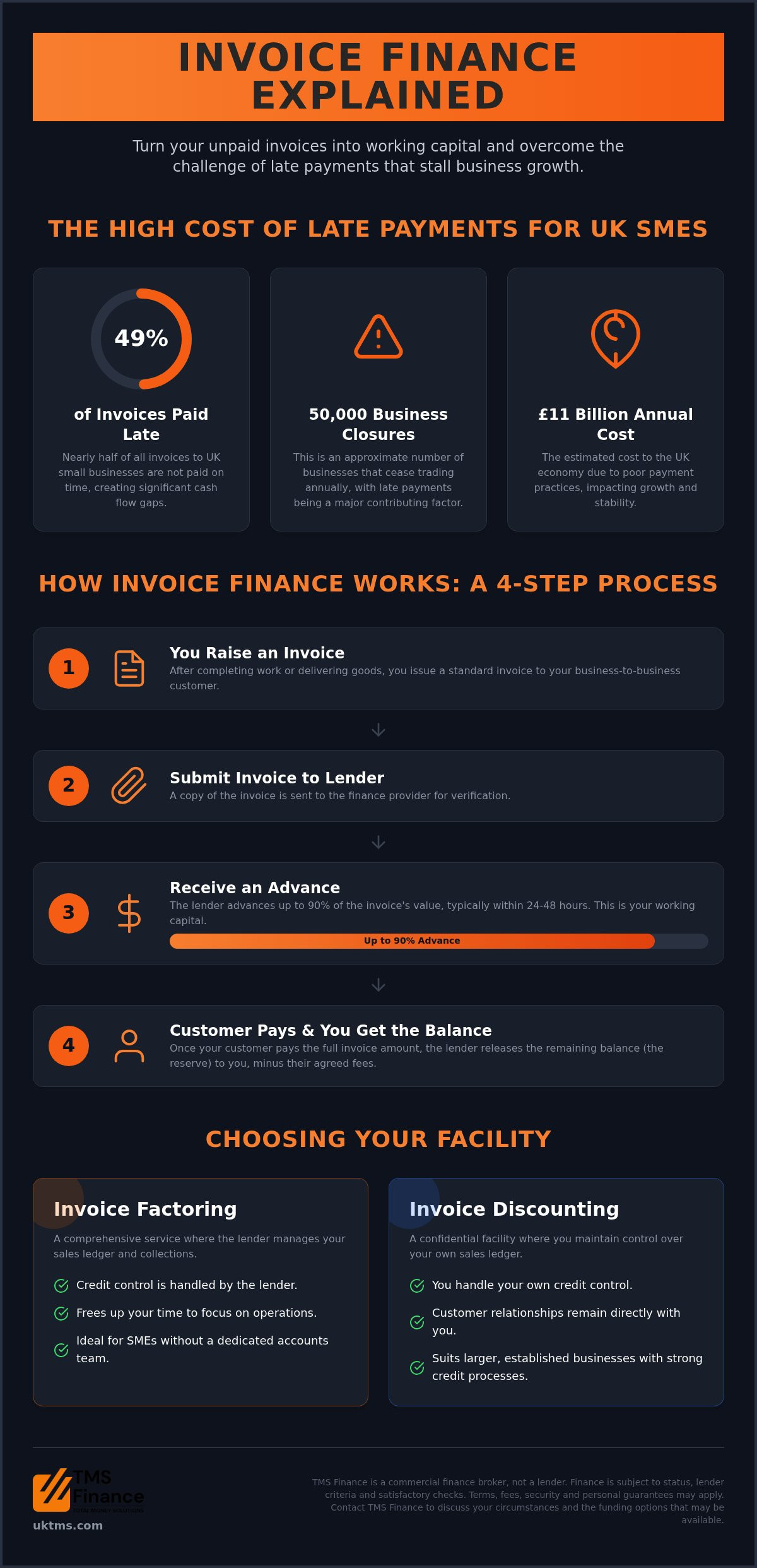
Nearly 49% of all invoices issued to UK small businesses are paid late, a trend that contributes to approximately 50,000 business closures every year. When you’re waiting 60 days or more for a client to settle a bill, the resulting cash flow gap does more than just cause stress. It prevents you from paying your own suppliers on time and often forces you to pass on new, profitable contracts because the working capital isn’t there to support them.
It’s frustrating to see a healthy order book on paper while your bank balance remains stagnant. You shouldn’t have to stall your growth just because a customer is slow to pay for work you’ve already completed. This guide explains how invoice finance acts as a professional bridge for these gaps, allowing you to access the value of your invoices almost as soon as they’re raised.
We’ll examine the different facilities available in 2026, from factoring to discounting, and how new legislation helps protect your cash flow. You’ll learn how to choose a facility that scales with your sales and provides the credit control support your business needs to stay secure.
Key Takeaways
- Identify the financial impact of delayed payments and how they can stall business growth.
- Learn the technical process of using invoice finance to receive up to 90% of your invoice value before your customer pays.
- Understand the eligibility requirements for B2B firms, including how lenders evaluate the quality of your debtor book.
- Gain clarity on the costs involved, from service fees to discount rates, and the security measures lenders require.
- See how TMS Finance helps you prepare a credible application to find a facility that matches your business objectives.
The Financial Impact of Delayed Payments on UK SMEs
In the UK B2B sector, 30, 60, or even 90-day payment terms are standard. However, data shows that nearly half of all invoices are paid late, with SMEs waiting an average of 27 days beyond the agreed due date. This delay isn’t just an administrative nuisance; it costs the UK economy an estimated £11 billion annually and affects 1.5 million businesses. When capital is locked in unpaid invoices, expanding companies often fall into a growth trap. You might be winning more work, but without liquid cash, you cannot fund the materials or labour required to start the next project.
The March 2026 legislation introduced a 60-day cap on payment terms for large firms, but even with these protections, the gap between finishing a job and receiving funds remains significant. If you’re managing multiple large contracts, a single late payment can ripple through your entire supply chain. This illiquidity places your VAT commitments, supplier relationships, and even payroll at risk. Losing a new contract because you lack the mobilisation capital is a common consequence of this cycle, as competitors with better liquidity can deploy staff and resources more quickly.
Identifying the Cash Flow Gap
A business can be profitable on paper but face a total collapse if it cannot meet immediate liabilities. Missing a tax payment or failing to meet payroll has severe consequences for your credit profile and staff retention. While some firms rely on bank overdrafts, these are often unsuitable for long-term delays and can be withdrawn at short notice. Understanding how to manage these periods is essential for improving business cash flow and maintaining operational stability. Using Factoring (finance) or other forms of invoice finance provides a structured way to align your cash inflows with your actual sales volume, rather than relying on a fixed credit limit.
Sector-Specific Cash Flow Challenges
Different industries face unique pressures that make invoice finance a practical tool for stability. In construction and trades, you must often pay for materials and subcontractors long before the main contractor settles your application for payment. This sector frequently experiences the longest delays, making it difficult to maintain a consistent workforce. Recruitment firms face a different challenge, needing to bridge the gap between weekly payroll for temporary staff and monthly or quarterly payments from their clients. For wholesalers and distributors, the challenge lies in funding new stock before the previous shipment’s revenue has arrived. In each of these scenarios, the inability to access cash tied up in your ledger prevents you from taking on larger, more profitable opportunities. Property developers face a similar challenge, where invoice finance can help bridge cash flow gaps during a build — though larger schemes may also require dedicated commercial property development finance to fund the full project lifecycle.
Understanding Invoice Finance: How It Works and Main Types
Invoice finance is a facility that allows you to borrow against the value of your outstanding sales invoices. It effectively turns your accounts receivable into immediate working capital. Unlike a traditional term loan with a fixed limit, this facility is flexible. As your sales volume and turnover increase, the amount of funding available to your business grows automatically. It’s a strategic tool for firms that need their cash flow to keep pace with their growth.
The process follows a logical sequence. First, you raise an invoice for completed work or delivered goods. You send a copy of this invoice to the lender, who then advances a percentage of its value. According to the British Business Bank guide to invoice finance, lenders typically advance between 70% and 95% of the invoice value, with 80-90% being the market average. The remaining balance, known as the reserve, is held by the lender until your customer pays the invoice. Once the payment is settled, the lender releases the reserve to you, minus their agreed fees.
This structure provides a “safe pair of hands” for your cash flow management. It ensures that the capital you’ve already earned isn’t trapped in your ledger for 60 or 90 days. If you’re ready to see how this could work for your specific ledger, you can start an application to review potential options.
Invoice Factoring vs. Invoice Discounting
Factoring is a comprehensive service that includes professional credit control. The lender manages your sales ledger and handles the collection of payments from your customers. This is often a practical solution for smaller businesses that lack a dedicated internal accounts team. It allows you to focus on operations while the lender ensures your debts are collected efficiently.
Invoice discounting is a more hands-off approach. You maintain your own credit control and collect payments from your customers as usual. This facility is typically used by larger, more established companies that already have robust internal administrative systems in place. It provides the same cash flow benefits as factoring but leaves you in full control of your customer relationships.
Disclosed vs. Confidential Facilities
A disclosed facility means your customers are aware that a lender is involved. This is standard in most factoring agreements, where the lender’s name appears on your invoices. In contrast, a confidential facility keeps the arrangement private. Your customers pay into a trust account held in your business name, so they’re unaware you’re using finance. Confidentiality is often preferred by firms that want to maintain a specific brand image, though lenders may require more detailed financial reporting to manage the increased risk.
Assessing Eligibility and Lender Requirements
Securing invoice finance depends on several factors, but the primary requirement is that your business operates on a B2B basis. Lenders need to see that you provide goods or services to other businesses or government bodies on credit terms. Most providers also look for a minimum annual turnover, though this threshold varies significantly between traditional banks and specialist lenders. Unlike unsecured loans, the lender’s risk is mitigated by the value of your sales ledger, which often makes this facility accessible to younger companies with a limited trading history.
Lenders will scrutinise your debtor book to assess the “concentration limit.” This refers to how much of your total debt is owed by a single customer. If one client represents 50% or more of your ledger, a lender may see this as a higher risk. They also require verifiable invoices. This means the work must be completed, the goods delivered, and the payment terms clearly defined in a written contract or purchase order. Pro-forma invoices or stage payments in certain industries may require specialist facilities to be eligible for funding.
Key Documents for a Credible Application
To present a credible case to a lender, you must provide accurate financial records. The most critical documents are your aged debtor and creditor reports. These show exactly who owes you money and how long those payments have been outstanding. Accuracy here is non-negotiable; any discrepancies can lead to a rejection during the audit phase. You will also need recent business bank statements, management accounts, and director identification. Preparing these documents in advance ensures the process remains methodical and structured. If you’re ready to gather these details, you can start your business loan application online.
Factors That Influence Lender Decisions
Approval is not based solely on your own credit profile. Lenders also evaluate the creditworthiness of your customers, as they are the ones ultimately settling the debt. They will look at your trading history and the nature of your industry to determine if the debt is “collectable.” For example, sectors with high dispute rates or complex contractual obligations may face stricter criteria. Lenders also consider your existing borrowing to ensure that a new facility is affordable and doesn’t conflict with current security arrangements, such as an existing debenture held by your bank.
Managing Costs, Security, and Potential Risks
Understanding the cost structure of invoice finance is essential for maintaining your profit margins. Lenders typically split their charges into two distinct parts: the service fee and the discount rate. The service fee covers the administration of the facility and, in the case of factoring, the cost of credit control. This is usually charged as a percentage of your turnover. The discount rate is the interest charged on the funds you actually draw down, which is often pegged to the Bank of England base rate.
Security is a standard requirement in commercial lending. Most providers will secure the facility with an all-assets debenture over the company. It’s also common for directors to be asked for personal guarantees. You must understand that if repayments are not maintained, any secured property or business assets could be at risk. This is why a methodical approach to choosing a facility is necessary to ensure the costs and security requirements align with your business’s financial health.
When Invoice Finance May Not Be Suitable
This type of funding is specifically designed for B2B transactions. If your business model involves a high volume of small B2C sales, such as a retail shop or an e-commerce site, you won’t have the debtor book required to secure the facility. Similarly, firms with poor internal accounting or those that cannot provide verifiable proof of delivery will struggle to meet lender criteria. If your business already has significant existing debt, a new lender might be unable to take the necessary security, making the facility unavailable.
Sensible Alternatives to Consider
If your business doesn’t fit the criteria for invoice finance, other funding routes may be more appropriate. Unsecured business loans are often a better fit for fixed-term growth projects where you don’t want to tie up your sales ledger. For smaller, ad-hoc cash flow needs, a revolving credit facility allows you to draw down funds only when required. Retail and hospitality businesses often find merchant cash advances more suitable, as repayments are linked directly to card machine sales. You can learn more about these options in our Business Loan Guide.
TMS Finance is a commercial finance broker, not a lender. Finance is subject to status, lender criteria and satisfactory checks. Terms, fees, security and personal guarantees may apply. Contact TMS Finance to discuss your circumstances and the funding options that may be available.
Navigating the Funding Process with TMS Finance
TMS Finance operates as a commercial finance broker, acting as a strategic partner to help you identify suitable funding routes. When you’re managing complex cash flow gaps, the priority is finding a facility that aligns with your specific operational needs. Our role involves understanding your business objectives first, whether that’s mobilising for a large infrastructure project or simply stabilising your monthly working capital. We evaluate the available options and help you determine which type of invoice finance or alternative facility is most appropriate for your current situation.
The TMS Finance Assessment Process
Our process is methodical and highly structured. It begins with an initial discussion to define your funding purpose and required timing. We then assist with document collection, ensuring that your financial information is presented in a credible manner to potential lenders. This includes reviewing your aged debtor reports and management accounts to identify any potential hurdles before an application is submitted. Finally, we present your case to lenders whose criteria align with your business profile, ensuring a clear line of communication through to completion.
Why Professional Guidance Matters
Professional guidance ensures that you only engage with providers likely to support your sector and business model. Randomly approaching multiple lenders can negatively impact your credit profile and lead to unnecessary delays. We focus on your long-term business objective rather than just a specific finance product. This approach allows us to explain the commercial terms and security obligations clearly before you make a commitment. By acting as an extension of your team, we help you manage the logistical headache of funding so you can stay focused on project delivery.
Before any agreement is finalised, we ensure you understand the ongoing obligations of the facility. This includes the reporting requirements and how the lender will interact with your customers. Transparency is vital for maintaining your brand reputation and ensuring the finance remains a supportive tool rather than an administrative burden. If you’re ready to review your options, you can explore our full range of finance products or start a formal business loan application today.
TMS Finance is a commercial finance broker, not a lender. Finance is subject to status, lender criteria and satisfactory checks. Terms, fees, security and personal guarantees may apply. Contact TMS Finance to discuss your circumstances and the funding options that may be available.
Securing Your Business Cash Flow for 2026
Managing cash flow effectively is about maintaining total operational control. Waiting for client payments shouldn’t prevent you from meeting your own commitments or winning new work. By using invoice finance, you align your working capital with your actual sales volume. This ensures that your business has the liquidity it needs to deploy resources and workforce effectively without the stress of a stagnant bank balance.
TMS Finance acts as a specialist UK commercial finance broker and a proud NACFB member. We provide national coverage for UK SMEs, helping you package applications for a credible presentation to lenders. Whether you’re in construction, recruitment, or wholesale, our goal is to find a facility that supports your growth. Taking proactive steps to stabilise your finances now allows you to focus on your long-term objectives with confidence.
TMS Finance is a commercial finance broker, not a lender. Contact TMS Finance to discuss your circumstances and the funding options that may be available.
Frequently Asked Questions
What is the difference between recourse and non-recourse invoice finance?
Recourse invoice finance is the most common arrangement where your business remains liable if a customer fails to pay. If an invoice remains unpaid after a set period, the lender will recourse the debt back to you, often by deducting the amount from your available funds. Non-recourse facilities include bad debt protection. In this scenario, the lender assumes the credit risk, protecting your cash flow against customer insolvency, though this typically involves a higher service fee.
Can I use invoice finance if I am a new business with limited trading history?
Yes, funding options may be available for younger companies. Unlike traditional bank loans that rely heavily on years of filed accounts, invoice finance focuses on the creditworthiness of your customers. If you are trading with established B2B clients, lenders are often more willing to provide a facility based on the strength of your sales ledger. This makes it a practical tool for new firms needing to bridge cash flow gaps during the early growth stages.
Will my customers know that I am using an invoice finance facility?
This depends on whether you choose a disclosed or confidential facility. With invoice factoring, the facility is disclosed, and the lender’s details appear on your invoices as they manage the collection process. If you prefer to keep the arrangement private, invoice discounting is typically confidential. Your customers continue to pay you directly into a trust account, and your brand reputation remains unaffected as you maintain full control over your credit management.
How much does invoice finance typically cost for a UK SME?
The total cost for a commercial facility is comprised of two main elements: a service fee and a discount rate. The service fee covers the administration and management of the arrangement, while the discount rate is the interest charged on the funds you draw down. Rates and terms vary by applicant and facility, depending on your turnover and the quality of your debtor book. It is important to review all commercial obligations before making a final decision.
What happens if a customer fails to pay an invoice that has been financed?
If a customer doesn’t pay, the outcome depends on your specific agreement. In a standard recourse facility, you are responsible for the debt, and the lender will usually reclaim the advanced funds from your reserve or future invoices. If you have a non-recourse facility with bad debt protection, the lender or their insurer may cover the loss, provided you have followed all agreed credit limits and reporting procedures correctly. This provides an additional layer of security.
Can I finance single invoices or do I have to finance the whole debtor book?
You have the choice between whole-ledger facilities and selective invoice finance. A whole-ledger facility covers your entire sales book and is generally used for ongoing, consistent working capital. If you only face occasional cash flow gaps, selective or spot finance allows you to fund individual invoices. This provides greater flexibility for businesses that only need to bridge specific contract mobilisation costs or manage seasonal peaks in their trading cycle without committing their entire ledger.
TMS Finance is a commercial finance broker, not a lender. Contact TMS Finance to discuss your circumstances and the funding options that may be available.