

Is your construction project at risk because your funding partner’s criteria don’t match your build timeline? Choosing the wrong development finance lenders often results in more than just high interest rates; it leads to project delays that directly impact your bottom line. You understand that capital is the lifeblood of any development, yet the vast number of specialist lenders in the UK makes it difficult to find a precise fit for your specific project needs.
We agree that the search for funding shouldn’t feel like a gamble with your profit margins. This article provides a clear framework to help you identify the most suitable funding partner for your construction project, whether you’re focused on urban intensification or transport-led schemes. You’ll learn how to maximise leverage while protecting your working capital and gain a clear understanding of total borrowing costs in the current 2026 market.
We’ll examine the different categories of lenders, from traditional banks to the latest non-bank funds, and explain how TMS Finance helps package your application to meet their specific requirements. By the end, you’ll have the technical knowledge needed to secure a facility that supports your project from ground-break to final exit.
Key Takeaways
- Mismatched lender criteria often cause significant construction delays and erode project profitability.
- Different development finance lenders, such as high street and challenger banks, offer varying levels of flexibility and pricing to suit specific project scales.
- Lenders prioritise your previous track record and a viable exit strategy, such as sale or refinance, when reviewing an application.
- Working with a specialist broker ensures your project documentation is packaged professionally to meet specific lender requirements.
- TMS Finance identifies the most suitable funding options by assessing project viability before approaching a range of possible lenders.
The Challenge of Finding Suitable Development Finance Lenders
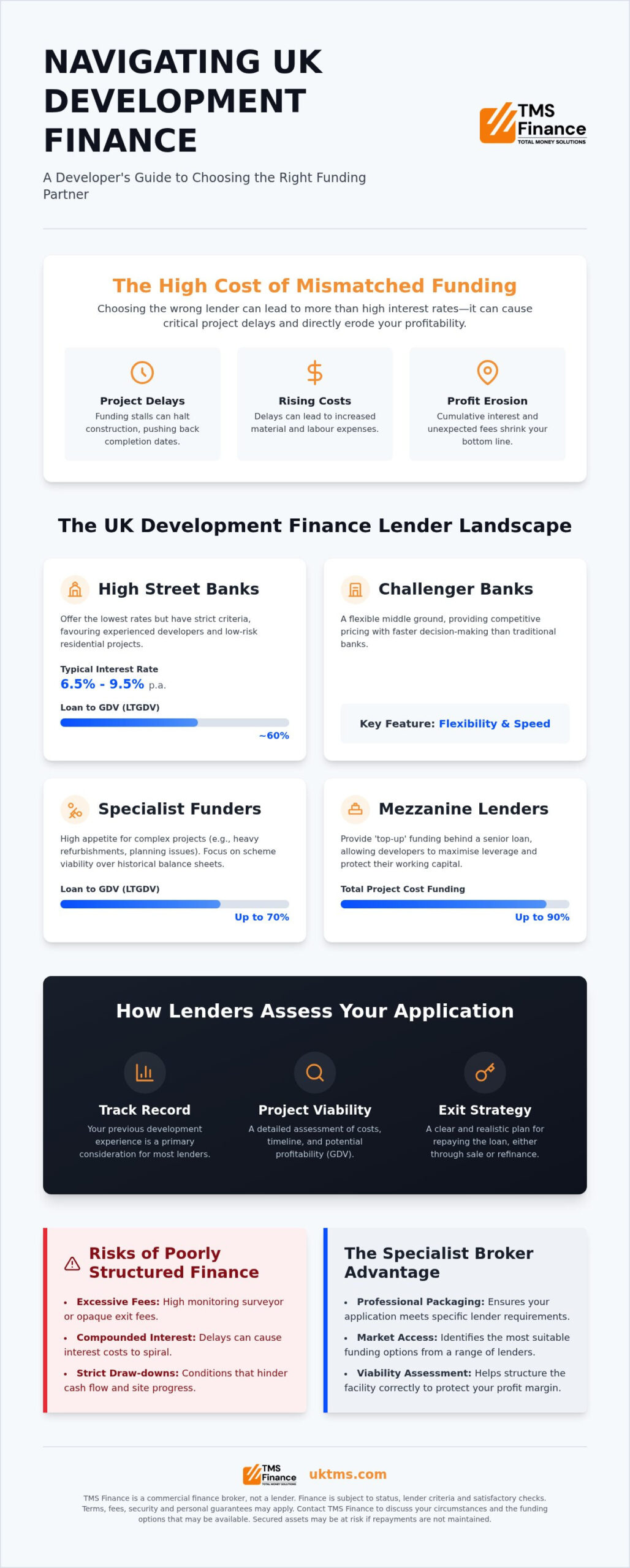
Securing capital for a construction project is rarely a straightforward process. Many developers find that the search for development finance lenders takes significantly longer than anticipated, often leading to critical delays before a single spade hits the ground. These delays aren’t just administrative inconveniences; they have a direct financial impact. When funding stalls, material costs can rise, and skilled labour may move to other sites. A mismatch between a project’s needs and a lender’s specific appetite can result in a total breakdown of the construction timeline.
Choosing a lender whose criteria don’t align with your exit strategy is a common pitfall. If you plan to sell the finished units but the lender requires a rapid repayment that doesn’t account for market absorption rates, you may be forced into an expensive bridging loan. It’s also vital to recognise that debt finance isn’t always the correct solution. For projects with thin margins, the cost of borrowing can quickly turn a potential profit into a loss. In these cases, seeking equity partners or delaying the project may be more responsible than taking on high-interest debt.
Why Traditional Banks Often Decline Development Projects
High-street banks generally prioritise lower-risk lending with established trading histories. Their strict capital requirements and conservative loan-to-cost (LTC) ratios often make them unsuitable for ambitious property projects. This caution leaves a significant funding gap that specialist development finance lenders are designed to fill. For a broader Development finance overview, it’s helpful to understand that these institutions provide the liquidity necessary for projects that don’t fit the rigid boxes of traditional retail banking. Specialist lenders focus more on the project’s viability and the developer’s specific track record rather than just historical balance sheets.
The Risks of Incorrectly Structured Development Finance
An incorrectly structured facility can severely impact your project’s Gross Development Value (GDV). High interest rates are a known factor, but the cumulative effect of compounded interest over a delayed build can be devastating. Beyond the headline rate, developers must be wary of hidden costs. These can include:
- Excessive monitoring surveyor fees
- Opaque exit fees calculated on GDV rather than the loan amount
- Strict draw-down conditions that hinder site progress
Professional guidance is essential to ensure you aren’t over-leveraged. You can view the range of finance products we can source to see how different structures might suit your specific project. Protecting your profit margin requires a lender who understands the logistical realities of UK construction and provides a facility that matches your build schedule.
Types of Development Finance Lenders in the UK Market
The UK market for development finance lenders is broad, ranging from institutional giants to agile private funds. Identifying the right partner requires an understanding of how these entities view risk and capital deployment. Each category of lender serves a specific purpose depending on the project’s scale, the developer’s experience, and the required leverage.
- High Street Banks: These provide the lowest interest rates, typically between 6.5% and 9.5% per annum for standard residential schemes. They prioritse low-risk projects and experienced developers.
- Challenger Banks: These institutions offer a middle ground. They are often more flexible than traditional banks and can provide competitive pricing with faster decision-making processes.
- Specialist Private Funders: These lenders have a high appetite for complex projects, including heavy refurbishments or sites with planning complications. They focus on the viability of the scheme rather than just the borrower’s historical balance sheet.
- Mezzanine Lenders: These provide “top-up” funding that sits behind a senior loan. This allows developers to reach higher leverage, sometimes up to 90% of the total project cost, which protects their own working capital.
High Street vs. Specialist Funding Appetites
High-street lenders often focus on a lower Loan-to-GDV (LTGDV) cap, typically around 60%. In contrast, specialist development finance lenders may stretch this to 70% for high-quality schemes. Speed is a critical differentiator. While a traditional bank committee might take several weeks to approve a facility, private capital can often provide a formal offer in days. High-street banks also maintain rigid sector preferences, often avoiding niche mixed-use projects or certain commercial assets that specialist funders are happy to support. If you need to understand the full range of available finance products, comparing these appetites is the first step.
The Role of Debt Funds and Private Investors
Debt funds operate outside the standard banking regulations that often restrict traditional lending. This freedom allows them to fund developers with limited track records or those tackling difficult brownfield sites. While the interest rates are generally higher than bank debt, the certainty of funding is often greater. They act as a strategic partner for developers who require a dependable “safe pair of hands” to ensure site progress isn’t stalled by liquidity issues. The trade-off for higher costs is often a more bespoke facility that matches the specific rhythm of your construction schedule. If you are ready to explore your options, you can start a finance application to see which lender type fits your project’s profile.
How Lenders Assess Your Development Finance Application
Experience is the primary filter for most development finance lenders. They prioritise applicants who can demonstrate a history of delivering similar schemes on time and within budget. If you’re planning a ten-unit residential build, having a portfolio of successful five-to-ten unit projects makes you a much more credible borrower. Lenders also scrutinise your build costs and Gross Development Value (GDV) to ensure the profit margin is realistic. A robust contingency fund, typically 5% to 10% of the total build costs, is a standard requirement to handle material price fluctuations or unforeseen site issues.
The quality of your exit strategy is equally critical. Lenders need a clear, documented plan for how the loan will be repaid. This usually involves the sale of the units or refinancing onto a long-term commercial mortgage. If the local market shows a slowdown in sales, the lender will expect a viable “Plan B,” such as a refurbishment-to-let bridge. They’ll look for evidence of demand in the specific area, such as recent comparable sales or local rental yields.
Key Financial Metrics Lenders Review
Financial appraisal centres on two main ratios that determine your borrowing capacity. Loan-to-Cost (LTC) defines how much of the actual build and land purchase the lender will cover; this is usually capped at 85% to 90%. Loan-to-GDV (LTGDV) is the final ceiling, representing the total loan amount relative to the project’s finished value. Most lenders limit this to 65% or 70%. Interest is often “rolled up” or retained, meaning you don’t make monthly payments. Instead, the total interest is added to the loan and settled at the end. However, the lender still assesses your ability to service the debt if the project overruns.
Security and Personal Guarantee Requirements
Almost all development funding is secured against the project itself. The lender will take a first legal charge over the land and any existing buildings. In addition to this asset security, most development finance lenders require Director’s Personal Guarantees (PGs). This ensures that the individuals behind the company are personally committed to the project’s success and provides the lender with additional recourse.
You must understand the implications of these security requirements. Secured property or assets are at risk if repayments are not maintained. If the project fails to meet its obligations, the lender has the legal right to seize the security to recover their funds. Personal guarantees also mean your private assets could be used to settle any shortfall. Professional advice is strongly recommended before you commit to any secured facility.
Preparing for a Credible Application to Development Lenders
A successful application depends on more than just a good site. Credibility is established through meticulous preparation and the presentation of a professional dossier. While some automated platforms promise instant results, development finance lenders require a comprehensive understanding of the project’s risks and rewards before they commit capital. A commercial broker acts as an essential extension of your team. They help package complex project information into a format that meets specific credit committee requirements, ensuring your application doesn’t stall due to missing data.
Lenders prioritse the “who” as much as the “what”. You must present a clear professional CV for your development team, including architects, contractors, and project managers. Highlighting their previous successful collaborations demonstrates that the project is in a safe pair of hands. This level of detail helps move your application past the initial screening and into the formal appraisal phase. It shows the lender that you’ve planned for technical precision and site safety from the outset, which is a significant factor in their risk assessment.
Essential Documentation for Development Funding
You can’t secure funding without a complete set of project documents. Most lenders won’t consider a site without full planning permission already in place. Your application should include granular build schedules and professional appraisals that justify your cost estimates. Evidence of building regulations compliance and structural warranties is also required for residential schemes. Financial records are mandatory; expect to provide recent bank statements, company accounts, and tax returns to prove the stability of the borrowing entity. This transparency builds trust and helps the lender assess the project’s overall viability.
The Importance of a Realistic Exit Strategy
Repayment is the lender’s primary concern. You must provide evidence of local market demand for the finished units to prove your exit strategy is realistic. This typically involves comparing sale and refinance options. If you intend to sell, include recent comparable sales data from the immediate area. Lenders look for market absorption rates to ensure you aren’t over-optimistic about how quickly units will sell. If you plan to retain the property, you must demonstrate that a long-term commercial mortgage can cover the development debt. Providing multiple credible repayment routes increases your chances of approval. You can learn more about property finance options to see which strategy aligns with your long-term goals.
Why Speak to TMS Finance About Development Funding?
TMS Finance is a commercial finance broker, not a lender. This distinction is vital for developers who need a professional advocate in a complex market. Instead of managing multiple direct relationships, you work with a partner that understands the specific entry requirements of various development finance lenders. We focus on identifying a possible lender fit from a range of available options. This ensures your project is presented to funders who already have a documented appetite for your specific sector, whether it’s residential, mixed-use, or commercial development.
We provide a methodical alternative to random outreach. Approaching lenders without understanding their current credit limits often leads to wasted time and missed opportunities. By understanding your desired outcome first, we help you avoid mismatched criteria that cause project delays. Our role involves a clear explanation of commercial terms, obligations, and risks. We ensure you understand the impact on your cash flow and total borrowing costs before you commit to a facility agreement.
The Value of Professional Brokerage Support
We support you in presenting complex requirements clearly to specialist funders. These lenders often require technical data and granular documentation that can be overwhelming to package. We provide guidance on the specific information and documents needed for a credible application, from detailed cost schedules to professional CVs of your build team. This structured approach mirrors the precision required in high-risk construction environments. It gives development finance lenders the confidence they need to deploy capital, knowing the project is being managed by a professional team with a clear plan.
Our focus remains on your business objective. We don’t just look at the headline interest rate; we assess how the facility structure affects your working capital and project milestones. This professional brokerage approach ensures that your funding is a strategic asset rather than a logistical headache. We act as a “safe pair of hands,” helping you navigate the requirements of the UK’s specialist lending market with technical expertise and a focus on project safety.
Next Steps for Your Property Project
If you have a project ready for appraisal, the next step is a direct conversation about your requirements and timing. You’ll need to explain your funding purpose, the current status of your planning permission, and the specific amount required to reach your project milestones. We’ll review your project viability and help you identify the most appropriate funding routes available in the current 2026 market.
TMS Finance is a commercial finance broker, not a lender. Finance is subject to status, lender criteria and satisfactory checks. Terms, fees, security and personal guarantees may apply. Contact TMS Finance to discuss your circumstances and the funding options that may be available.
Securing the Right Funding Partner for Your Project
Successful property development in 2026 requires a funding structure that matches your build timeline and exit strategy. You’ve seen that the UK market offers diverse options, from challenger banks to specialist private funds. Evaluating the range of available development finance lenders is a technical challenge that demands precision and a clear understanding of total borrowing costs.
As an NACFB member brokerage with national UK coverage and specialist property finance expertise, TMS Finance provides the professional support needed to package your application effectively. We help you identify a possible lender fit, ensuring your project is presented to funders with the right criteria for your specific construction needs. Taking the time to structure your finance correctly today protects your profit margins and ensures site progress remains steady.
We are ready to help you move your project forward with confidence.
TMS Finance is a commercial finance broker, not a lender. Finance is subject to status, lender criteria and satisfactory checks. Terms, fees, security and personal guarantees may apply. Contact TMS Finance to discuss your circumstances and the funding options that may be available.
Frequently Asked Questions
What is the typical interest rate for development finance lenders in 2026?
Typical interest rates for standard residential projects by experienced developers currently range from 6.5% to 9.5% per annum. For more complex schemes or borrowers with limited track records, rates can reach up to 13% per annum. These figures depend on the lender’s risk assessment, the project’s specific metrics, and the current Bank of England base rate. All funding is subject to status and lender criteria. You should seek professional advice before committing to a facility.
Can I get development finance with no previous experience?
Securing funding without a track record is difficult but possible through certain specialist development finance lenders. You will likely need to partner with an experienced contractor or project manager to mitigate the lender’s risk. Expect lower leverage and higher interest rates compared to established developers. Lenders will scrutinise your professional team’s CVs to ensure the project is in a safe pair of hands. This helps move your application past the initial screening phase.
How much deposit do I need for a development finance loan?
Most lenders require you to contribute between 10% and 15% of the total project costs. While some facilities fund up to 90% of the build and land purchase, the Loan-to-GDV cap, usually around 65% to 70%, often limits the total borrowing. You will need sufficient cash reserves to cover this equity gap and a contingency fund. Protecting your working capital is essential, so understanding these leverage limits early helps in planning your project’s cash flow.
Do development finance lenders require a personal guarantee?
Yes, most development finance lenders require a Director’s Personal Guarantee as part of the security package. This ensures that the individuals behind the borrowing entity are personally committed to the project’s completion. In addition to the legal charge over the property, a personal guarantee means your private assets could be at risk if the loan is not repaid. You should seek independent legal and financial advice before signing any documents that involve personal liability.
How long does it take to secure a development finance offer?
The timeline to secure a formal offer depends on the project’s complexity and the lender’s internal processes. While some specialist funders provide indicative terms within 48 hours, a full credit approval usually takes two to four weeks. This period involves property valuations, legal due diligence, and a review of your planning documents. Working with a broker helps speed up this process by ensuring all required evidence and documentation are prepared correctly from the start.
TMS Finance is a commercial finance broker, not a lender. Contact TMS Finance to discuss your circumstances and the funding options that may be available.