

A technically perfect build plan doesn’t guarantee funding if the financial structure isn’t equally robust. Many developers find that securing commercial property development finance is often more challenging than the construction itself. It’s frustrating to watch a viable project stall because of cash flow gaps or rigid lender requirements that don’t account for the realities of speculative builds.
You likely understand that the cost of capital and the speed of delivery are your two biggest variables. A delay in funding doesn’t just push back your completion date; it erodes your profit margins and increases your exposure to market shifts. This guide provides the clarity you need to secure the capital required for commercial builds. We’ll show you how to satisfy complex eligibility criteria and manage the inherent risks of high-stakes property projects.
We’ll break down the total cost of borrowing, from arrangement fees to exit strategies, so you can budget with precision. You’ll also learn how to identify a lender that matches your specific project profile; whether you’re working on an industrial warehouse or a mixed-use development. By the end of this guide, you’ll have a professional framework for packaging your application and protecting your investment.
Key Takeaways
- Learn how to bridge capital gaps that cause project delays and understand why development finance is a vital short-term solution for commercial builds.
- Discover how lenders use loan-to-cost and gross development value metrics to calculate your borrowing capacity; this ensures you have enough capital for every construction stage.
- Understand the eligibility criteria for commercial property development finance, including the importance of a detailed cost schedule and a clear build programme.
- Review the impact of arrangement fees and interest on your total facility, noting that secured property is at risk if you do not maintain repayments.
- Find out how professional brokerage helps you identify a suitable lender fit from available routes rather than relying on a single bank’s criteria.
Overcoming Funding Gaps in Commercial Property Projects
Project delays are rarely just about scheduling; they’re about liquidity. When a site sits idle, the financial impact is immediate and compounding. You face rising contract mobilisation costs, increased interest on existing debt, and the potential loss of skilled labour as contractors move to more reliable projects. A lack of capital at a critical junction doesn’t just stall progress; it threatens the entire viability of the build.
Commercial property development finance provides a structured solution to these cash flow bottlenecks. It’s a short-term funding facility, typically lasting between 12 and 24 months, designed to cover the purchase of land and the subsequent construction costs. Unlike a standard term loan, this facility is built around the future value of the finished asset, allowing you to borrow against the potential of the project rather than just your current balance sheet.
Traditional business loans often fail to meet the specific requirements of a large-scale build. They usually require monthly interest payments from day one, which can drain your working capital before the site even reaches ground level. Development finance is more flexible; it allows interest to be rolled up into the loan facility. This means your cash remains available for site operations, with the debt being settled once the property is sold or transitioned to a long-term commercial mortgage.
The Challenge of Staged Construction Costs
Construction isn’t a single expense; it’s a series of escalating financial commitments. If your funding isn’t synchronised with your build programme, you risk a mid-build halt. The Real estate development process depends on a steady flow of capital to meet material and labour obligations. Development finance manages this through staged drawdowns, where funds are released in arrears following a site inspection by a monitoring surveyor. This methodical approach ensures that you only pay interest on the money you’ve actually used, while protecting your working capital for unexpected site costs or utility delays.
Acquisition vs. Development Funding
Acquiring a site and building it out require different financial strategies. A site purchase often needs to happen quickly, sometimes before a full construction firm is appointed or planning is finalised. If you’re buying land without planning permission, the risk is higher and funding options are more restricted. Once permission is secured, the site’s value increases, which can be used as leverage for the build-out phase. In cases where you need to secure a site immediately but aren’t ready to start the build, bridging finance may be a more suitable short-term alternative to cover the initial purchase.
Understanding the Mechanics of Development Funding
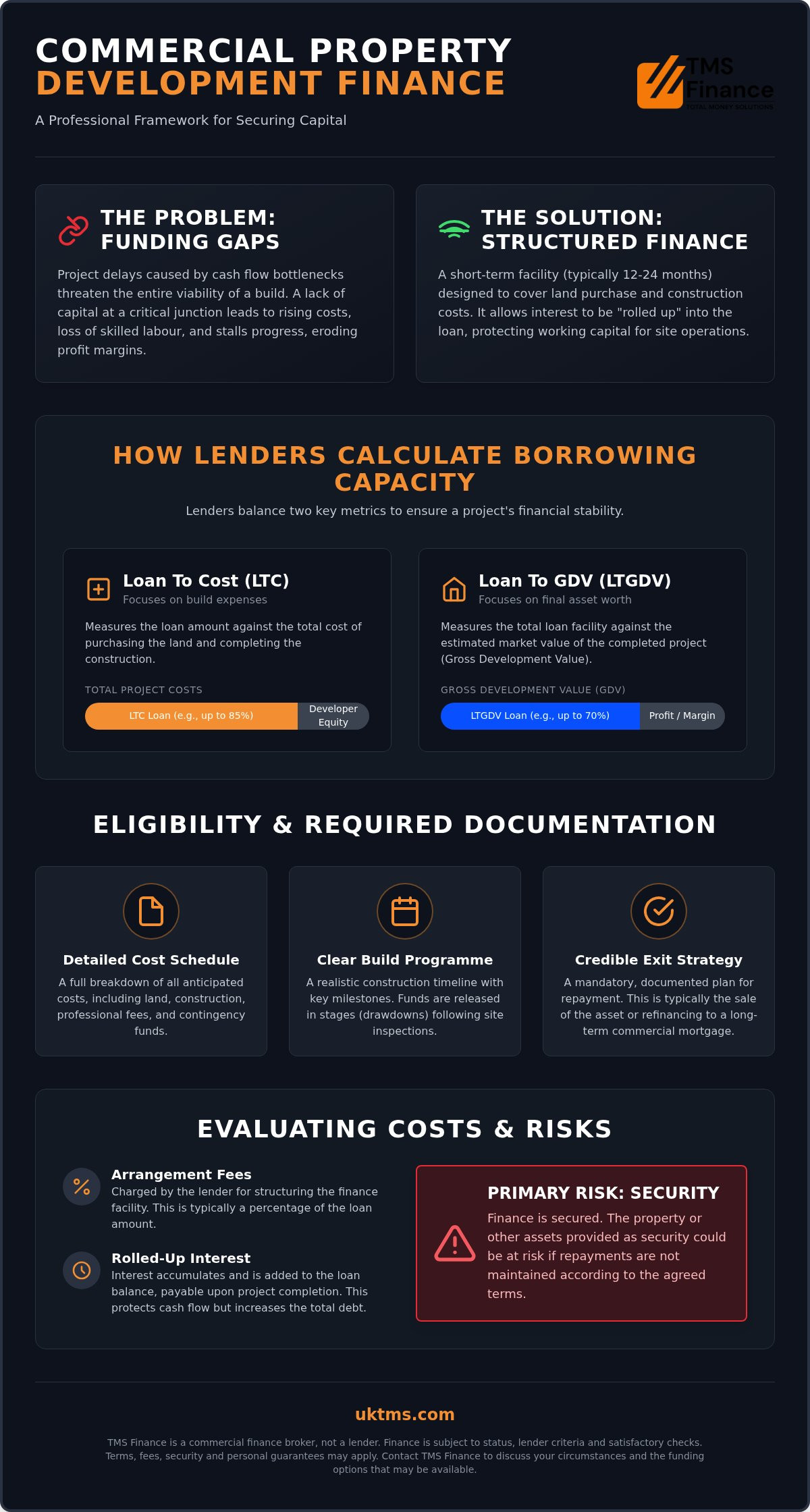
Lenders evaluate commercial property development finance through two specific lenses: the cost of the build and the final worth of the asset. The first metric is Loan to Cost (LTC), which typically covers a significant portion of the actual construction and site expenses. The second is Loan to Gross Development Value (LTGDV). This ensures the total debt remains within a safe margin of the project’s projected end value. Balancing these two figures is essential for maintaining a project’s financial stability and ensuring you don’t over-leverage the site.
Interest treatment is another critical mechanic. Most developers prefer rolled-up interest, where monthly payments are not required during the construction phase. Instead, the interest is added to the total loan facility and settled upon completion. This approach protects your monthly cash flow, though it does increase the total amount owed. Alternatively, some developers choose to service the interest monthly if they have existing revenue streams. TMS Finance helps you package these figures correctly. You can submit your project details to begin a review of your specific funding requirements.
A credible exit strategy is mandatory for lender approval. A lender will rarely commit funds without a clear, documented path to repayment. This usually involves either the sale of the completed units or a refinance onto a long-term commercial mortgage. Without a viable exit, the risk is deemed too high, regardless of the project’s potential profit.
Gross Development Value (GDV) Explained
Lenders focus on the final value because it represents their primary security. GDV is the estimated market value of a property once all development work is finished. Professional valuations are used to determine this figure, taking into account local market trends and comparable sales. If the valuation is too conservative, it can reduce the total funding available, potentially leaving a gap that you must fill with additional equity.
Staged Drawdowns and Monitoring
Funding is not released in a single lump sum. Instead, it follows a structured drawdown process. An Independent Monitoring Surveyor (IMS) visits the site at agreed intervals to verify that work has reached specific milestones. Once the IMS confirms the progress and the quality of the build, the lender releases the next tranche of funds. This system ensures that the loan remains aligned with the value added to the site. You must manage your build schedule carefully to avoid delays between work completion and fund release, as any mismatch can lead to temporary liquidity issues with subcontractors.
Assessing Eligibility and Required Documentation
Lenders treat commercial property development finance as a high-risk investment. They don’t just look at the site; they look at the developer’s ability to execute the project. Your professional experience in the construction sector is often the deciding factor in an application. If you lack a personal track record, lenders will scrutinise your main contractor and professional team. A “safe pair of hands” approach is required to demonstrate that the project is in competent control and that you have managed similar logistical challenges before.
To move from an initial enquiry to a formal offer, you must provide a granular level of detail. A vague estimate of costs will lead to a rejection. Lenders require a detailed cost schedule and a comprehensive build programme. This shows you’ve accounted for material lead times, labour availability, and contingency funds. You can learn about the business loan application process to see how these documents fit into the wider funding timeline.
The Essential Document Checklist
Precision in your paperwork reduces delays. Lenders need to see a complete package before they can issue a credit-backed offer. This usually includes:
- Full planning permission documents and building regulations approval.
- Aged debtor and creditor reports alongside recent business bank statements.
- Director identification and proof of address for all key stakeholders.
- Detailed professional CVs highlighting previous successful developments.
Missing a single document can stall an application for weeks. Having this pack ready signals to the lender that you are organised and professional. It also allows for a more accurate valuation of the site, as the surveyor will have all the facts required to assess the project’s potential.
Demonstrating Project Viability
Securing commercial property development finance requires proof that the numbers work. Project viability is proven through data, not just architectural drawings. A robust cash-flow forecast is essential. It must show how you intend to use the staged drawdowns and how you will cover any shortfalls. Lenders also focus heavily on the repayment route. Whether you plan to sell the asset or move to a commercial mortgage, you need evidence of market demand or a preliminary agreement for the refinance.
Presenting these complex requirements clearly is a core part of the brokerage process. TMS Finance is a commercial finance broker, not a lender; we review your business information to identify a possible lender fit from available routes. This packaging service ensures your application addresses lender concerns regarding risk and safety before the formal assessment begins.
Evaluating Costs, Risks, and Security Requirements
Commercial property development finance involves several cost layers beyond the interest rate. You must budget for arrangement fees, which are typically charged when the facility is established. Professional costs are also a significant part of the project budget. These include valuation fees to determine the site’s current and future worth, legal fees for both your solicitor and the lender’s, and ongoing monitoring surveyor fees for every site inspection. These costs are often deducted from the initial drawdown or added to the loan facility.
Interest is frequently rolled up into the loan rather than being serviced monthly. While this preserves your cash flow during the construction phase, it increases the total facility size. Because you’re borrowing the interest as well as the capital, the final debt grows over time. You must factor this compounding effect into your profit margins to ensure the project remains viable after all finance costs are settled. It’s essential to understand the total cost of borrowing before committing to a specific lender.
Understanding Security and Personal Guarantees
Lenders require substantial security for development projects. This almost always takes the form of a first legal charge over the development property. This gives the lender the right to take control of the asset if the terms of the loan are breached. Most lenders also require personal guarantees from the directors. This means your personal assets could be used to settle the debt if the business cannot. The property or asset used as security may be at risk if repayments are not maintained.
When Finance May Not Be Suitable
Borrowing isn’t always the safest route for every project. High-leverage finance on a speculative development can be dangerous if the market shifts or construction costs spike. In these scenarios, the interest costs can quickly consume your equity. If a project has a low profit margin or a high level of uncertainty, equity investment or a joint venture might be a better alternative. These options involve sharing the profit, but they also share the risk. You should seek professional advice to determine if the debt level is appropriate for your specific site.
TMS Finance is a commercial finance broker, not a lender. Finance is subject to status, lender criteria and satisfactory checks. Terms, fees, security and personal guarantees may apply. Contact TMS Finance to discuss your circumstances and the funding options that may be available.
Navigating the Application Process with TMS Finance
The journey to securing commercial property development finance begins with a methodical assessment of your project’s technical and financial requirements. We start with an initial discussion to understand your build programme, the site’s current status, and your required timelines. This step is critical because it allows us to identify potential logistical headaches before they reach a lender’s desk. We review your business information to identify a possible lender fit from available routes, ensuring your application is directed toward institutions that have an appetite for your specific project type.
Once we’ve reviewed your documentation, we present your case accurately to suitable lenders within our network. This isn’t a generic broadcast; it’s a strategic placement of your project. You can explore our range of property finance products to see the different facilities we support. Our goal is to ensure that the information presented is clear, fair, and compliant with what lenders expect to see in a high-stakes application. This professional packaging reduces the risk of rejection and helps build immediate confidence with credit committees.
The Broker’s Role in Lender Selection
Different lenders specialise in different sectors. Some prefer industrial units, while others focus on mixed-use residential schemes. We identify lenders whose criteria match your specific project type, saving you the time wasted on unsuitable applications. We support you through complex documentation and queries, acting as a strategic partner to help you understand the main terms and obligations before you make a decision. This level of professional guidance is essential when dealing with high-value construction projects where precision is non-negotiable.
Moving from Offer to Completion
Receiving a formal offer is a major milestone, but the process doesn’t end there. We help you review the key commercial terms and repayment obligations to ensure they align with your exit strategy. Following the offer, we support you through the valuation and legal process to completion. This involves coordinating with surveyors and solicitors to ensure that all security requirements are met and that funds are ready for the first drawdown. If your project requires a faster solution for site acquisition, you might consider our Bridging Loan Guide for UK Property Developers for more information.
TMS Finance is a commercial finance broker, not a lender. Finance is subject to status, lender criteria and satisfactory checks. Terms, fees, security and personal guarantees may apply. Contact TMS Finance to discuss your circumstances and the funding options that may be available.
Securing Your Project’s Financial Future
Successful construction projects require more than just technical expertise; they demand a robust financial structure that can withstand the pressures of the build phase. You’ve seen how commercial property development finance acts as a critical bridge between site acquisition and completion. By understanding the mechanics of gross development value and the necessity of staged drawdowns, you can maintain the liquidity required to keep your contractors on-site and your timelines on track.
TMS Finance provides expert guidance on application packaging for property investors across the UK. As a member of the National Association of Commercial Finance Brokers (NACFB), we focus on identifying a possible lender fit that matches your project’s risk profile. This methodical approach ensures your project is positioned as a credible opportunity from the initial discussion through to final completion.
We’re ready to help you move your development project forward with precision and professional support.
TMS Finance is a commercial finance broker, not a lender. Contact TMS Finance to discuss your circumstances and the funding options that may be available.
Frequently Asked Questions
What is the typical duration of a commercial development loan?
Commercial development loans typically last between 12 and 24 months. This timeframe is designed to cover the construction phase and the subsequent sale or refinance of the asset. Because it’s a short-term facility, it isn’t suitable for long-term property holding. Lenders expect a clear exit strategy within this period. If your project is complex, you may need a longer term; however, this will increase the total interest rolled up into the facility.
Can I get development finance without planning permission?
Securing commercial property development finance without full planning permission is difficult. Most lenders require planning to be in place before they commit to construction funding. If you’re purchasing a site while awaiting a decision, bridging finance may be a more suitable alternative for the acquisition. Once permission is granted, you can then transition to a development facility. This staged approach ensures that the lender’s capital is not exposed to planning risk during the build.
How much deposit is required for commercial property development?
The required deposit depends on the lender’s Loan to Cost (LTC) and Loan to Gross Development Value (LTGDV) limits. You’ll typically need to contribute between 10% and 40% of the total project costs. Lenders want to see that you have sufficient equity in the project to manage unexpected site costs. Providing a higher deposit can sometimes lead to more favourable terms, as it reduces the lender’s overall exposure to the project’s inherent construction risks.
What is the difference between a commercial mortgage and development finance?
Development finance is a short-term facility released in stages to fund construction work. In contrast, a commercial mortgage is a long-term loan used to purchase or refinance a finished property that is already generating revenue or being used for business operations. Many developers use commercial property development finance to complete a build and then refinance onto a commercial mortgage once the property is tenanted. This transition provides a stable, long-term repayment structure for the finished asset.
What happens if my project goes over schedule?
If a project goes over schedule, you may incur extension fees or higher penalty interest rates. Delays also increase the amount of rolled-up interest, which can significantly impact your final profit margins. It’s essential to include a realistic contingency period in your build programme from the start. If you anticipate a delay, communicating with the lender early is vital. They may offer a loan extension, though this is subject to their criteria and a reassessment of the project.
Is development finance available for first-time developers?
Funding is available for first-time developers, but lenders will place greater emphasis on the experience of your professional team. They’ll scrutinise the track record of your main contractor, architect, and monitoring surveyor to ensure the build is in a “safe pair of hands.” You may find that lending limits are more conservative for your first project. Providing a detailed cost schedule and a robust exit strategy is essential to build lender confidence in your application and viability.
What are the common fees associated with property development funding?
You should budget for several professional and lender fees during the process. These typically include arrangement fees for setting up the facility and exit fees when the loan is repaid. You’ll also be responsible for valuation fees, legal costs for both your solicitor and the lender’s, and monitoring surveyor fees for site inspections. These costs are often deducted from the loan facility, so you must factor them into your initial cash-flow forecasts and project budget calculations.
TMS Finance is a commercial finance broker, not a lender. Contact TMS Finance to discuss your circumstances and the funding options that may be available.