

A project featuring a ground-floor retail unit and residential flats above is more than just a building; it’s a financial hybrid that many high-street lenders view as a high-risk complication. If the commercial element exceeds a specific percentage of the total floor space, you may find your application rejected before it even reaches a surveyor. Securing mixed-use development finance requires a precise understanding of how lenders weigh these different asset classes against one another. Without the right structure, a valuation mismatch between the shop and the apartments can quickly derail your projected returns.
It’s frustrating when a viable project is held back by these technicalities or concerns over commercial lease terms. You need a funding structure that accounts for the different construction phases and cash flow requirements of both sectors. This guide provides a practical path to a successful application, helping you understand lender criteria for hybrid projects and how to present your case effectively. We’ll cover eligibility, cost management, and why working with a specialist broker is essential for projects that don’t fit into a standard residential or commercial box. By the end, you’ll have a clear framework to keep your development moving forward.
Key Takeaways
- Understand that lenders view hybrid projects as higher risk than pure residential schemes, particularly regarding commercial vacancy rates and exit strategies.
- Learn how mixed-use development finance provides staged funding for both purchase and construction, managed through regular site inspections.
- Identify the specific experience lenders look for in property professionals, focusing on a proven track record in both residential and commercial sectors.
- Discover how to structure a credible application to avoid common delays caused by valuation mismatches or floor space ratio restrictions.
- See how a specialist broker can package complex hybrid requirements to find a lender whose criteria match your project’s specific commercial-to-residential split.
The Financial Complexity of Mixed-Use Property Development
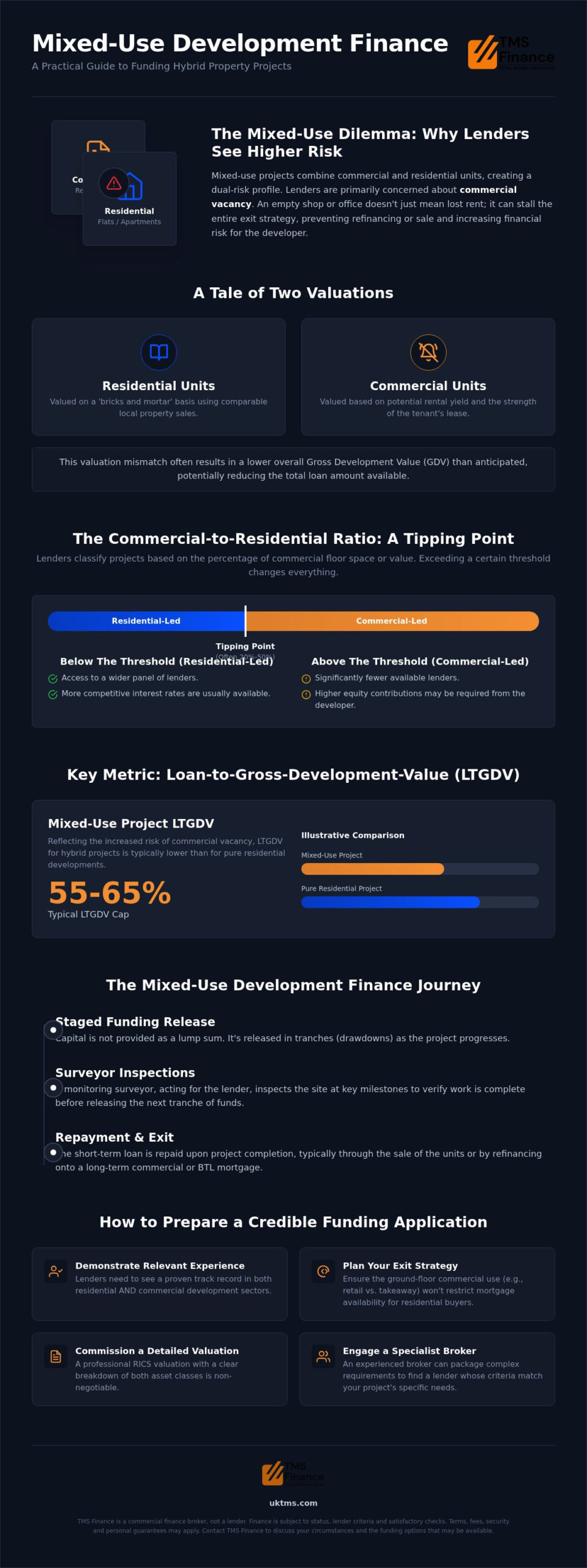
Mixed-use projects are a staple of UK high streets, typically featuring ground-floor retail or office units with residential flats above. While these developments offer diversified income streams, they present a dual-risk profile that complicates the lending process. Lenders generally view mixed-use schemes as higher risk than pure residential projects. The primary concern is commercial vacancy. If a shop unit remains empty, it doesn’t just result in lost rent; it can stall your entire exit strategy, preventing you from refinancing onto a term loan or selling the asset.
Securing mixed-use development finance requires balancing these two distinct asset classes. Borrowing costs often increase if the commercial element exceeds specific thresholds, as fewer lenders are willing to take on the specialised risk associated with commercial tenants. Delays in securing a pre-let or a reliable commercial occupant can have a significant financial impact, potentially leaving the developer stuck on expensive bridge rates for longer than planned.
Why Mixed-Use Projects Face Unique Funding Hurdles
The difficulty begins with valuation. Residential units are usually valued on a bricks and mortar basis using comparable local sales. Commercial units, however, are valued based on rental yield and the strength of the tenant’s lease. This mismatch often leads to a lower overall valuation than the developer expects, which can reduce the amount of capital a lender is willing to provide.
Saleability is another major factor. Many residential lenders won’t provide mortgages for flats located above certain types of businesses, such as laundrettes, petrol stations, or takeaways, due to risks regarding fire, noise, and odour. If your exit strategy relies on selling the flats to individual buyers, you must ensure the ground-floor use doesn’t restrict their ability to get a mortgage. Finding a single lender willing to fund both components of the build remains one of the biggest hurdles for property professionals.
The Impact of Commercial-to-Residential Ratios
Lenders categorise projects based on the ratio of residential to commercial floor space or value. Most specialist lenders have a tipping point, often between 20% and 50% of the total area. If the commercial element stays below this threshold, the project is considered residential-led. This usually allows access to a wider panel of lenders and more competitive interest rates.
Once the commercial portion exceeds these limits, the project shifts into semi-commercial or full commercial territory. This change significantly reduces the number of available lenders and may require higher equity contributions from the developer. If you alter your planning permission during the build and inadvertently increase the commercial floor space, you risk breaching your loan covenants. This could lead to the lender withdrawing further drawdowns or demanding immediate repayment, putting the entire project at risk.
How Mixed-Use Development Finance Works
Mixed-use development finance is a short-term loan used to cover the purchase and construction costs of a hybrid project. Unlike a standard mortgage, this facility is designed to be repaid once the build is complete, either through the sale of the units or by refinancing onto a long-term loan. Funding is typically released in stages following inspections by a monitoring surveyor. This professional acts as the lender’s representative, visiting the site to verify that work has reached the required milestone before the next tranche of capital is released. Lenders focus heavily on the Gross Development Value (GDV) of the finished project to determine how much they’re willing to lend. Loan-to-Gross-Development-Value (LTGDV) is the primary metric lenders use to determine maximum loan amounts.
Calculating Loan-to-Gross-Development-Value (LTGDV)
Lenders assess the combined value of residential sales and commercial capitalisation to reach a total GDV. For the residential portion, they look at comparable local property prices. For the commercial units, the value is determined by the potential rental yield and the quality of the expected tenant. LTGDV limits for mixed-use projects are often lower than pure residential developments, typically capped between 55% and 65%. This lower limit reflects the increased risk of commercial vacancy. A professional RICS valuation is essential, as it must provide a detailed breakdown of how both asset classes contribute to the project’s final worth. Property professionals often find that packaging these details correctly is the difference between a quick offer and a rejection. You can start your application online to see which funding routes are available for your project.
Understanding Interest Roll-up and Servicing
Most developers choose to “roll up” interest into the facility. This means you don’t need to make monthly repayments during the construction phase; instead, the interest is added to the loan balance and settled at the end of the term. While this helps your monthly cash flow, it’s important to understand that interest costs reduce the net loan amount you receive at the start of the project. For example, if your total facility is £1.5 million and the interest and fees total £150,000, your actual usable net loan is £1.35 million. Accurate cash-flow forecasting is critical, especially for projects with long commercial fit-out periods. If a retail unit takes six months longer than expected to let, the interest will continue to accrue, potentially eating into your profit margins.
Evaluating Lender Criteria for Hybrid Projects
Lenders look beyond the physical asset when assessing an application; they evaluate the developer’s ability to manage a hybrid environment. Securing mixed-use development finance is often contingent on showing that you understand both the residential sales market and the commercial leasing market. A project featuring ten flats and a ground-floor retail unit requires two distinct exit strategies. You must prove how you’ll repay the debt, whether that’s through individual unit sales, a commercial term mortgage, or a combination of both once the units are occupied.
Security is a non-negotiable element of these facilities. Lenders will almost always take a first legal charge over the entire development site. They’ll also require personal guarantees from the company directors. This ensures that the developer remains fully committed to the project’s completion and the eventual repayment of the capital. If you don’t have a clear plan for both components, the lender may view the project as speculative and decline the facility.
Pre-Let and Pre-Sale Requirements
Lenders are naturally cautious about “speculative” commercial space. If the ground floor consists of a large office or retail unit, the lender might insist on a pre-let agreement before releasing the main build costs. This means a tenant has signed heads of terms or a formal agreement to lease before construction is finished. While residential off-plan sales are helpful for your profile, they aren’t always mandatory. However, having several flats under offer can significantly improve your borrowing terms. The biggest risk is relying on a single large commercial tenant; if they pull out late in the build, the project’s valuation can drop, leaving a gap in your exit plan.
The Role of Professional Experience in Approval
First-time developers often find it difficult to secure mixed-use development finance because they lack a proven track record in both sectors. If you’ve only built houses, a lender will worry about your ability to deliver a commercial unit that meets specific tenant requirements. You can mitigate this risk by:
- Partnering with an experienced main contractor who has completed hybrid schemes.
- Appointing a reputable commercial agent early in the process to advise on unit layout.
- Providing a detailed CV of previous projects, even if they were purely residential.
A broker’s job is to package your team’s collective experience effectively. We present your track record, previous project photos, and profit statements to show the lender you’re a dependable partner capable of executing the build safely and efficiently.
How to Prepare a Credible Mixed-Use Funding Application
Most delays in securing mixed-use development finance stem from incomplete paperwork. A lender won’t offer terms on a project they don’t fully understand. Providing a comprehensive application pack allows a broker to identify the most suitable lender fit quickly. This pack must include full planning permissions and a clear breakdown of any Section 106 or Community Infrastructure Levy (CIL) obligations. These legal agreements can significantly impact your cash flow and the final project value, so they must be clearly documented from the outset.
Essential Documentation for Commercial Elements
Commercial units require a different level of detail compared to residential flats. You must provide separate cost schedules for the commercial shell and core versus the residential finishes. Lenders also want evidence of local demand. Agent reports that outline current commercial yields and vacancy rates in the specific area provide the necessary data to support your Gross Development Value. If you have draft leases or letters of intent from potential tenants, include them. These documents reduce the lender’s perceived risk and can lead to more competitive borrowing terms.
Presenting Your Exit Strategy and Contingency Plans
Your application must demonstrate a clear path to repayment. This might involve selling the residential units and refinancing the commercial element onto a long-term commercial mortgage. You need a “Plan B” for the commercial unit if it remains vacant at the point of completion. Lenders will look at whether the residential sales alone can service a portion of the debt or if you have the personal liquidity to cover interest payments. Providing evidence of exit routes, such as quotes for buy-to-let mortgages for the flats, shows that you’ve planned for all scenarios.
Securing Funding with a Specialist Commercial Broker
TMS Finance is a commercial finance broker, not a lender. We provide access to a range of funding routes, specialising in commercial property development finance for hybrid projects. Securing mixed-use development finance involves more than just finding a low interest rate; it’s about identifying a funder that understands the specific risks of your site. A broker acts as a strategic partner, packaging your complex hybrid requirements so they’re presented clearly to funders who have the appetite for mixed-use assets. This specialist support ensures you understand the commercial terms, costs, and risks before you commit to a facility.
Identifying Suitable Lender Fit via a Broker
Randomly approaching banks often leads to unnecessary rejections. Every decline leaves a mark on your credit footprint and can make subsequent applications more difficult. At TMS Finance, we review your project details, planning permissions, and experience to find development finance lenders whose criteria match your specific commercial-to-residential split. We know which lenders are comfortable with high-street retail and which ones prefer office space or industrial units. This targeted approach saves time and protects your professional reputation within the lending market.
Supporting Your Project from Initial Discussion to Completion
Our process is methodical and structured. It begins with an initial discussion to understand your project’s timing, scale, and desired exit. We don’t just pass on a name; we help you gather the necessary documentation and respond to technical lender queries that often arise during the underwriting phase. Mixed-use projects have many moving parts, and communication between surveyors, solicitors, and lenders must be managed with precision.
We provide ongoing support through to the final completion. This includes managing the dialogue between all parties to ensure that construction drawdowns happen on schedule. By acting as a “safe pair of hands,” we allow property professionals to focus on the build while we handle the logistical complexities of the funding. This integrated approach ensures that your mixed-use development finance facility remains compliant with your loan covenants throughout the construction phase.
TMS Finance is a commercial finance broker, not a lender. Finance is subject to status, lender criteria and satisfactory checks. Terms, fees, security and personal guarantees may apply. Contact TMS Finance to discuss your circumstances and the funding options that may be available.
Moving Your Hybrid Project Forward
Mixed-use schemes offer significant rewards but require a meticulous approach to risk management. Success depends on ensuring your exit strategy accounts for both asset classes, whether through residential unit sales or commercial refinancing. Securing mixed-use development finance requires a credible application that satisfies specific lender ratios and professional experience requirements.
As a member of the National Association of Commercial Finance Brokers (NACFB), TMS Finance provides specialist property finance expertise with national UK coverage. We help you package complex hybrid applications to ensure they meet the rigorous standards expected by commercial funders. Planning for every contingency, from commercial vacancy to valuation mismatches, is the most effective way to keep your development viable.
We’re ready to help you identify the right funding route for your next project.
TMS Finance is a commercial finance broker, not a lender. Finance is subject to status, lender criteria and satisfactory checks. Terms, fees, security and personal guarantees may apply. Contact TMS Finance to discuss your circumstances and the funding options that may be available.
Frequently Asked Questions
Can I get a single loan for a mixed-use development?
Yes, specialist lenders provide a single facility for hybrid projects that combines both residential and commercial elements. Securing mixed-use development finance under one agreement is often more efficient than managing separate loans for each part of the building. However, the lender will assess the risk of each sector differently. A broker helps package these requirements so the lender sees a unified, viable project with a clear path to completion and repayment.
What is the maximum loan-to-cost for mixed-use projects?
Lenders typically offer up to 80% or 90% of the total project costs, though this depends on the applicant and the specific facility. The final limit is heavily influenced by the Gross Development Value and your previous experience. If the commercial portion is large, the loan-to-cost may be lower to mitigate vacancy risks. You should provide a detailed cost schedule to help the lender assess the project’s affordability and the strength of the security provided.
Do I need a commercial tenant in place before applying for finance?
You don’t always need a tenant in place, but having a pre-let agreement can significantly improve your borrowing terms. Lenders are naturally cautious about speculative commercial space. If the ground floor is a major part of the project’s value, a letter of intent or a draft lease provides the security funders look for. Without a tenant, you must prove strong local demand through agent reports to justify your projected rental yields and exit strategy.
What happens if the residential part sells but the shop doesn’t let?
This scenario creates a partial exit where residential sales pay down a portion of the debt. If the commercial unit remains vacant, you may need to refinance the remaining balance onto a short-term bridging loan. This gives you more time to find a tenant without the pressure of construction loan deadlines. It’s vital to have a contingency plan and enough liquidity to cover interest payments during this period to protect your investment and maintain lender confidence.
What documents do I need for a mixed-use development loan?
You’ll need a comprehensive application pack to secure mixed-use development finance. This includes recent business bank statements, filed accounts, and VAT returns. For the property itself, lenders require full planning documents, detailed cost schedules, and a professional RICS valuation. You should also provide evidence of your experience, such as a CV of previous projects, and agent reports confirming the demand for both residential and commercial units. A broker can assist you in preparing these.
TMS Finance is a commercial finance broker, not a lender. Contact TMS Finance to discuss your circumstances and the funding options that may be available.
One Response