

Paying a commercial landlord every month often feels like funding someone else’s retirement while your own cash flow remains under constant pressure. You have likely seen rising rental costs drain your working capital, leaving you with little control over your business premises or long-term overheads. For many enterprise leaders, the transition from tenant to owner-occupier is the most effective way to stabilise overheads and build an enduring asset. Identifying a dedicated commercial mortgage broker UK businesses can rely on, such as TMS Finance, is a critical step in this process, ensuring your finance application is precisely structured to meet the underwriting demands of mainstream and specialist lenders nationwide.
We understand that the route to commercial property ownership is frequently complicated by stringent lending criteria and complex application processes. This guide delivers a clear roadmap to securing professional business property funding. You will learn how to navigate the pitfalls that lead to lender rejection, evaluate prevailing borrowing costs, and prepare the core documentation required for an underwritten approval. We also outline how to manage statutory considerations, including Stamp Duty Land Tax and commercial Energy Performance Certificate standards. Armed with these insights, your business can confidently move toward strategic property acquisition and long-term financial stability.
Key Takeaways
- Evaluate the long-term financial benefits of transitioning from leasehold to owner-occupancy to stabilise overheads and build property equity.
- Understand how lenders assess trading history and bank conduct to prepare a credible application that meets strict eligibility criteria.
- Discover how a commercial mortgage broker stockport businesses can consult helps identify suitable lenders and manages the technical document collection process.
- Identify the full scope of borrowing costs, including valuation fees and legal charges, while understanding the risks associated with secured property finance.
- Differentiate between owner-occupied mortgages and commercial investments to ensure your funding structure aligns with your specific business objectives.
The Financial Impact of Unsuitable Business Premises
High rental costs represent a significant drain on monthly cash flow for many UK SMEs. When you pay rent, you are essentially servicing a landlord’s debt rather than building your own business assets. This expenditure offers no long-term capital return and leaves your business vulnerable to unpredictable rent reviews and lease renewals. Engaging a commercial mortgage broker stockport is often the first step for businesses looking to move away from these rising costs and gain control over their fixed overheads.
Space constraints often act as a bottleneck for growth. If your current premises cannot accommodate more staff or additional stock, your revenue potential is capped. Moving to larger, owned premises allows for strategic scaling and provides a tangible asset on the company balance sheet. Delaying this transition can be costly; property prices may rise, or you might miss out on a site that is perfectly suited to your operational needs. Meticulous planning is required to ensure the acquisition aligns with your long-term business objectives.
Rent vs. Ownership: A Strategic Shift
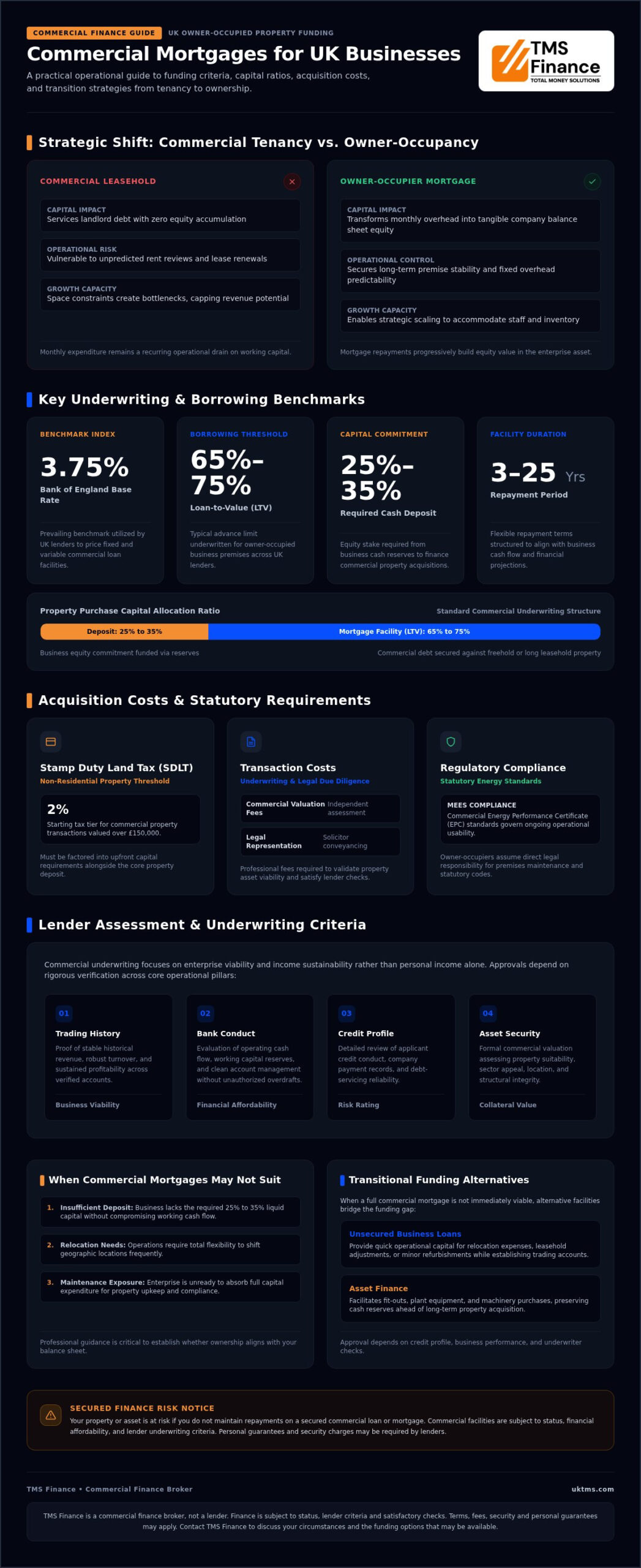
Owning your premises transforms a monthly cost into a capital investment. While rental payments are lost forever, mortgage repayments gradually increase your equity in the building. commercial mortgages are specifically designed for this purpose, allowing businesses to secure long-term stability. With the Bank of England Base Rate currently at 3.75%, understanding the difference between fixed and variable options is crucial for precise budgeting. It’s important to remember that your property is at risk if you do not maintain repayments on a secured loan.
Ownership is not suitable for every business. If your company lacks a sufficient deposit, typically between 25% and 35%, or if you require total flexibility to move locations frequently, a mortgage might not be the right choice. Property ownership also brings responsibilities for maintenance and compliance with regulations like the Minimum Energy Efficiency Standards (MEES). You should seek professional advice to determine if property acquisition is the right move for your specific circumstances.
Identifying the Property Funding Gap
The transition from a home office to a warehouse or from a small shop to a larger retail unit often creates a funding gap. Small businesses often struggle to bridge this gap with cash reserves alone. Using a commercial mortgage broker stockport ensures your application is presented professionally to lenders who understand your sector. TMS Finance is a commercial finance broker, not a lender, and we focus on identifying the right lender fit for your business needs.
If a full mortgage isn’t immediately viable, alternative options like unsecured business loans or asset finance can provide integrated capital solutions. These can help with moving costs or minor renovations while you build the necessary trading history for a property purchase. Approval for any finance is never guaranteed; it depends on the applicant’s credit profile, business performance, and affordability. Acting too slowly can lead to missed opportunities in a competitive market, so evaluating your funding options early is a proactive business strategy.
How Commercial Mortgages Work for UK Businesses
A commercial mortgage is a loan secured against property that is not your primary residence. These facilities are designed for business purposes, whether you intend to trade from the building or rent it out to third parties. Lending criteria for these products differ significantly from residential standards because underwriters focus on business viability and income generation rather than personal salary alone. Identifying a professional commercial mortgage broker stockport helps you determine which lenders are most likely to support your specific sector and property type.
Typical Loan-to-Value (LTV) ratios for owner-occupied premises usually range between 65% and 75%. This means you will generally need a deposit of at least 25% to 35% of the purchase price. Repayment terms are flexible, often spanning from 3 to 25 years. Lenders benchmark their pricing against the Bank of England Base Rate, which currently stands at 3.75%. You must also account for Stamp Duty Land Tax, which starts at 2% for non-residential property valued over £150,000. A commercial mortgage broker stockport ensures these costs are factored into your initial affordability assessment.
Owner-Occupied Property Finance
Owner-occupied finance is for businesses that plan to trade directly from the premises they are purchasing. Lenders assess the performance of the business to determine affordability, looking for a Debt Service Coverage Ratio (DSCR) typically between 1.25x and 1.50x. This ensures your trading cash flow can comfortably cover the annual debt commitments. Using property as security can provide a stable foundation for long-term working capital, allowing you to reinvest profits into growth rather than rent.
Commercial Investment and Portfolios
For those looking to generate income from property, commercial investment mortgages provide funding for Houses in Multiple Occupation (HMOs), multi-unit blocks, and wider portfolios. In these cases, the lender focuses heavily on rental yield and the quality of the tenants. A professional property finance guide can help you understand the specific underwriting requirements for investment projects. Yield requirements vary depending on the asset type and location, requiring a bespoke approach to every application.
If you are unsure whether your business performance meets current lender expectations, you can submit a preliminary application to discuss your options. Approval depends on credit profile and property valuation; your secured asset is at risk if repayments are not maintained.
Lender Criteria and Application Packaging
Securing a commercial mortgage requires more than a simple credit check. Lenders evaluate the specific purpose of the funding alongside your trading history and credit profile. They scrutinise bank conduct; consistent repayment evidence and healthy cash flow are essential for approval. Randomly approaching multiple lenders often leads to unnecessary rejections and multiple hard credit searches, which can damage your credit score. A professional National Association of Commercial Finance Brokers member, such as a commercial mortgage broker stockport businesses trust, understands these nuances. By working with a commercial mortgage broker stockport, you ensure your case is presented to the right decision-makers first.
Essential Documentation for a Credible Case
Preparing a robust application package is vital for speed and success. Lenders require a comprehensive set of documents to verify your business performance and affordability. You’ll need to provide at least two years of filed accounts and the most recent management accounts to demonstrate stability. Accuracy in these records is non-negotiable. Expect to submit the following:
- Six months of business bank statements to evidence bank conduct.
- Recent VAT returns and aged debtor reports.
- Detailed cash-flow forecasts to prove future affordability.
- Director identification and proof of address for compliance checks.
Precision in this documentation demonstrates professional competence. It gives the lender confidence that your business is well-managed and capable of meeting its financial obligations over the long term.
Presenting Complex Requirements Clearly
Lenders need to understand the business objective behind your property purchase. Whether you’re expanding a hospitality site or acquiring a construction yard, your industry experience matters. We help translate these complex requirements into a narrative that lenders can approve. A clear explanation of how the property will improve operations or reduce costs can be the difference between a decline and an offer. If you’re ready to start this process, you can complete a business loan application to provide the initial details.
Approval depends on the applicant, business performance, credit profile, affordability, security, and the lender’s criteria. Finance may not be suitable if your business cannot demonstrate consistent profitability or if you have significant recent credit issues. Remember that your secured property or asset could be at risk if repayments are not maintained.
Understanding Costs, Risks, and Security
Commercial property finance is a long-term commitment that requires a clear understanding of the total cost of borrowing. Interest rates are generally structured as either fixed or variable. Fixed rates offer protection against market volatility, allowing for precise financial forecasting. Variable rates typically track the Bank of England Base Rate, which means your monthly repayments will fluctuate if the rate changes from its current 3.75%. Choosing between these options depends on your business’s cash flow stability and risk tolerance. A commercial mortgage broker stockport provides the technical analysis needed to evaluate these products effectively.
Beyond interest, several professional fees apply to every transaction. These include:
- Valuation fees to confirm the property’s market value for the lender.
- Legal fees for both the lender’s and your own representation.
- Lender arrangement fees, often calculated as a percentage of the total loan.
- Broker fees for managing the application and lender negotiations.
Focusing solely on the lowest headline interest rate can be a mistake. A facility with a slightly higher rate but lower arrangement fees or more flexible repayment terms might be more cost-effective over the loan’s duration. Every business has unique requirements, and a commercial mortgage broker stockport helps you identify which structure aligns best with your operational goals.
The Reality of Secured Lending
Lenders secure their capital against the property itself. This means your business premises are at risk if you fail to maintain the agreed repayment schedule. During the underwriting process, lenders evaluate the liquidity and condition of the collateral to determine its suitability as security. Most commercial lenders also require personal guarantees from company directors, which creates a personal liability for the debt. We strongly recommend that you seek independent legal and financial advice before signing any loan agreement to ensure you fully understand these obligations.
When Finance May Not Be Suitable
A commercial mortgage may not be the most efficient solution if your business is experiencing rapid, unpredictable growth or if you are already heavily leveraged. Taking on significant debt during periods of economic uncertainty can strain your working capital. In such cases, alternatives like Invoice Finance or asset-backed lending for specific equipment may be more appropriate. These options focus on current assets rather than long-term property debt, providing more flexibility for day-to-day operations.
Why Work with a Commercial Finance Broker?
A professional commercial mortgage broker stockport acts as a strategic intermediary between your business and a diverse range of lenders. Their primary role involves more than simply finding a rate; they conduct a methodical assessment of your requirements to identify a precise lender fit. By understanding specific underwriting appetites, a broker ensures your application is not wasted on institutions unlikely to support your sector or property type. This targeted approach protects your credit profile and saves significant time during the acquisition process.
Your broker provides essential guidance on the information needed to build a credible case. This includes a technical review of your accounts, bank conduct, and property details before any submission occurs. They offer a clear explanation of commercial terms, repayment obligations, and associated risks, ensuring you make an informed decision based on facts rather than marketing rhetoric. From the initial discussion through to the final completion, a commercial mortgage broker stockport provides the professional support required to manage complex logistical and financial challenges.
The TMS Finance Approach
TMS Finance prioritises a commercial focus on your business objectives and the long-term impact on your cash flow. We operate as a “safe pair of hands,” providing a dependable and no-nonsense partnership for UK business owners. As members of the National Association of Commercial Finance Brokers (NACFB), we adhere to strict professional standards and a dedicated code of practice. Founded in 2005, our firm has an exclusively B2B focus, providing national coverage for businesses and property investors across the UK. We view ourselves as an extension of your team, dedicated to solving the logistical headaches of property funding.
Next Steps for Your Property Project
Moving from a leasehold to an owner-occupied premises requires meticulous planning and preparation. To begin the process, you should gather your headline business information, including the last two years of filed accounts and a summary of your current credit position. Consider the desired outcome of your project and the specific timing of your funding requirement to ensure the facility aligns with your operational milestones.
When you are ready to explore the available options, you can Apply Now to provide your initial details. We will review your circumstances and discuss the potential funding routes that match your business profile. Approval is subject to status and lender criteria; remember that your secured property is at risk if repayments are not maintained.
TMS Finance is a commercial finance broker, not a lender. Finance is subject to status, lender criteria and satisfactory checks. Terms, fees, security and personal guarantees may apply. Contact TMS Finance to discuss your circumstances and the funding options that may be available.
Strategic Funding for Your Business Premises
Transitioning from a leasehold to an owner-occupied property is a significant step for any UK business. You’ll build long-term equity and protect your cash flow from unpredictable rent reviews. Success in this process depends on meticulous preparation and professional application packaging. Working with a commercial mortgage broker stockport businesses can rely on ensures your case is presented with the technical precision required for approval.
As an NACFB Registered Broker with specialist property finance knowledge, TMS Finance provides national UK coverage to support your acquisition goals. We focus on identifying the right lender fit while ensuring you understand the costs and risks involved. Approval depends on business performance and credit profile; your secured property is at risk if repayments aren’t maintained.
Taking control of your business premises provides a stable foundation for future growth. We are ready to help you manage the logistical challenges of property funding through expert guidance and professional execution.
TMS Finance is a commercial finance broker, not a lender. Finance is subject to status, lender criteria and satisfactory checks. Terms, fees, security and personal guarantees may apply. Contact TMS Finance to discuss your circumstances and the funding options that may be available.
Frequently Asked Questions
What is the difference between a commercial mortgage and a business loan?
A commercial mortgage is a long-term loan secured specifically against property or land, whereas a business loan can be unsecured or tied to other assets. Mortgages typically offer longer repayment terms and are used for property acquisition or refinancing. Using a commercial mortgage broker stockport helps clarify which facility aligns with your capital structure. Business loans are generally better suited for short-term working capital needs rather than long-term property investment.
How much deposit is typically required for a commercial mortgage in the UK?
Lenders generally require a deposit between 25% and 35% of the property’s value. This reflects a Loan-to-Value (LTV) ratio of 65% to 75%. The specific requirement depends on your industry sector, trading history, and the quality of the property. You must also account for additional acquisition costs such as Stamp Duty Land Tax and professional valuation fees. Higher deposits may be needed for specialist properties or businesses with a shorter trading history.
Can a new business or startup apply for a commercial mortgage?
Funding options may be available for younger companies, provided they can demonstrate a robust business plan and strong management experience. Lenders will focus heavily on cash-flow forecasts and any additional security you can provide. A commercial mortgage broker stockport can help package your application to meet the specific requirements of lenders who support new ventures. While more challenging than for established firms, startup property finance is possible with the right preparation.
What happens if my business cannot maintain the mortgage repayments?
Your secured property is at risk if you do not maintain the agreed repayment schedule. As a secured loan, the property acts as collateral, and the lender has the legal right to repossess the asset to recover their capital. Defaulting on payments will also significantly damage your business credit profile and may trigger personal liability if a guarantee is in place. You should seek professional advice immediately if you anticipate difficulties in meeting your financial obligations.
Are personal guarantees always required for commercial property finance?
Personal guarantees are a standard requirement for most commercial mortgages, particularly for limited companies. This agreement makes directors personally liable for the debt if the business defaults on its repayments. Lenders use these to ensure director commitment and provide extra security for the loan. You should review the legal implications of a personal guarantee with an independent solicitor before signing any mortgage offer to ensure you understand the personal financial risk.
TMS Finance is a commercial finance broker, not a lender.