

Could a business loan to pay HMRC tax bill UK businesses owe protect cash for payroll and suppliers, or create repayments that last beyond the tax deadline? When a tax commitment competes with working capital, delaying action can lead to interest or penalties. Borrowing without a clear repayment plan may put further pressure on cash flow.
It’s reasonable to consider funding when a bill is due and cash is committed elsewhere. But a commercial loan isn’t the only route, and it won’t suit every business. An HMRC Time to Pay arrangement, invoice finance or a revolving credit facility may be worth comparing, depending on your circumstances and the terms available.
This article explains the funding options, what lenders may assess, and the costs, security and personal guarantees to consider. It also covers when borrowing may not be suitable and what information can help you discuss the requirement with a broker. TMS Finance is a commercial finance broker and a member of the National Association of Commercial Finance Brokers. It can help you present the funding need clearly and consider possible options, but cannot promise approval. Any decision should account for affordability, timing and the effect on the business after the tax bill is paid.
Key Takeaways
- Compare borrowing with an HMRC payment arrangement before deciding how to cover the bill.
- Assess a business loan to pay an HMRC tax bill against cash flow and the full repayment obligation.
- Prepare relevant records, such as accounts, bank statements and cash-flow forecasts, for a discussion about possible finance.
- Compare a business loan, working-capital finance, revolving credit and invoice finance against the specific funding need.
- TMS Finance can review the requirement and support an application, but lender decisions depend on individual circumstances and criteria.
HMRC Tax Bill Due? Understand the Cash-Flow Impact Before Borrowing
An HMRC payment can fall due just as wages, supplier invoices and other trading costs need covering. Paying the bill from available cash may help avoid a growing tax debt, but could leave the business short of funds for day-to-day commitments. Borrowing may help with a temporary timing gap, but the repayments must also fit the business’s cash flow.
Tax-bill finance is business funding used to help meet a tax commitment while spreading its cash-flow impact over time. Assess a business loan to pay an HMRC tax bill against both the payment deadline and the business’s ability to repay. HM Revenue and Customs (HMRC) administers the UK tax system, but the amount due and payment date depend on the business’s circumstances.
First, distinguish a short-term timing problem from a deeper affordability issue. A timing gap might arise when expected customer receipts arrive after a tax payment is due. If income is persistently insufficient to cover tax and ordinary operating costs, taking on new repayments may add pressure rather than resolve it. Review expected receipts and essential outgoings before deciding whether finance could bridge the gap sustainably.
Which business tax commitments may create a cash-flow gap?
VAT, PAYE and Corporation Tax can each coincide with other significant outgoings. Payment dates and obligations depend on the business and its tax position, so don’t use a general example to determine what you owe. Check the bill, amount and deadline directly with HMRC, or ask a qualified tax adviser if anything is unclear.
Confirming these details gives you a firmer basis for planning. It can also help separate the tax amount from the cash needed for payroll, suppliers and ongoing trading.
Why acting early matters without rushing into a loan
An unpaid bill can continue to compete with routine commitments, and late payment may lead to interest or penalties under rules that vary by tax and circumstances. Contact HMRC promptly to explain the position and discuss what options may apply. Don’t assume borrowing is the only route or that a payment arrangement will automatically be agreed.
Acting early is different from rushing. Finance timing depends on the case and lender, and approval isn’t guaranteed. Before pursuing a business loan, consider whether repayments would remain manageable alongside wages, suppliers and future tax commitments. If the business cannot meet its obligations sustainably, seek advice from an appropriate professional rather than relying on further borrowing alone.
Business loan to pay HMRC tax bill UK: Compare the Available Routes
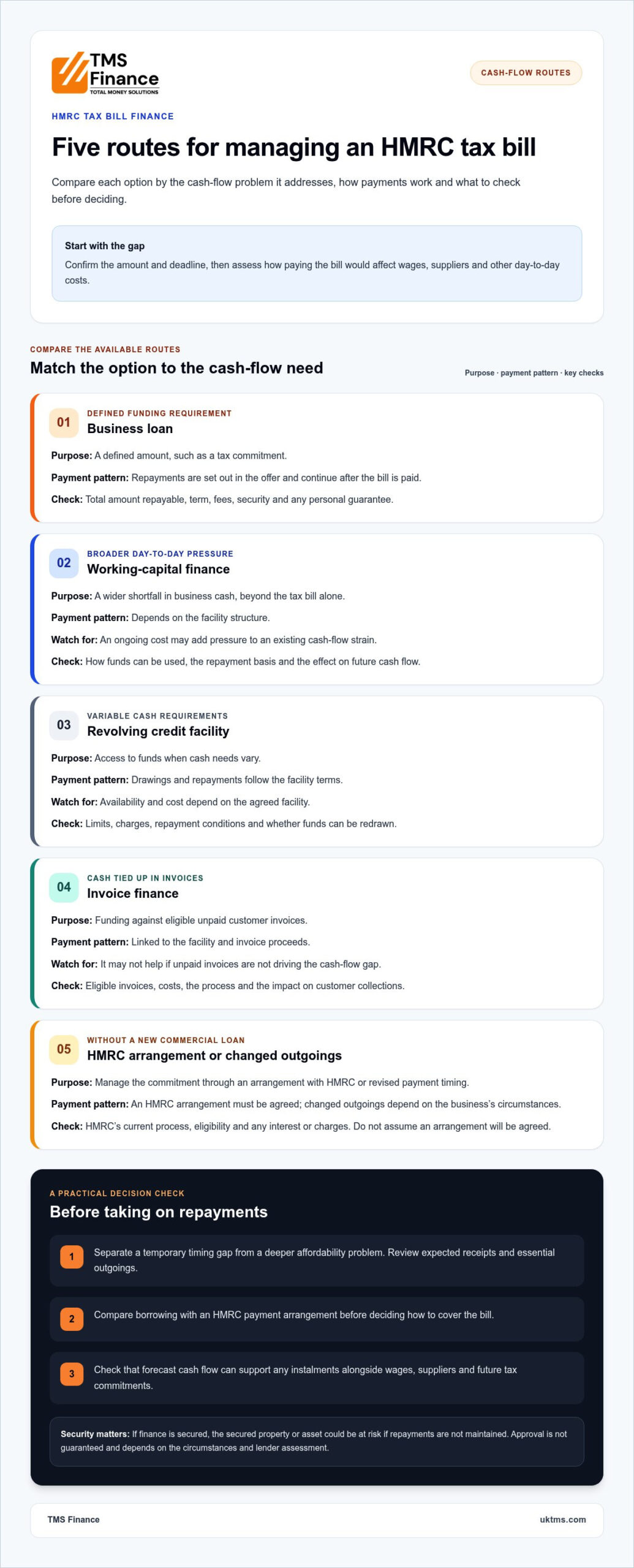
Once you know the amount and timing of the commitment, compare how each route would affect cash flow after the bill is dealt with. A business loan may provide a defined sum with a repayment schedule set out in the offer. Working-capital finance can address a wider shortfall, while a revolving credit facility may let the business draw funds as needed, subject to its terms. Whichever route you consider, check affordability.
Invoice finance is relevant when unpaid customer invoices are part of the cash-flow gap. It may release funding against eligible invoices, but you should understand how the facility works, what it costs and how it interacts with customer payments. It won’t be a fit simply because a tax bill is due.
| Route | Purpose | Repayment pattern | Potential drawback | What to investigate |
|---|---|---|---|---|
| Business loan | A defined funding requirement, such as a tax commitment | Repayments set out in the offer | Repayments continue after the bill is paid | Total amount repayable, term, fees, security and any personal guarantee |
| Working-capital finance | Broader pressure on day-to-day business cash | Depends on facility structure | May add an ongoing cost to an existing cash-flow strain | How funds can be used, repayment basis and effect on future cash flow |
| Revolving credit facility | Access to funds when cash needs vary | Drawings and repayments follow facility terms | Availability and cost depend on the agreed facility | Limits, charges, repayment conditions and whether funds can be redrawn |
| Invoice finance | Cash tied up in relevant unpaid invoices | Linked to the facility and invoice proceeds | Not useful if unpaid invoices aren’t driving the gap | Eligible invoices, costs, process and impact on customer collections |
| HMRC arrangement or changed outgoings | Manage the commitment without a new commercial loan | Agreed with HMRC, or based on revised payment timing | Availability and terms depend on the circumstances | HMRC’s current process, eligibility and any interest or charges |
When a business loan may fit the tax-payment requirement
A loan may be worth assessing when the amount is clear, there’s a credible repayment route and forecast cash flow can support the instalments alongside normal costs. A business loan to pay an HMRC tax bill isn’t automatically suitable just because a payment is due. The lender’s decision depends on the applicant, the facility and the lender’s assessment.
Alternatives to borrowing for an HMRC bill
Ask HMRC about payment arrangements and check the current process and eligibility. For Corporation Tax, consult official HMRC guidance on paying Corporation Tax. You could also review whether discretionary outgoings can be timed differently without disrupting essential operations. For tax-specific decisions, speak to an accountant or tax adviser.
Compare the amount, timing and repayment route before deciding. If finance remains under consideration, outline the requirement through the business loan application.
Will Borrowing Make the HMRC Bill More Manageable? Assess Costs and Risks
Borrowing can move the pressure from the tax deadline to future months. Before deciding, compare the amount needed for the HMRC bill with the full amount repayable under a finance offer. Consider interest, fees and any other costs stated in the terms. A lower immediate cash outlay doesn’t necessarily mean a lower overall cost.
Finance is manageable only when projected repayments fit realistic business cash flow. Build the repayments into a forecast alongside wages, suppliers, rent, existing borrowing and future tax commitments. Test the figures against cautious assumptions, such as customer payments arriving later than expected or sales falling below forecast. If repayments work only in an optimistic scenario, the facility may add strain rather than relieve it.
Compare the cost and structure of a loan with the consequences and terms of the HMRC commitment. These depend on the tax and circumstances. For general payment information, consult HMRC’s guide to paying your tax, and seek professional advice if you’re unsure about tax treatment or the business’s financial position.
Check affordability against a realistic repayment route
Work out whether the shortfall is a temporary mismatch between receipts and outgoings, or part of persistent trading losses. A short timing gap may have a clear repayment source, such as expected customer receipts. Ongoing losses are different: borrowing doesn’t correct a continuing gap between income and costs. Review forecast cash flow over the proposed repayment period, allowing for essential expenses and existing commitments.
If the business’s position is unclear, speak with an accountant or another appropriate professional before taking on further obligations.
Understand security, guarantees and when not to borrow
Lenders may consider trading history, bank conduct, credit profile and existing borrowing. They may also assess affordability and security. These are possible factors, not universal approval rules: requirements vary by lender and facility. Whether a business loan to pay an HMRC tax bill is suitable depends on the applicant, business performance, credit profile, affordability, security and the lender’s criteria.
Check whether the proposed facility is secured and whether a personal guarantee is required. Read the terms carefully so you understand what assets or people may be exposed. If finance is secured, the property or asset used as security could be at risk if repayments aren’t maintained. A personal guarantee may also create personal liability under its terms.
Borrowing may be unsuitable if there’s no credible source for repayments, the forecast shows the business cannot meet them, or new debt would worsen existing financial distress. In that situation, don’t treat a loan as a substitute for addressing the underlying problem. Seek appropriate professional advice and discuss the business’s position with HMRC where the tax commitment is concerned.
Prepare a Tax-Bill Finance Discussion: Information and Next Steps
A clear funding discussion starts with facts, not an assumed loan amount. Confirm the tax bill and payment date, map the business’s cash flow, identify alternatives, then assess whether borrowing is affordable. This helps distinguish the amount needed to meet the commitment from the wider working capital the business may need to keep trading.
- Confirm the bill. Check the amount, tax type and payment date with HMRC. Resolve any uncertainty before using the figure in a funding request.
- Map cash flow. Set out expected income and essential outgoings, including wages, suppliers and existing repayments. Note when funds are expected to arrive.
- Identify alternatives. Consider HMRC payment options and whether discretionary business outgoings can be timed differently.
- Assess borrowing. If there is still a funding gap, compare the amount required and proposed repayment route with a realistic forecast.
What information may help a broker understand the requirement?
State how much is needed, when it’s required and what the funds would cover. Explain the repayment route you expect to rely on, such as forecast trading income or customer receipts, and how it fits alongside existing commitments. This helps clarify the purpose. Base a business loan to pay an HMRC bill on the actual shortfall, not an estimate made before checking the bill.
Have relevant records ready where available. A broker or lender may ask for:
- Business bank statements
- Filed or management accounts
- Cash-flow forecasts
- VAT returns, where relevant
- Details of existing borrowing and repayments
- The HMRC bill or information confirming the amount and payment date
Requirements vary with the applicant and proposed facility, so this list doesn’t guarantee what will be requested. Keeping records consistent and up to date can make it easier to explain how the funding need arose and how repayments may fit the business’s finances. The business loan application guide can help you prepare details for an initial discussion.
What to do before making a funding decision
Contact HMRC promptly about the tax position and any payment options that may apply. For tax-specific questions, including obligations or tax treatment, speak with an accountant or tax adviser. A commercial finance broker can review the funding requirement and relevant information, but can’t replace tax advice or guarantee a lender decision.
Before proceeding, check that the requested amount, timing and repayment plan align with the records and forecast. If the figures remain uncertain, resolve that first rather than relying on assumed finance or a completion date. If you’re ready to discuss the requirement, use the business loan application to outline the amount, purpose and timing.
How TMS Finance Can Help Assess a Business Loan for an HMRC Bill
A funding discussion should start with the requirement, not an assumption that a loan is the answer. TMS Finance can discuss the amount needed, its purpose and timing, then review relevant information to understand the business’s position. It can consider possible lender fit through the routes available to it and, if an application proceeds, help prepare it and explain key commercial terms.
What broker support can and cannot do
Support can include organising documents, presenting the funding request clearly and responding to lender queries. This keeps the application grounded in the business’s circumstances and the purpose of the borrowing. Use the business loan application to set out the requirement for discussion.
A broker can’t override a lender’s criteria or make an unaffordable case suitable. Before accepting an offer, review the total repayment obligation, fees, repayment terms, security and any personal guarantee. If security is offered, understand what could be at risk if repayments aren’t maintained.
Discuss the requirement clearly and decide without pressure
For a useful initial discussion, be ready to explain:
- The amount required and what it will cover
- When the funds are needed, based on the confirmed tax commitment
- The expected repayment source and how it fits the business’s cash flow
- Alternatives considered, such as discussing payment options with HMRC
These details help TMS Finance assess the request and consider possible funding routes. They don’t guarantee that finance will be available or suitable. Compare any proposed terms and costs with the business’s forecast, and seek advice from an accountant or tax adviser on tax-specific questions. To outline the amount, purpose and timing, discuss your business loan requirement.
Make the next decision with a clear repayment plan
Before committing, decide what a workable outcome looks like for the business after the tax bill is addressed. If a business loan to pay HMRC tax bill UK businesses are considering forms part of that plan, make sure the funding amount and expected repayment source are clear. A considered decision can help avoid obligations that future cash flow may not support.
Use confirmed figures to discuss the requirement and assess whether a funding conversation is appropriate. You can outline the amount, purpose and timing through TMS Finance’s business loan application page.
A measured next step keeps the business’s ongoing commitments in view. If your business needs funding for a tax bill, cash flow, equipment, stock, growth or property, contact TMS Finance. Explain how much you need, what it will be used for and when it is required, so the requirement can be assessed and possible options explored.
TMS Finance is a commercial finance broker, not a lender. Finance is subject to status, lender criteria and satisfactory checks. Terms, fees, security and personal guarantees may apply. Contact TMS Finance to discuss your circumstances and the funding options that may be available.
Frequently Asked Questions
Will HMRC wait while my business applies for a loan?
Not automatically. A pending finance application doesn’t change an HMRC payment deadline or confirm that extra time has been agreed. Contact HMRC promptly to explain your circumstances and ask what payment options may apply. Keep a note of any agreed arrangement and its terms. Don’t rely on a possible loan to delay speaking with HMRC, as lender decisions and completion timing depend on the case.
Can a business loan be used to pay VAT, PAYE or Corporation Tax?
It may be possible to use business borrowing towards VAT, PAYE or Corporation Tax, depending on the facility’s terms and lender assessment. Consider a business loan to pay an HMRC tax bill alongside the business’s repayment capacity, not just the amount due. Confirm the bill and payment date with HMRC, and check with an accountant or tax adviser if you’re unsure about the tax position.
Is interest on a business loan used for a tax bill tax-deductible?
Interest may be an allowable business expense where the borrowing is for a legitimate business purpose, but the tax treatment depends on the circumstances. Don’t assume the full interest cost can be deducted or rely on a general explanation for your accounts. Ask your accountant or tax adviser to assess your business’s position before making a tax return or accounting decision. The loan’s terms should separately set out the interest and other charges.
What documents might a lender request for finance to pay an HMRC bill?
A lender may ask for recent business bank statements, filed or management accounts, VAT returns, cash-flow forecasts and details of current borrowing. It may also ask for the HMRC bill, an explanation of the repayment source or aged debtor and creditor reports to understand cash coming in and payments due. Requirements differ by applicant and facility, so treat these as preparation rather than a guaranteed document list.
Could a director’s personal guarantee be required for a business loan?
Yes, a lender may require a director’s personal guarantee, depending on the facility and its assessment of the application. Before signing, read the guarantee’s scope and terms carefully, including what liability it could create if the business doesn’t repay. Ask the broker or lender to explain the commercial terms, and seek independent legal advice if you’re unsure about the personal implications. A guarantee is a serious commitment, not a routine formality.