

Turnover sets a useful starting point, but profit and cash flow help determine what a company can afford to repay. For an unsecured business loan, a typical guide is 20-25% of annual turnover. That means a business with £600,000 in turnover might typically access £120,000-£150,000. How much a UK limited company can borrow based on turnover and profit also depends on its trading history, existing repayments and the lender’s criteria.
A high turnover figure does not tell the whole story if profits are thin or cash is already committed to other borrowing. Lenders assess whether the business can afford repayments from its cash flow, alongside its financial performance and credit profile. This guide explains how those factors shape a borrowing decision, what information lenders may consider and how different types of business finance can suit different needs. Use it to judge whether a potential borrowing amount and its repayments fit your company’s finances.
Key Takeaways
- Turnover alone doesn’t set a borrowing limit. Profit, cash flow and existing repayments help show whether a company can sustain new commitments.
- Secured borrowing depends on the asset’s value and any existing lending against it. The asset or property used as security could be at risk if repayments aren’t maintained.
- Trading history and recent business performance can affect how lenders assess an application, alongside the company’s credit profile.
- Prepare clear information about the company’s revenue, directors, shareholders and recent bank activity to support the application process.
- Business loans aren’t the only possible route. Asset finance or invoice finance may better match a specific purchase or cash-flow need.
Am I eligible for a company loan?
Eligibility depends on the amount requested and the company’s ability to repay it. Lenders assess turnover, profit, credit history, cash flow and available security.
Secured and Unsecured Loan Amounts
A secured loan uses a business asset or property as security, while an unsecured loan does not rely on that security. This distinction matters because security can affect the borrowing limit and the consequences of missed repayments. The secured asset could be at risk if repayments aren’t maintained. Unsecured borrowing is often capped at £500,000, although the amount depends on affordability and lender criteria.
Turnover-Based Unsecured Loan Limits
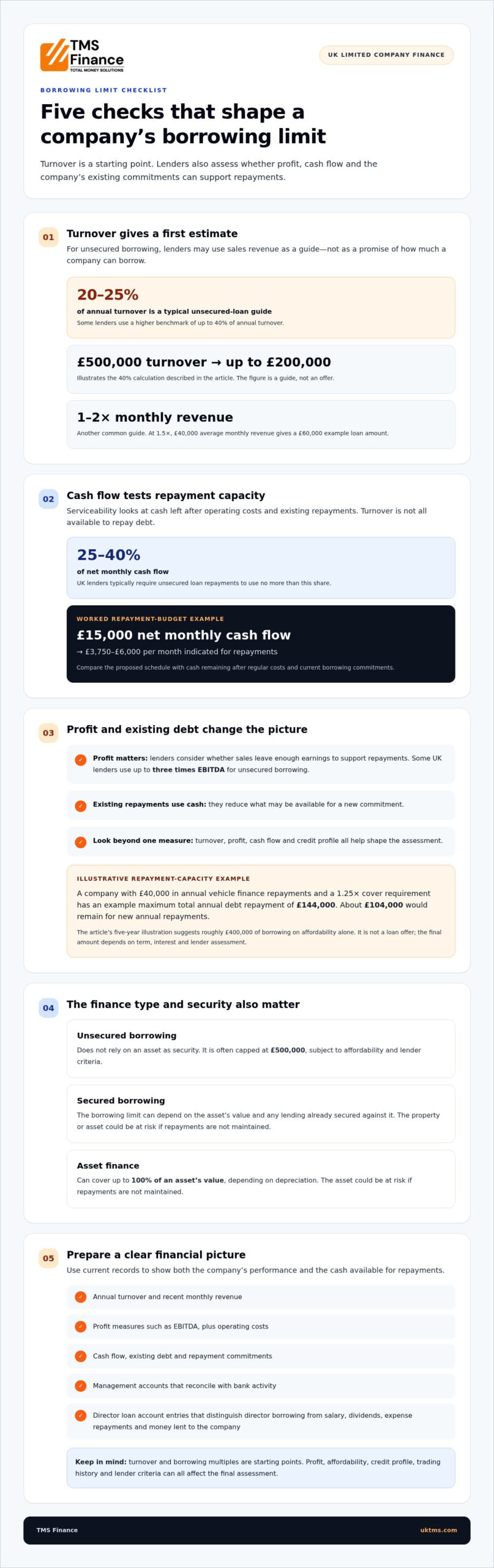
Turnover-based limits use sales revenue as a guide to the loan size a business could support. Most UK lenders typically advance 20-25% of annual turnover for unsecured borrowing. A company with £600,000 annual turnover might typically access £120,000-£150,000. Some lenders use a higher benchmark, offering up to 40% of annual turnover, so a company with £500,000 turnover could reach £200,000 under that calculation.
Monthly revenue offers another view. A common guide is one to two times average monthly revenue; some lenders use 1.5 times. At £40,000 monthly revenue, that 1.5-times example gives £60,000. These figures are starting points, not substitutes for reviewing profit, repayment capacity or credit score.
Repayment Affordability and Net Cash Flow
Serviceability measures whether a company can meet repayments from cash remaining after operating costs. It matters because a large turnover figure does not mean all revenue is available for debt. UK lenders typically require unsecured business loan repayments to use no more than 25-40% of net monthly cash flow. With £15,000 net monthly cash flow, that indicates a repayment budget of £3,750-£6,000 per month.
To assess affordability, calculate cash flow after regular costs and existing repayments, then compare the remaining amount with the proposed repayment schedule. Existing commitments reduce the cash available for new borrowing. Accurate cash-flow records and a clear view of avoidable costs can help show the company’s repayment position.
Loan-to-Turnover and Loan-to-Profit Multiples
Loan multiples compare a proposed loan with revenue or profit, giving lenders a quick measure of scale. Some UK lenders use up to three times EBITDA for unsecured borrowing. EBITDA differs from turnover because it reflects earnings before interest, tax, depreciation and amortisation. A turnover multiple can therefore suggest one borrowing limit, while the company’s profit measure points to another.
For a limited company, review annual turnover, recent monthly revenue and profit measures such as EBITDA, rather than relying on one figure. Lenders may also consider existing debt and cash flow when assessing repayments. Consistent management accounts that reconcile with bank activity can help explain the difference between reported sales and cash available.
Bank term loans, overdrafts and asset finance use different assessment approaches, so there is no single borrowing amount for each. Asset finance can cover up to 100% of an asset’s value, depending on depreciation; the asset may be at risk if repayments aren’t maintained.
Record money a director borrows from or pays into the company in a director’s loan account. This distinguishes director borrowing from salary, dividends, expense repayments and money previously lent to the company. Accurate entries help show the company’s liabilities and cash position during an assessment.
The effect of profit and existing repayments
Profit matters because it indicates whether sales leave enough earnings to support debt repayments. Existing repayments also use cash that could otherwise go towards new borrowing. Lenders may consider both when assessing whether a proposed repayment fits the company’s finances.
Consider an illustrative company with £40,000 in annual vehicle finance repayments. Using a 1.25-times cover requirement, its maximum total annual debt repayments are £144,000. After the vehicle finance, about £104,000 remains for new annual repayments. This is a repayment-capacity example, not a guaranteed loan amount. The final borrowing depends on the term, interest and lender assessment.
A five-year term could, in the same hypothetical example, support a loan of roughly £400,000 on affordability alone. That figure is not an offer or an indication of the total cost. It shows why a repayment budget and loan term matter alongside profit. A company seeking working capital should compare the proposed commitment with its actual cash-flow pattern, not profit alone.
Interest, fees and total repayment
Interest and fees affect the total cost of borrowing, so review the full repayment schedule rather than focusing only on a headline figure. Any example should be treated as hypothetical, based on stated assumptions, and not as a prediction of an individual company’s offer. Rates, fees and terms vary by applicant, facility and provider.
For an unsecured loan, the company does not offer an asset as security, but approval still depends on its financial position and credit profile. A director or company member should understand the repayment commitment and any personal guarantee before agreeing. If a loan is secured against property or another asset, that security could be at risk if repayments aren’t maintained.
Repayment periods and approval timing
Limited-company loan terms can range from 3-72 months, depending on the product. A shorter term generally means less time to repay, while a longer term spreads repayments across more months. The total cost and repayment amount must be considered together. Early repayment terms also vary by agreement, so the contract determines whether paying ahead changes the amount due.
Some UK lenders can fund a limited-company loan within days after documents and due diligence are complete. That timing depends on completing the required checks; it should not be treated as a promised approval period. Prepare current financial records and explain existing borrowing clearly to help lenders assess repayment capacity without avoidable information gaps.
Before seeking additional capital, compare the proposed repayment with existing commitments and the company’s expected cash flow. This can help establish whether an unsecured business loan application reflects a sustainable borrowing amount and term.
How turnover, trading history and cash flow affect assessment
Lenders may use turnover to understand the scale of business activity, then assess whether profit and cash flow can support repayments. They may also consider trading history and recent changes in revenue.
To calculate a borrowing limit from turnover, lenders may apply a revenue-based benchmark, then test the result against affordability. A hypothetical company with £1.2 million turnover and £180,000 EBITDA shows why both measures matter: turnover records sales, while EBITDA gives a view of operating earnings before interest, tax, depreciation and amortisation. Neither figure alone shows how much cash remains after bills and existing payments.
Turnover trends and trading history
Recent performance can affect how a lender interprets annual accounts. Lenders may review whether turnover has grown or remained steady in recent months. A stable pattern can help explain whether annual sales reflect current trading. A sudden fall may prompt questions about future income, while reported growth should be supported by reliable sales and cash records.
Trading history gives context to those figures. Most lenders prefer a UK limited company to have 6-12 months of trading history, while some accept businesses with only a few months if revenue is strong. The business’s financial records should show when sales were earned and when customers paid. This distinction matters when invoices remain unpaid or trading is seasonal.
Cash flow and repayment cover
Cash flow shows whether incoming funds can meet operating costs and debt payments on time. UK lenders often look for a debt service coverage ratio of around 1.25 times or more. This compares cash available for debt service with required repayments. For example, a lender assessing that ratio considers whether earnings provide sufficient cover, rather than treating turnover as cash available to spend.
Existing borrowing matters because repayments reduce the cash available for new finance. Reconcile bank statements, management accounts and repayment schedules to present a clearer picture. This can help explain differences between recorded sales, customer receipts and cash remaining after regular commitments.
Card sales and merchant cash advances
A merchant cash advance links funding to card sales, making card revenue central to the assessment. A UK business with monthly card sales of £50,000 could potentially borrow £75,000 at 150% of average monthly card sales. Businesses with 12-24 months of trading may be offered closer to 100% of monthly card sales.
With a merchant cash advance, repayments are linked to card receipts, so changing sales can affect the amount collected over time. This structure may suit a business with regular card transactions, but may fit less well if revenue mainly comes through invoices or bank transfers. Compare expected deductions with normal cash-flow needs before committing.
What factors influence your borrowing limit?
Lenders assess the company’s history, credit profile, existing commitments and repayment capacity. The same financial figures can lead to different outcomes across banks, government-backed schemes and alternative lenders.
Lender Types and Borrowing Capacity
Banks, government-backed schemes and alternative lenders each assess applications against their own criteria. This matters because the funding route affects which terms, security and eligibility requirements apply. Compare the product’s purpose and repayment structure with the company’s need, rather than judging options by the maximum advertised amount.
A scheme does not remove the lender’s assessment. The company’s finances, credit profile and ability to repay still matter. Different lenders may assess applications in different ways, but their criteria and checks remain central to the decision.
For secured borrowing, lenders may assess the property or other assets offered as security, alongside existing charges and company income. Security may support an application, but it also creates risk: the asset could be at risk if repayments are not maintained. Consider that exposure before choosing a secured route.
Company and Financial Assessment Factors
Company age gives context to its accounts and trading record. Most lenders prefer a UK limited company to have 6-12 months of trading history. Credit history can influence how a lender views repayment risk, while existing debt reduces the income available for another commitment. Cash flow helps show whether regular payments can be met as they fall due.
These factors work together. A newer company with limited accounts may have less evidence of established trading; existing borrowing can constrain capacity even where sales are strong. Lenders may also assess whether turnover has grown or remained steady over the previous six months. Clear records help explain changes in income and commitments.
Application information may include annual revenue, details of directors and shareholders, and bank statements covering the past year. Bring the figures together before applying: reconcile accounts with bank activity, list current debts and repayment amounts, and explain significant changes in trading. This gives lenders a consistent view of income, cash flow and liabilities.
Initial eligibility checks may use soft credit checks. A hard search usually occurs if the applicant proceeds with a specific lender. Understand which stage an application has reached and review the proposed terms, security and repayment obligations before proceeding. A lender’s final decision depends on the application and its criteria.
Eligibility and application information
Eligibility depends on the company’s trading record, financial position, credit profile, borrowing purpose and lender criteria. A clear application connects the funding request to a specific business need and a realistic repayment plan.
Trading History and Eligibility
Trading history shows lenders how long a company has operated and what financial evidence supports its income. Most lenders prefer a UK limited company to have 6-12 months of trading history. Unsecured business loans are typically available to companies with at least 12 months of trading, although some lenders consider shorter records where revenue is strong.
Newer companies can explain their trading position using consistent records. For example, a company with several months of sales can show how invoices, customer receipts and bank activity relate. A gap between invoiced sales and cash received may affect how lenders assess available funds.
Company age is only one part of an assessment. Lenders may also consider business performance, credit history, affordability and any security offered. A longer trading record does not replace evidence that the company can meet repayments from its income.
Eligibility Requirements
Build the application around the funding purpose. For equipment, identify the asset and explain how it supports the business. For working capital, describe the cash-flow need and planned use. A defined purpose helps the lender assess whether the requested amount and repayment structure suit the company’s circumstances.
Application information may include annual revenue, details of directors and shareholders, and bank statements covering the past year. Keep the figures consistent across those records. If accounts show a different pattern from bank receipts, explain the timing of customer payments or other relevant transactions.
Before applying, organise the company’s key records and confirm the amount requested. Include current borrowing and regular repayments so affordability can be assessed alongside the new funding. Check that the directors’ and shareholders’ details match the company information in the application.
Credit checks can form part of the process. Initial eligibility checks may be soft credit checks; a hard search usually occurs if the applicant proceeds with a specific lender. Ask what stage the application has reached before authorising further checks, and review the proposed repayment, fees, security and any personal guarantee before accepting terms.
Use this preparation to make your business loan application clear and complete.
TMS Finance: Business Loans
TMS Finance is a commercial finance broker, not a lender. It can help you explore business finance options in light of your company’s turnover, profit, existing repayments and funding purpose. This is useful when a borrowing estimate needs to be tested against a practical repayment plan.
Depending on the requirement and provider criteria, options may include business loans, asset finance for equipment, or invoice finance for eligible unpaid invoices. Each has a different structure, so consider how repayments fit the company’s income and existing commitments before proceeding.
Contact TMS Finance to discuss your circumstances and possible funding options.
TMS Finance is a commercial finance broker, not a lender. Finance is subject to status, lender criteria and satisfactory checks. Terms, fees, security and personal guarantees may apply. Contact TMS Finance to discuss your circumstances and the funding options that may be available.
Plan your next funding decision
How much a UK limited company can borrow based on turnover and profit is only one part of a sound funding decision. Match the amount and repayment structure to the business purpose, timing and expected cash flow. Borrowing that does not fit those needs can put pressure on working capital.
TMS Finance can discuss business funding options, including business loans, asset finance and invoice finance. As a commercial finance broker, it helps businesses consider possible routes based on their circumstances and funding requirements. A business loan may suit a defined funding need, while asset or invoice finance may relate more directly to a purchase or eligible unpaid invoices.
Before you proceed, set out what the funds will support and how repayments could fit alongside existing commitments. Approval depends on the applicant, business performance, credit profile, affordability, security and lender criteria.
A clear funding purpose and repayment plan provide a practical starting point for discussing your options.
TMS Finance is a commercial finance broker, not a lender. Finance is subject to status, lender criteria and satisfactory checks. Terms, fees, security and personal guarantees may apply. Contact TMS Finance to discuss your circumstances and the funding options that may be available.
Frequently Asked Questions
How much can your business borrow?
How much a UK limited company can borrow based on turnover and profit depends on how those figures relate to the funding purpose and repayment plan. Treat any estimate as a planning guide, not an offer. Before settling on a borrowing amount, consider whether it will cover a defined need and whether the business can use the funds effectively without relying on uncertain future income.
Want to know more about limited company loans?
A limited company can discuss its funding needs with a commercial finance broker, which can help present the case to lenders. TMS Finance’s process starts by understanding the purpose and timing, then reviewing the information, considering potential lender fit and supporting the application. This can help organise a complex requirement, but the lender makes the decision. Understand the terms and costs before accepting an offer.
Affordability: can the business service the debt?
Test proposed repayments against a cash-flow forecast that includes expected receipts and known outgoings. Compare a normal trading period with a weaker one, such as a seasonal dip or delayed contract payment. If the business would struggle to meet essential commitments in that weaker scenario, the borrowing may be unsuitable. Consider delaying the expenditure, reducing its scope or using existing cash reserves where appropriate.
What affects eligibility?
Eligibility may also depend on the people behind the company and the proposed repayment route. Lenders may consider directors’ experience, bank conduct and how clearly the funding purpose is explained. A personal guarantee may be required for some facilities. Before agreeing, understand what it covers and seek professional advice if its legal or financial effect is unclear.
What else changes the figure?
Customer concentration and the quality of outstanding invoices may matter when funding relates to receivables. A ledger heavily dependent on one customer may be assessed differently from one with a broader spread of invoices. Disputed invoices, overdue balances or contractual retentions may also affect eligibility under a provider’s terms. Review the ledger and note any exceptions before discussing invoice finance.
How do UK lenders assess profit, EBITDA and net profit when deciding company loan amounts?
EBITDA and net profit describe different stages of a company’s financial performance. Lenders may compare reported earnings with management accounts and bank activity to understand whether those earnings translate into funds for repayments. If the accounts include unusual or one-off items, explain them clearly with supporting records. An accountant can clarify how to present those items; lenders decide how they affect the assessment.
What financial records and documents do UK lenders require for a limited company loan?
The documents required depend on the facility and its purpose. For invoice finance, an aged debtor report can show invoice dates and outstanding balances. For equipment finance, a supplier quotation or invoice identifies the asset and purchase requirement. Property applications may involve property details, valuation information and planning documents. Prepare records relevant to the requested facility alongside the company’s core financial information.
How do the British Business Bank and government-backed loan schemes affect borrowing limits and eligibility?
A government-backed scheme may set conditions for a participating facility, but it does not make the British Business Bank the lender to your company. The lender assesses the application and applies its own criteria alongside the scheme’s terms. Review the conditions for the specific facility, including repayment obligations and security. Compare a scheme with other suitable routes, rather than treating it as automatic approval.
TMS Finance is a commercial finance broker, not a lender. Contact TMS Finance to discuss your circumstances and the funding options that may be available.