

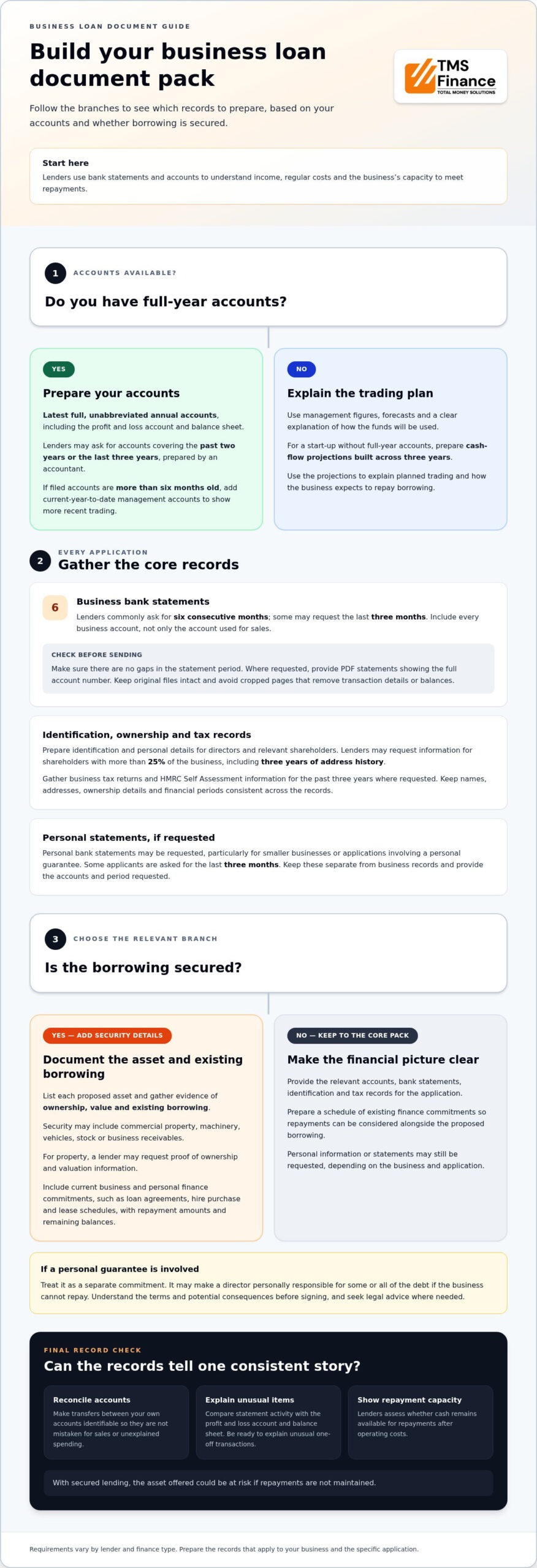
What documents do UK lenders need before approving a business loan? Most applications need business bank statements, financial accounts, tax records and identification for the people behind the business. Lenders commonly ask for six consecutive months of business bank statements, although requirements vary by lender and finance type. Start-ups without full-year accounts can use cash-flow projections built across three years to explain their plans for trading and repayment.
It’s understandable to think that missing accounts could prevent a new business from applying. If full-year accounts aren’t available, management figures, forecasts and a clear explanation of how the funds will be used can help present the business’s position. This guide covers the records to prepare, supporting documents for secured borrowing and how lenders may assess repayment capacity.
Key Takeaways
- Gather records across every business account so lenders can understand cash flow, not just turnover.
- New businesses can use realistic forecasts to explain how they plan to trade and repay borrowing.
- Prepare tax records, ownership details and evidence of existing finance alongside your accounts.
- For secured borrowing, organise information about the proposed asset and any borrowing already secured against it.
- Make your funding purpose clear and show how repayments could fit alongside essential business costs.
Business bank statements and cash flow
Prepare clear financial records showing how money moves through the business. Lenders may use bank statements and accounts to assess income, regular costs and the business’s capacity to meet repayments.
Gather business bank statements
Collect the consecutive business bank statements requested for the application. Lenders commonly ask for six months, though some may request the last three months. Include every business account, not only the account used for sales. That gives a fuller picture of cash flow, balances and transfers between accounts.
Compile financial statements and annual accounts
Set aside the latest full, unabbreviated annual accounts, including the profit and loss account and balance sheet. Lenders may also ask for accounts covering the past two years or the last three years prepared by an accountant. If filed accounts are more than six months old, current-year-to-date management accounts can help show more recent trading.
- Check the statement period and format. Compare the dates on each bank statement to ensure there are no gaps in the period provided. Some lenders ask for PDF statements that show the full account number. Keep the original files intact, and avoid cropped pages that remove transaction details or opening and closing balances.
- Reconcile activity across accounts. If the business uses more than one account, prepare statements for each one. Review transfers, customer receipts, supplier payments, payroll, rent and tax outgoings. Make sure transfers between your own accounts are identifiable, so they aren’t mistaken for additional sales or unexplained spending.
- Review cash flow against the accounts. Compare statement activity with the profit and loss account and balance sheet. Check that customer income and regular costs are recorded consistently. Lenders assess whether cash remains available for repayments after operating costs, so flag unusual one-off transactions and be ready to explain their business purpose.
- Update records for recent trading. Where annual accounts do not reflect the latest position, include current management statements and cash-flow information. A lender may ask for an in-depth profit and loss statement and balance sheet. Keep figures consistent across records, including the latest 12 months where that period is available.
Personal statements may also be requested, particularly for smaller businesses or applications involving a personal guarantee. Some applicants are asked for the last three months of personal bank statements. Keep these separate from business records, and provide only the period and accounts requested. For guidance on preparing an application, see the business loan application process.
What extra documents might be needed for a secured loan?
Secured lending may involve checks on the asset, the business and the people supporting the application. Alongside core financial records, prepare relevant tax returns, borrowing details and evidence of ownership.
Limited companies, sole traders and partnerships may need different supporting information because their ownership structures and financial records differ. A limited company, for example, may need to identify its shareholders, while a sole trader’s application may include personal financial information.
-
Document security and personal guarantees
List each asset proposed as security and gather evidence of ownership, value and any existing borrowing against it. Depending on the facility, security may include commercial property, machinery, vehicles, stock or business receivables. For property, a lender may request proof of ownership and valuation information. Check that the asset details match existing finance records before submitting them.
Treat any personal guarantee as a separate commitment. It may make a director personally responsible for some or all of the debt if the business cannot repay. Understand the terms and potential consequences before signing, and seek legal advice where needed.
-
Provide directors’ and shareholders’ personal information
Prepare identification and personal details for directors and relevant shareholders. Lenders may request information from directors and shareholders with more than 25% of the business, including three years of address history. They may also review directors’ personal credit records, particularly for smaller businesses, start-ups or applications involving personal guarantees.
Keep names, addresses and ownership details consistent across the application and company records. A clear shareholder list helps show who owns and controls the business.
-
Prepare business and personal tax returns
Gather business tax returns and HMRC Self Assessment information for the past three years where requested. Returns help a lender compare declared income with accounts, bank activity and forecasts. For a sole trader or partner, personal tax records may also help explain how business income supports repayments. Use complete records and make sure the periods match the application’s financial information.
-
Summarise existing borrowing and repayments
Prepare a schedule of current business and personal finance commitments. Include loan agreements, hire purchase and lease schedules, with repayment amounts and remaining balances. This helps a lender assess existing commitments alongside the proposed borrowing. Include borrowing secured against business or personal assets, so any prior claims on the security are clear.
Use the schedule to consider whether repayments fit alongside operating costs. With secured lending, the asset offered could be at risk if repayments aren’t maintained.
Organised records can make it easier to explain the proposed security and repayment position. The business loan application process can help you prepare for a funding discussion.
Business plans and financial forecasts
A clear plan connects the amount requested to a defined business purpose and a realistic repayment route. Build forecasts around the funding period, trading assumptions and potential pressure points.
- Set out the purpose and repayment plan. Explain how the funds will be used, such as buying stock, meeting costs for a new contract or investing in equipment. Show how the spending is expected to support income, productivity or growth. Explain how the business plans to repay the borrowing from trading, and identify the assumptions behind projected sales, costs and profit.
- Prepare forecasts that match the application. A three-way forecast brings together cash flow, profit and loss, and a balance sheet. For a start-up without full-year accounts, prepare cash-flow projections across three years. A funding plan should cover at least three years or the loan period, whichever is shorter. For larger facilities, lenders can request plans or projections covering the next 12 to 24 months.
- Test the figures against difficult trading conditions. Model scenarios such as falling sales or late customer payments. Show how these changes could affect cash available for wages, suppliers, rent and repayments. Link the forecast to actual business bank activity and existing assets rather than relying on sales growth alone. If a start-up has no trading history, explain the assumptions behind each forecast instead of presenting estimates as established results.
- Match the plan to the finance request and your commitments. Lenders typically require a business plan for start-up applications; for most unsecured loans below £100,000, they don’t require one. Where a director gives a personal guarantee, include the resulting personal commitment in repayment planning. The lender assesses the business case and affordability, so don’t treat personal support as a substitute for a credible forecast.
- Allow time to complete the application. Small businesses often approach their main business bank and leave little time before their funding deadline. Start assembling forecasts before the funds are needed, then make sure the requested amount, spending plan and repayment assumptions agree throughout the application. Survey findings for Q1 2022 to Q3 2023 reported that 31% of SMEs were happy to use finance, compared with 44% of ethnic minority businesses. A well-supported plan helps explain the proposal on its own business merits.
The cited survey also found that 27% of all SMEs described themselves as ambitious risk takers, compared with 57% of all ethnic minority businesses. These figures describe risk appetite, not evidence that an individual application is affordable. Applicants still need to set out the intended use of funds and demonstrate capacity to repay, with forecasts tested against falling sales or delayed customer payments.
Accounts, tax records and repayment capacity
Limited companies, sole traders and partnerships may need different records because their accounts and ownership structures differ. Prepare accounts, tax information and current figures that show income available for repayments.
-
Review company accounts and management figures
Compare filed accounts with current management figures before applying. Check that income, costs, liabilities and cash balances agree across each record. Lenders generally ask for filed accounts or management accounts prepared within the last 12 months. If filed accounts are more than six months old, current-year-to-date management accounts can show how trading has changed.
Use consistent accounting periods throughout the application. For example, don’t compare a full-year profit figure with partial-year costs without explaining the different periods. If figures have changed significantly, identify why and support the explanation with current records.
-
Provide business current account details
Enter the correct business bank account details and check that the account name matches the applicant. If the business trades through several accounts, provide the relevant details for each. Accurate information helps connect the application’s income and expenditure with the bank statements supplied.
Compare account activity with the stated turnover and regular commitments. Differences between recorded customer income and bank receipts can prompt follow-up questions. Keep a clear note of transfers between the business’s own accounts so they aren’t mistaken for sales.
-
Prepare and submit documents to avoid delays
Organise application files by type, such as accounts, tax records and current-year figures. Use clear file names and ensure each document is complete and readable. Missing pages, inconsistent periods or unexplained differences can lead to further requests and delay assessment.
Before submitting, compare the application figures with the supporting records. Check that the funding purpose, business income and repayment information are consistent. A complete, well-organised file helps a lender assess affordability against its criteria.
- Prepare an alternative if filed accounts aren’t available. A new business may not yet have filed accounts. Provide available management figures, business bank records and realistic forecasts to show its trading position. Explain the assumptions behind projected income and costs, and how expected cash flow could support repayments.
Tax returns can provide context for the financial picture. Lenders may request business tax returns, with the relevant records depending on the business structure. A company’s filed accounts and a sole trader’s Self Assessment information differ, so provide records that accurately reflect the applicant and its owners.
Core documents for unsecured business loans
For an unsecured application, knowing what documents UK lenders need before approving a business loan helps you prepare evidence of trading, ownership, identity and repayment capacity. Requirements vary between banks, online lenders and government-backed routes, and may depend on whether you already bank with the lender. Start-up applications may also need a business plan and forecasts.
-
Identify documents for unsecured applications
Build a core file with business bank statements, financial accounts, relevant business and personal tax records, and details of existing finance. Add photo ID and proof of address for directors or beneficial owners, plus a shareholder list for a limited company. A lender may request VAT returns, asset details or quotations where relevant. Check that each document is complete and matches the applicant’s details.
- Show the business’s trading and credit history. Include records that explain sales, regular costs and current borrowing payments. Lenders may consider business credit information, trading history, revenue and existing commitments. Prepare a clear schedule of loans, hire purchase and leases so proposed payments can be assessed alongside current obligations.
- Separate business and personal information. Keep company accounts and business records distinct from owners’ personal documents. A lender may review directors’ personal credit records, particularly for smaller businesses, start-ups or applications involving a personal guarantee. Provide requested personal income information and address evidence for relevant owners, ensuring names and addresses match their identification.
- Match the evidence to the amount and purpose. For most unsecured business loans below £100,000, lenders don’t require a business plan. For facilities above £100,000, lenders typically ask for additional documents. State whether funds will support stock, equipment or growth, then include quotations or forecasts that directly support that purpose. Avoid generic plans that don’t explain the borrowing request.
-
Compare lender-specific document requirements
Ask for the document checklist before assembling your final application. A bank may already hold some records if you’re an existing customer, while another lender may request them directly. Online lenders also set their own requirements, so don’t assume one application’s checklist applies elsewhere. A government-backed start-up route may require a business plan and forecasts to explain the proposal.
- Check the application for missing evidence. Confirm that identity documents, account details, tax records and financial statements cover the requested periods. Include all relevant business accounts and explain gaps or differences between records. Incomplete documents, unclear funding objectives or a weak credit profile can contribute to rejection, so resolve inconsistencies before submitting.
- Keep a final copy of every submission. Save the exact documents and figures sent to the lender. If it requests more information, you can respond using consistent records rather than rebuilding the application. Keep track of which lenders received each document so you can answer follow-up questions accurately.
TMS Finance: Business Loans
TMS Finance is a credit broker, not a lender. It helps businesses explore Business Loans for costs or growth and consider whether Asset Finance, Invoice Finance or Commercial Mortgages better fit their funding purpose. TMS Finance can help organise financial information, prepare an application and explain the options available through selected providers.
Approval depends on your circumstances, business performance, credit profile, affordability, security and lender criteria. Interest, fees and total repayments can vary. Consider whether repayments fit your cash flow, and seek professional advice where appropriate.
TMS Finance is a commercial finance broker, not a lender. Finance is subject to status, lender criteria and satisfactory checks. Terms, fees, security and personal guarantees may apply. Contact TMS Finance to discuss your circumstances and the funding options that may be available.
Get your application ready for the next step
Knowing what documents UK lenders need before approving a business loan gives you a practical starting point. Next, make sure the funding request fits your business’s priorities and repayment capacity. Borrowing should serve a clear purpose and come with a workable plan, rather than adding unsustainable pressure to cash flow.
Before approaching a lender, bring your records together and note any points that need explanation, such as a change in trading or an unusual commitment. A clear account of your plans can help frame a discussion about suitable commercial finance. Approval depends on your circumstances, business performance, credit profile, affordability, security and lender criteria.
A considered funding decision starts with clear information and a repayment plan the business can sustain.
TMS Finance is a commercial finance broker, not a lender. Finance is subject to status, lender criteria and satisfactory checks. Terms, fees, security and personal guarantees may apply. Contact TMS Finance to discuss your circumstances and the funding options that may be available.
Frequently Asked Questions
Do start-ups need accounts if they are newly trading?
No. A newly trading business may not have filed accounts to submit. It can explain its position using forecasts and available management information. Make the assumptions clear, including how expected sales relate to costs and planned repayments. If the business has only recently started trading, separate actual figures from projections so a lender can distinguish proven performance from future expectations.
Why do lenders ask for Companies House details?
Companies House records can help a lender compare a limited company’s stated ownership and management with its public filings. Check that the directors and shareholders named in the application match the company’s current records. If a recent change has not yet appeared in a filing, explain it and provide accurate supporting details. This can reduce questions about who controls or represents the borrowing business.
Why do traditional lenders require so much paperwork?
Each document helps assess a different part of the application. Financial records support the business’s repayment case, while identity and ownership information establish who is applying. Credit and existing borrowing details help show current commitments. Together, these checks help a lender assess affordability, business performance, credit profile and any proposed security against its own criteria.
What can I do if a lender rejects my application?
Ask the lender for the reason behind its decision and use the response to identify any gaps in the application. UK applicants can ask for a rejection reason within 30 to 60 days of the result. Review whether the concern relates to affordability, credit history, trading information or incomplete evidence. Address the relevant issue before deciding whether to make another application.
What extra documents do UK lenders request for larger loans or specific industries?
For larger facilities, lenders may request additional documents, including business plans or financial projections covering the next 12 to 24 months. Secured borrowing may require asset details, proof of ownership, valuations and existing borrowing information; businesses in regulated industries may need licences, permits and certifications.