

A funding gap can affect payroll, supplier payments or a planned purchase. Knowing what documents are needed for a business loan UK lenders may request can help you prepare a clearer application and reduce avoidable follow-up questions.
It can be hard to know which records matter when you’re also managing day-to-day commitments. The documents depend on the business, the purpose of the borrowing and the facility being considered. This guide covers the records lenders may ask for, why they matter and how to prepare them. It also explains what to weigh up if borrowing may not suit your circumstances.
Start with your financial records, then add evidence that explains how you intend to use the funds. TMS Finance is a commercial finance broker. It reviews funding requirements, helps prepare applications and considers possible finance options through its available lender routes. Well-organised documents can make the request easier to understand, but the lender makes the decision.
Key Takeaways
- Gather the core financial records, then add evidence that explains the funding purpose.
- The documents UK lenders may request vary by applicant, facility and lender.
- Match supporting evidence to the request, such as a supplier quotation for an equipment purchase.
- Check that accounts, forecasts and the requested amount present a consistent picture.
- Weigh the costs, risks and alternatives before borrowing, and understand how a broker can help prepare an application.
UK Business Loan Documents: Requirements and Importance
A cash-flow shortfall, equipment purchase or growth plan may prompt you to consider borrowing. A lender needs enough information to understand the request, the business’s position and how repayments may be made. Missing records or conflicting figures can lead to follow-up questions and slow the assessment while the business still has a funding need.
A business-loan document pack helps explain the business, the proposed use of funds and the repayment plan. It may include financial records, director information and documents relating to a purchase or project. If you’re asking what documents are needed for a business loan in the UK, there is no single checklist for every application. Requirements depend on the applicant, facility and lender.
A Business loan can take different forms, and the information required may vary with the type of borrowing. A commercial loan application for an established company may require different evidence from an application under a scheme designed for people starting or growing a young business. TMS Finance’s business loan application support helps organise information around the funding requirement. It does not guarantee a lending decision.
What can a lender learn from the application documents?
Records can help a lender assess trading performance, cash flow and existing financial commitments, and consider whether proposed repayments appear affordable. Evidence of the funding purpose, such as a project outline or purchase details, explains how the requested amount would be used. Lenders may weigh these and other factors differently, so no single document or factor guarantees an outcome.
For an equipment purchase, the application can explain how the asset will be used in the business. For working capital, a cash-flow forecast and bank records can help show when money is expected to come in and when costs fall due. The aim is to connect the amount requested to its intended use and the business’s circumstances. For a broader overview of working capital finance for growing UK businesses, including how different facilities may address cash-flow timing gaps, consider the funding need and repayment pressure together.
Are Start Up Loan documents the same as business-loan documents?
GOV.UK and Start Up Loans guidance relates to a particular government-backed scheme. Start Up Loans are personal loans for business purposes, rather than commercial borrowing made directly to a business. Scheme-specific paperwork is not a checklist for every commercial finance application.
No single document list applies to every business finance facility. The records required depend on the applicant, purpose and lender’s assessment. First identify whether you’re considering the Start Up Loans scheme or commercial borrowing for a business. For tax, accounting or legal questions, seek advice from an appropriately qualified professional.
Core business-loan documents: accounts, bank statements and cash-flow evidence
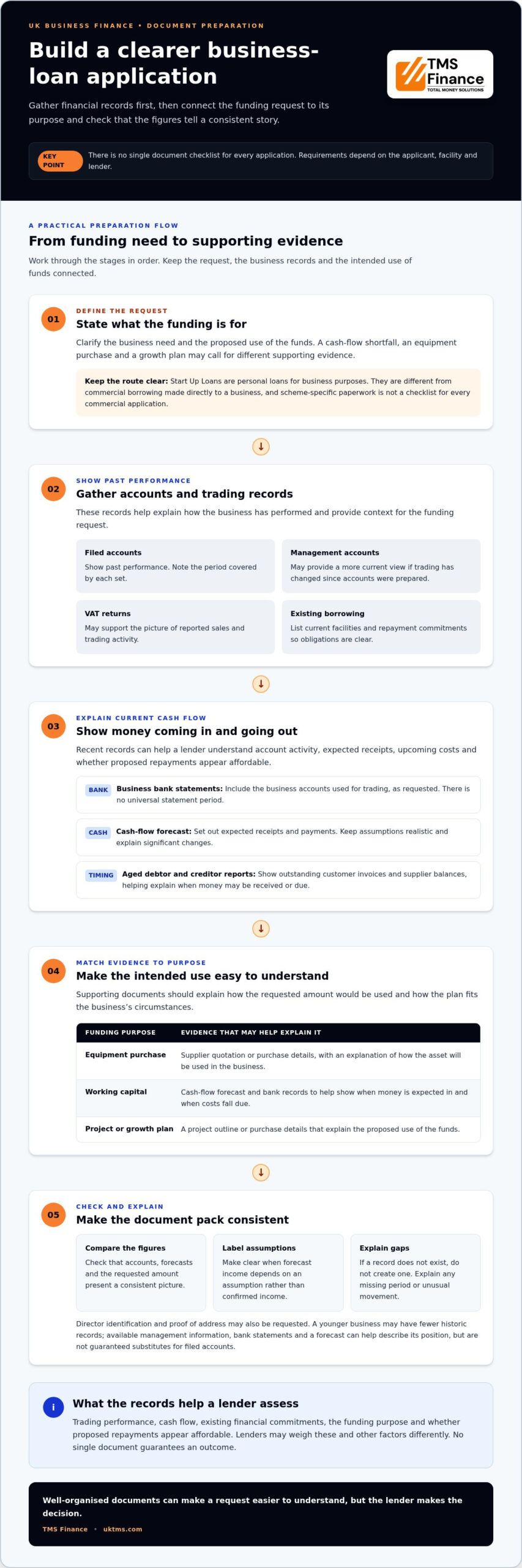
Once you have defined the funding purpose, gather records that show how the business is performing now as well as in the past. Recent business bank statements are commonly requested, but there is no universal statement period. Do not assume that a timeframe used for one scheme or lender applies to every commercial application.
Which financial records should an established business gather?
Filed accounts show past performance. Recent management accounts can provide a more current view if trading conditions have changed since the accounts were prepared. Bank statements show account activity and help explain how cash moves through the business. Taken together, these records can help a lender compare reported performance with recent income and outgoings.
- Filed accounts or management accounts: Gather the available accounts and note the period each set covers.
- Business bank statements: Include the business accounts used for trading, as requested for the application.
- Cash-flow forecasts: Set out expected receipts and payments. Keep assumptions realistic and explain significant changes.
- VAT returns: These may be relevant as supporting evidence of reported sales and trading activity.
- Aged debtor and creditor reports: These show outstanding customer invoices and supplier balances, helping explain when money may be received or due.
- Existing borrowing: List current facilities and repayment commitments so the application presents the business’s obligations clearly.
- Director information: Be ready to provide identification and proof of address if requested.
Forecasts and aged reports add context that historic accounts alone may not show. A forecast can indicate when a large customer payment is expected, while an aged debtor report can show whether the invoice is overdue. Check that figures and dates match across the documents. If a forecast depends on an assumption, label it rather than presenting it as confirmed income.
What if the business has limited trading history or no filed accounts?
A younger business may have fewer historic records. Available management information, bank statements and a cash-flow forecast can help describe its position, but they are not guaranteed substitutes for filed accounts. The documents requested depend on the application and lender. Keep scheme-specific paperwork separate: GOV.UK’s guidance for a Start Up Loan applies to that particular route, not every commercial business-loan application.
If a record does not exist, do not create one to fill the gap. List what is available and explain any missing period or unusual movement. An accountant can help prepare financial information if needed. TMS Finance can review records and help organise an application. Read about its business loan application support to understand the process. Clear, consistent evidence helps explain the request, but cannot guarantee approval.
Match business-loan documents to the funding purpose
Financial records show how the business is performing. Supporting evidence should also explain why the requested amount fits the planned use. Keep the pack focused: the relevant documents depend on the facility and the case, so not every example below will apply.
If you’re asking what documents are needed for a business loan in the UK, start with the funding purpose. This guide shows examples of evidence that may help explain the request:
- Working capital: A cash-flow forecast and relevant bank records can show when a shortfall is expected and how the funds will be used.
- Stock or trade funding: Stock lists, supplier quotations or invoices may support the amount requested and planned purchases.
- Contract or invoice-related funding: Contract details, invoices or evidence of scheduled work may help explain expected income and payment timing.
- Asset or equipment finance: A supplier quotation or invoice can identify the asset, its cost and the intended purchase.
- Merchant cash advance: Card-processing statements may be requested to show card transaction activity.
- Property finance: Property details, valuation information, planning documents, project cost schedules and evidence of the proposed exit may be relevant, depending on the case.
What evidence may support working capital, stock or contract funding?
Connect the documents to the cash-flow need. If funding is sought to buy stock ahead of a busy trading period, supplier quotations and a forecast can show planned spending alongside expected sales receipts. For contract funding, relevant contract or invoice information may explain when work will be carried out and when payment is expected. These records support the explanation but do not determine the lending decision.
Keep dates and amounts aligned. If the forecast assumes a customer payment, supporting contract or invoice details can provide context. For card-based businesses, processing statements may be relevant to a merchant cash advance application. The lender decides what information it needs.
What documents may support equipment or property finance?
For an asset purchase, a quotation or supplier invoice identifies what the business intends to buy. For property funding, group the evidence around the property or project. Property details, valuation information and relevant planning documents can describe the proposal. A cost schedule sets out expected project spending, while exit evidence can help explain how a property-funding facility is intended to be repaid.
Requirements vary. A Lloyds Bank business loan application guide gives one lender’s perspective on application information, but it is not a universal checklist. TMS Finance reviews funding requests and helps prepare supporting information. Its business loan application support can help organise the case around the funding purpose and relevant evidence.
Prepare the application carefully, understand the risks and consider alternatives
A complete file is easier to review, but borrowing also needs to make sense for the business. Check that the amount requested, intended use and proposed repayment plan fit the company’s cash flow. Knowing what documents are needed for a business loan UK lenders may request is useful, but the records must support a realistic decision about taking on debt.
How can a business make its document pack easier to assess?
Use a simple preparation sequence. Define the funding purpose and amount, gather relevant records, then reconcile figures across accounts and forecasts. Label files by category, such as business records, directors, existing borrowing and funding purpose. Note missing information or unusual changes and explain them plainly. Do not alter or overstate evidence to make the figures appear stronger.
Check that the requested amount matches the supporting documents. If a forecast assumes particular income or costs, make sure the underlying information is consistent. If circumstances have changed since the accounts were prepared, explain what changed and when. This makes the application easier to follow and can reduce avoidable confusion.
A complete, consistent document pack supports a clearer assessment, but it cannot guarantee approval. Lenders make their own decisions. They may consider the applicant, business performance, credit profile, affordability, security and other factors. They may also ask follow-up questions or request further information.
When might borrowing be unsuitable?
Pause if repayments could put more pressure on already strained cash flow or if the business case relies on uncertain income. Consider whether the spending can be delayed, phased or met from available business cash without weakening essential reserves. You could also review whether an existing facility better matches the need. Compare business loan repayments and total costs before proceeding.
Review the proposed terms, fees, repayment schedule and any security or personal guarantee carefully. If finance is secured against a business asset or property, that asset could be at risk if repayments are not maintained. A personal guarantee may create personal liability, so understand its terms before agreeing. A different facility or longer term does not automatically resolve affordability concerns.
For tax, legal or accounting questions, seek advice from a suitably qualified professional. Personal financial questions also call for advice based on your circumstances. TMS Finance is a commercial finance broker. It reviews funding requirements, helps prepare information and considers possible facilities through its available routes, but it cannot promise a lender’s decision.
How TMS Finance supports a UK business-loan application
Preparing documents is one part of an application. The funding purpose, amount and timing need to make sense alongside the business’s records and repayment plan. TMS Finance begins by discussing these details, then reviews the information available and helps organise documents so the request is presented clearly.
What does a commercial finance broker do with your documents?
TMS Finance reviews the funding requirement and helps assemble an application for possible lender consideration. It considers suitable facilities and lenders available through its routes, then supports the process by helping respond to lender queries. TMS Finance is a commercial finance broker, not a lender. It cannot override lender criteria or promise an offer.
There is no fixed route to approval. Lenders assess each application under their own criteria, which may include the applicant, business performance, credit profile, affordability and any security offered. Preparing documents helps explain the case, but the decision remains with the lender.
If a lender makes an offer, review the full terms before deciding whether to proceed. Pay particular attention to:
- Repayment amounts, schedule and obligations
- Interest, fees and other costs stated in the offer
- Whether security or a personal guarantee is required, and what it covers
- Any conditions that must be met before completion
Ask questions about terms you do not understand. If finance is secured against property or another asset, it could be at risk if repayments are not maintained. Completion depends on the circumstances and the lender’s requirements being met.
What should you do before discussing your funding requirement?
Set out the amount sought, intended use, timing and business outcome you expect the funding to support. Gather the core records already available and note anything still being prepared. Listing gaps helps keep the discussion practical without presenting incomplete information as final.
Bring together the key figures and explain important assumptions. If the request supports a planned purchase or project, have the relevant supporting information ready. TMS Finance can review the material, help prepare documents and support you through lender questions. This can make the application easier to follow, but does not guarantee approval, rates or completion.
To discuss your funding need and prepare the next steps, visit the business loan application page. The documents UK lenders may request depend on your circumstances and the facility being considered.
Turn your funding plan into a clear next step
Before moving ahead, decide what a successful funding outcome would look like and how you will judge whether repayments remain manageable. This gives you a practical basis for discussing the request, rather than focusing on paperwork alone. If you’re still considering what documents are needed for a business loan UK lenders may request, TMS Finance can help organise the information around your circumstances.
TMS Finance is a member of the National Association of Commercial Finance Brokers. As a commercial finance broker, it supports document preparation, application presentation and offer review. Any offer and completion depend on the lender’s assessment, its criteria and the details of the case. Take time to understand the terms before deciding whether to proceed.
A considered application can help you make a more informed decision about the funding your business needs and what it can reasonably take on.
Frequently Asked Questions
Do I need filed accounts to apply for a business loan?
Not always. The evidence requested depends on your trading history and the finance being considered. An established business may have filed accounts, while a newer one may have management information and forecasts to explain its current position. These records are not automatically interchangeable. If your latest accounts do not reflect a major change, such as a new contract or a fall in sales, explain the context clearly.
How recent do business bank statements need to be for a loan application?
There is no single statement period for every commercial application. A lender may request recent statements to understand account activity and will specify the period and format it needs. Provide complete statements for the relevant business accounts rather than selected pages. If a transaction looks unusual, a brief factual explanation may help. The documents needed for a business loan in the UK depend on the application, so do not rely on another lender’s checklist.
Does every business loan application need a business plan?
No. A business plan may help explain a start-up or growth proposal, but it is not a universal requirement for commercial borrowing. For a specific purchase, a clear purpose and supporting quotation may be more relevant. For working capital, a lender may focus on trading and cash-flow evidence. The documents UK lenders may consider depend on the facility and the details of your case.
Can a new business apply for a loan without trading accounts?
It may be possible to discuss an application, but having no filed accounts does not establish whether finance is suitable or whether a lender will approve it. A new business can prepare available records, a forecast and a clear explanation of how funding supports its plan. For example, distinguish confirmed orders from hoped-for sales. A commercial finance broker can help identify relevant evidence, while the lender decides under its own criteria.
Are the documents for a Start Up Loan the same as for a commercial business loan?
No, the document requirements can differ. The government-backed Start Up Loans scheme is structured as a personal loan for business purposes, and its guidance applies to that scheme. Commercial business finance is assessed in a different context and may involve business records or evidence specific to the facility. Do not assume a scheme checklist applies to other borrowing. Organise evidence around your business and funding purpose.
TMS Finance is a commercial finance broker, not a lender. Finance is subject to status, lender criteria and satisfactory checks. Terms, fees, security and personal guarantees may apply. Contact TMS Finance to discuss your circumstances and the funding options that may be available.