

Could a profitable project still leave your construction business short of cash? It can when wages, materials, plant and subcontractor invoices fall due before stage payments arrive, or when cash is tied up in unpaid invoices and retentions. Construction company cash flow finance UK businesses consider should address the timing and cause of the gap, not just the amount required.
Borrowing brings costs and repayment commitments, and security may be required. The right facility depends on your business, its financial position and how the borrowing could be repaid. But leaving a cash-flow gap unaddressed can put pressure on payroll, supplier relationships and your ability to mobilise for work. Start by forecasting the shortfall and testing whether borrowing is affordable.
This guide explains common sources of construction cash-flow gaps and compares possible options, including invoice finance, working-capital finance, revolving credit and asset finance. It covers the information that may support an enquiry, the costs and risks to weigh, and when borrowing may not be suitable. TMS Finance is a commercial finance broker and a member of the National Association of Commercial Finance Brokers. It helps businesses assess funding needs, prepare applications and review offers. The lender makes the lending decision.
Key Takeaways
- Map project costs against expected payments to identify the size and timing of a cash-flow gap.
- Compare business loans, revolving credit, invoice finance, asset finance and trade finance by purpose and realistic repayment source.
- Assess total borrowing costs, repayment terms, security and any personal guarantee before deciding whether finance is manageable.
- Prepare a clearer construction company cash flow finance UK enquiry with forecasts, accounts, bank statements and details of existing borrowing.
- TMS Finance can help assess the funding need, prepare an application and explain an offer. It cannot guarantee approval.
Why construction company cash flow can tighten between project costs and payments
Construction costs can fall due before the related customer payment arrives. A business may need to mobilise a site, buy materials, pay subcontractors and meet payroll while waiting for a stage payment or invoice to be settled. Tax commitments and overheads continue alongside project costs, leaving several demands competing for the same working capital.
Construction company cash flow finance UK businesses consider is funding intended to address a timing gap or working-capital requirement. The facility should fit the reason for the shortfall and have a realistic repayment route. It is not a fix for an unviable project: borrowing adds a repayment commitment and cannot make weak project economics work.
A strong turnover figure or profitable contract does not mean cash is available when bills fall due.
Where construction cash flow pressure commonly starts
The gap can begin before work is underway. Mobilisation, labour, plant hire and initial material purchases may need to be paid upfront, while customer receipts depend on agreed stages or invoice terms. Retentions and late payments can extend the time before all contracted income reaches the business.
Illustrative hypothetical example: A contractor pays for materials and subcontractor work before submitting a stage invoice. The customer’s payment arrives after the next payroll and supplier dates. The contract may still be profitable overall, but the timing creates a temporary cash shortfall. The actual size and duration depend on the contract, payment schedule and costs.
Separate a temporary mismatch from an ongoing shortfall. If cash is expected to recover when identified invoices are paid, the pressure may be time-limited. If costs repeatedly exceed receipts, margins are insufficient, or payment delays keep rolling forward, the business may have a structural problem. Review the forecast and the contract economics before considering borrowing. Broader cash-management steps are covered in Improving Business Cash Flow: 2026 Guide for UK SMEs.
Why delaying a response can affect delivery
Limited working capital can make it harder to pay suppliers on time, maintain payroll, order materials or mobilise for the next stage. These effects are not inevitable, but unresolved pressure can strain commercial relationships and restrict the options available. An early review helps you identify upcoming commitments and estimate when expected receipts may clear.
Map outgoings against expected payments, including uncertainty around invoice dates and customer receipts. This helps clarify the amount, duration and purpose of any funding need. It also lets you test whether repayments could be supported by cash the business reasonably expects to receive.
Project finance is a separate concept that considers a project’s projected cash flows and structure. The Project finance overview provides background. For a contractor assessing a working-capital gap, the practical priority is to establish whether the contract and repayment route are viable. Borrowing cannot repair an unviable contract or an unreliable repayment plan.
Construction company cash flow finance options and what each may fund
The right facility depends on what the money needs to cover, how long it is needed and where repayments could come from. Construction company cash flow finance UK businesses consider can include several types of funding, but no option is suitable by default. Availability, security and terms depend on the applicant, transaction and lender criteria.
Match the facility to the specific cash flow need
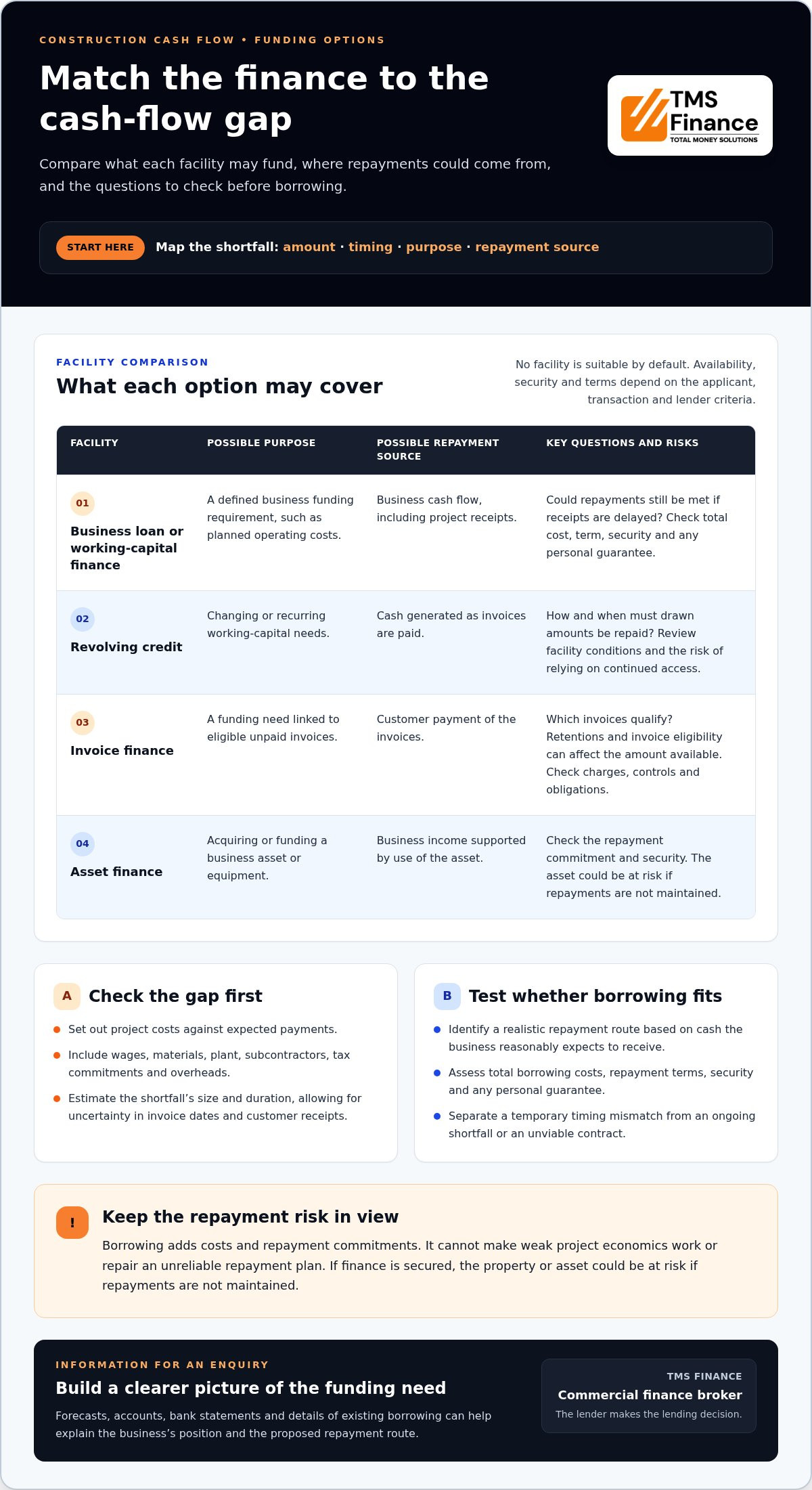
A business loan or working-capital facility may suit a defined requirement, such as covering planned operating costs. A revolving credit facility may be worth considering when the amount needed changes over time, but its repayment terms and access conditions must fit the forecast. Invoice finance may be relevant when eligible unpaid invoices are central to the gap. Invoice eligibility and retentions can affect the amount available. Read the invoice finance guide for more detail.
| Facility | Possible purpose | Possible repayment source | Key risks and questions |
|---|---|---|---|
| Business loan or working-capital finance | A defined business funding requirement | Business cash flow, including project receipts | Can repayments be met if receipts are delayed? Check total cost, term and any security or personal guarantee. |
| Revolving credit | Changing or recurring working-capital needs | Cash generated as invoices are paid | How and when must amounts drawn be repaid? Review facility conditions and the risk of relying on continued access. |
| Invoice finance | A funding need linked to eligible unpaid invoices | Customer payment of the invoices | Which invoices qualify, and what charges, controls or obligations apply? |
| Asset finance | Acquiring or funding a business asset or equipment | Business income supported by use of the asset | Check the repayment commitment and security. The asset could be at risk if repayments are not maintained. |
| Trade or stock finance | Eligible purchases of supplies or stock | Receipts from the work or sales supported by those purchases | Does the funding period match the purchase and payment cycle? Check the structure and terms. |
Consider equipment and supplier-related funding
Asset and equipment finance may be relevant when a business needs a revenue-generating asset, rather than general cash for unrelated costs. Trade or stock finance may suit eligible purchases of supplies. In either case, compare the expected use of the asset or supplies with business cash flow and repayment dates. Structure and terms vary by applicant and facility. For housing development projects, GOV.UK provides information about the Home Building Fund. This is separate from routine working-capital finance.
Compare options against the specific gap, not just the amount offered. TMS Finance can help frame a funding enquiry around its purpose and cash-flow impact. If you are assessing a business loan, you can prepare a business loan application with the requirement and repayment plan clearly set out.
How to compare construction finance costs, repayment fit and risks
A finance offer needs to work beyond the headline amount. Compare the full repayment commitment with your cash-flow forecast, existing borrowing and expected receipts. When assessing construction company cash flow finance UK businesses may consider, ask whether repayments remain affordable if project timing or costs change.
Test repayment affordability against project scenarios
Put expected receipts, committed costs and existing repayments into one forecast. Check when cash is due in and out, then compare those dates with the proposed repayment schedule and facility term. Do not treat projected contract revenue as cash already available: receipts may depend on completed work, invoice approval and payment timing.
Illustrative downside scenario: If a project receipt arrives later than forecast, test whether the business can still meet finance repayments and essential commitments from other expected cash. If the plan only works when every payment arrives on time, the repayment route may be too fragile.
Compare the full cost and obligations
Review each offer in writing. A lower regular repayment may come with a longer term, while a shorter term can put more pressure on monthly cash flow. Compare the total amount repayable, interest, any stated fees, repayment frequency, term and conditions for using or repaying the facility. If the borrowing is variable or could run longer than planned, understand how that could affect the cost.
- Repayment fit: Does the schedule align with forecast cash receipts, including if payments are delayed?
- Security: What property or asset is being offered, and what could happen if repayments are not maintained?
- Personal guarantee: Is one required, what obligations does it create, and who would be responsible under its terms?
- Flexibility: Are there conditions or charges for early repayment, changes in use or continued access?
With secured finance, the property or asset used as security could be at risk if repayments are not maintained. A personal guarantee can also create personal obligations. Read the terms carefully and consider independent legal or financial advice if you are unsure about the commitment.
Recognise when borrowing may not be the right answer
Persistent operating losses, an uncertain repayment source or commitments the business cannot afford are warning signs. More borrowing may increase pressure rather than resolve it. First consider whether cash flow could be improved by reviewing customer payment terms, agreeing a different payment schedule where possible, or phasing expenditure to match project progress.
If the forecast still shows a shortfall, establish whether it is temporary and what would repay the facility. If the issue concerns contract viability, tax, legal obligations or accounting treatment, seek advice from an appropriately qualified professional. TMS Finance can discuss the funding requirement and consider whether a finance route fits the cash-flow impact. This does not guarantee an offer or approval.
Prepare a credible construction finance enquiry with the right evidence
A clear enquiry explains what the business needs, when it needs it and how the funding could be repaid. For construction company cash flow finance UK businesses are considering, set out the project costs and expected receipts behind the request. This gives a broker or lender a practical basis to assess the requirement, although document requests and lender criteria vary by facility.
Set out the funding purpose and timing
State the amount required, what it will fund and when it is needed. Link the request to identifiable costs, such as a materials order or subcontractor commitment, and compare these with expected project receipts. Explain the proposed repayment route, including which income is expected to support repayments and when. Connecting the funding purpose to a realistic repayment plan makes the enquiry easier to assess.
Build the enquiry in a logical order:
- Define the need: Describe the specific shortfall and separate it from other business or project costs.
- Map the timing: Record when key costs fall due and when customer payments are expected.
- Assemble evidence: Gather current business information and project documents that support the figures.
- Explain repayment: Show the expected source of repayment and consider how delayed receipts could affect the plan.
Organise business and project information
Prepare recent business bank statements, filed or management accounts and a cash-flow forecast. Make sure the forecast reflects expected receipts and committed costs, not just planned work. Details of existing borrowing can show current repayment commitments and the wider funding position. Keep dates and figures consistent across documents, and explain material changes or assumptions.
Depending on the facility and lender, useful supporting evidence may include:
- Project contracts, payment schedules and cost breakdowns
- Aged debtor and creditor reports, where relevant to the cash-flow need
- Details of existing finance, balances and repayments
- Supplier quotations or asset information for an equipment-related request
- Project or valuation evidence for a property-backed requirement, where applicable
This is not a universal checklist. The information requested depends on the applicant, transaction and facility. If invoices are central to the requirement, Invoice Finance: A 2026 Guide to Managing UK Business Cash Flow covers invoice-focused considerations in more detail.
To organise the information for a business loan application, set out the purpose, timing and repayment plan alongside the supporting evidence.
How TMS Finance supports construction companies exploring cash flow finance
TMS Finance is a commercial finance broker, not a lender. It supports construction businesses by understanding the funding requirement, reviewing information and considering potential lender and facility fit through routes available to TMS Finance. It does not represent the whole market, and a discussion does not guarantee an offer or approval.
TMS Finance works with businesses in sectors including construction and trades, and is a member of the National Association of Commercial Finance Brokers. Its focus is to understand the purpose of the funding and its likely cash-flow impact, rather than assess the amount requested in isolation.
What happens when a business discusses its requirement
An initial discussion covers the purpose, amount and timing of the funding, along with the outcome the business needs. TMS Finance reviews the information, assesses the requirement and considers potential lender fit. If an application is appropriate, it can help organise supporting documents and present the case clearly. Queries, checks and completion requirements depend on the transaction and lender.
The process can include application support and offer review, helping the business understand proposed terms before deciding how to proceed. Consider the repayment schedule, costs, security and any personal guarantee carefully. Lenders may consider the applicant’s business performance, credit profile, affordability, security and repayment route. The decision rests with the lender.
What to prepare before making an enquiry
Set out the cash-flow gap, the project commitments behind it and the expected repayment source. Gather relevant business and project evidence, such as forecasts, accounts, bank statements, payment schedules or supplier quotations. Clear, consistent information helps explain how the request relates to the project and the business’s finances. The documents needed vary by facility and lender.
Construction company cash flow finance UK businesses consider should be assessed against a clear funding purpose and realistic repayment route. If figures or payment timing are uncertain, explain the assumptions rather than treating forecasts as guaranteed receipts. This gives the discussion a sound basis and helps identify any further information needed.
Make your next funding decision with a clear plan
Before pursuing construction company cash flow finance UK, decide what a workable outcome looks like for your business. Set clear limits for the repayment commitment and any security you would consider. Use those boundaries to assess whether a proposed facility could support the project without putting essential operations under undue pressure.
If the figures change as the project progresses, revisit the decision rather than relying on assumptions made at the outset. You can then decide whether to proceed, adjust the plan or consider another approach.
A measured decision keeps the business’s cash-flow needs and the risks of borrowing in view. If your business needs funding for cash flow, equipment, stock, growth or property, contact TMS Finance. Explain how much you need, what it will fund and when it is required, so TMS Finance can assess which options may be worth exploring.
Frequently Asked Questions
Can a newly established construction company apply for cash flow finance?
A newly established construction company may be considered for finance, depending on the business, application and facility. An enquiry should explain trading activity to date, the project or costs to fund, expected receipts and the proposed repayment source. Where trading history is limited, relevant experience or confirmed work may help explain the business’s position. No single factor guarantees approval.
What happens if a construction project payment is delayed after borrowing?
A delayed payment can leave the business owing repayments before the expected project cash arrives. Contact the lender promptly to explain the change and understand what the agreement requires. Do not assume a repayment date can be changed or paused without the lender’s agreement. Update the cash forecast, identify other expected receipts and review essential commitments. If the delay points to a wider contract or solvency concern, seek appropriate professional advice.
Can construction cash flow finance be secured against a business asset or property?
It may be, depending on the facility, applicant and lender’s assessment. The lender will set out any security requirements and the obligations attached to them. Property or assets used as security could be at risk if repayments are not maintained. A lender may also require a personal guarantee, which can create personal obligations. Read the offer and seek independent legal advice if you are unsure about the security terms.
How quickly can construction finance be arranged in the UK?
There is no standard timeframe for every application. Completion time depends on the case and lender, and may be affected by how quickly information is provided, the facility being considered and any additional checks or requirements. A complete, consistent application can help avoid delays caused by missing details, but it cannot guarantee a decision or completion date. Do not commit to project spending on the assumption that finance will arrive by a particular date.
What alternatives should a construction company consider before borrowing?
Review whether the cash gap can be reduced without adding repayments. Possible steps include discussing milestone payments or revised payment dates with customers, phasing purchases to match project progress, and following up overdue invoices. Check whether planned spending can be rescheduled without disrupting delivery. If the forecast still shows persistent losses or no dependable repayment source, borrowing may add pressure. Consider speaking with an accountant or another qualified professional about the business’s position.
TMS Finance is a commercial finance broker, not a lender. Finance is subject to status, lender criteria and satisfactory checks. Terms, fees, security and personal guarantees may apply. Contact TMS Finance to discuss your circumstances and the funding options that may be available.