

An unpaid invoice can look like income on the books, but it cannot cover payroll, suppliers, tax bills or the costs of your next contract. For UK SMEs, funding unpaid invoices and retentions UK businesses are owed may help address that cash-flow gap. The right route depends on when payment is due, what the funding will cover and how it could be repaid.
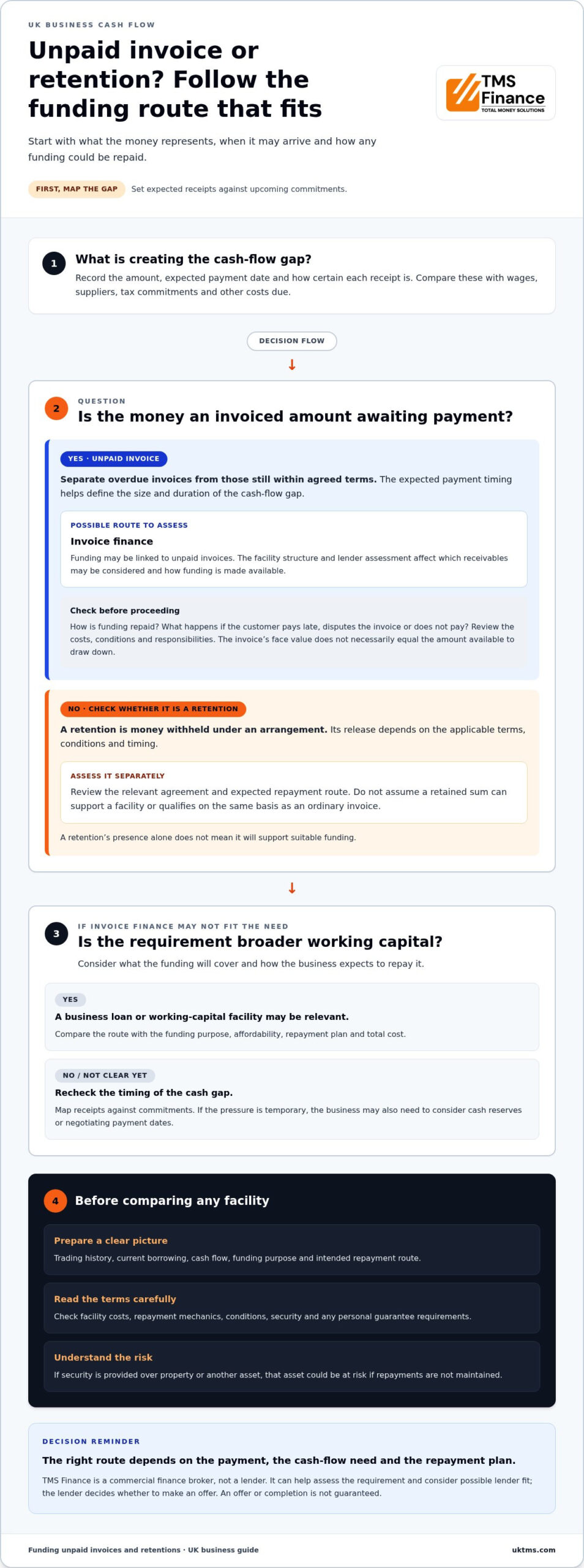
Uncertain payment dates can put working capital under pressure, particularly when part of a construction payment is being held as retention. Invoice finance may suit some unpaid invoices, while a business loan or working-capital facility may be relevant in other cases. Retentions need separate consideration: their presence alone does not mean they will support a suitable facility.
This guide explains how payment delays affect cash flow, which funding routes a business might consider, and what costs and risks to weigh before applying. It also covers the information to prepare before speaking with TMS Finance. TMS Finance is a commercial finance broker, not a lender. It can help assess your requirement and consider possible lender fit, but the lender makes the decision on any application.
Key Takeaways
- Separate overdue invoices from payments that are still within agreed terms. This helps show the source and timing of the cash-flow gap.
- Invoice finance may link funding to unpaid invoices, but the facility structure and lender assessment affect how it works.
- Compare funding unpaid invoices and retentions UK options by purpose, repayment route, affordability and total cost.
- Prepare clear details of your trading history, current borrowing, cash flow and intended repayment before discussing an application.
- TMS Finance can help assess your requirement, organise information and consider possible lender fit. An offer or completion is not guaranteed.
How unpaid invoices and retentions can put UK business cash flow under pressure
Completing a job or making a sale does not mean the money is available to use. An unpaid invoice is an invoice that has not yet been settled. It may still be within the agreed payment terms, or it may be overdue. Until the money arrives, the business may need to cover wages, materials, fuel, tax commitments and the next contract from other cash.
Review invoice finance eligibility, costs and funding options with TMS Finance.
A retention is different. It is money withheld from a payment under an arrangement, with release dependent on the terms that apply. The business may know why the sum is being held, but it cannot use that cash until the agreed release conditions and timing are met.
In short: an unpaid invoice is awaiting payment; a retention is withheld under an arrangement and released according to its terms. Both can tie up cash, but the expected payment date and reason for the delay may differ. That distinction matters when working out the size and duration of a funding need.
For example, a contractor might finish work and invoice a customer while also having part of an earlier payment held as retention. Supplier invoices and payroll still fall due, and the next contract may require mobilisation costs before the customer pays. This can put pressure on working capital even when the business has work booked and expects to receive the money later.
Why a profitable business can still face a cash-flow gap
Profit and cash available today are not the same thing. A business may record income from completed work but still have to wait for the customer’s payment. Meanwhile, wages, supplier bills and other operating costs may be due on fixed dates. This mismatch between receipts and outgoings can make it harder to meet commitments or prepare for the next job. A delayed receipt does not, by itself, mean the business is insolvent, but it can make cash planning more difficult.
The practical issue is often timing. If expected receipts arrive later than planned, a business may need to delay purchases, negotiate payment dates or use existing cash reserves. If the gap continues, it may restrict the business’s ability to take on work that requires upfront spending. Map expected receipts against upcoming commitments to see whether the pressure is temporary or part of a recurring pattern. Include the amount, due date and how certain each expected receipt is.
Why retentions need separate consideration
Retentions are common in construction, where a client or main contractor may hold back part of a payment under an arrangement. The release date and conditions depend on the terms, so a retention should not be treated as cash with a certain arrival date. Nor should a business assume every retained sum can support borrowing. The relevant agreement and expected repayment route need to be understood before considering funding.
That distinction can shape which options are worth exploring. Invoice finance is associated with funding linked to receivables. Debtor finance provides an overview of this broader category. A retention may involve different timing and conditions from an ordinary customer invoice. Funding unpaid invoices and retentions UK businesses consider should therefore be assessed against the specific payment gap, rather than treating all money owed as equivalent.
How funding against unpaid invoices may work
Invoice finance is one way a business may access funding linked to unpaid invoices instead of waiting for the customer to pay before seeking working capital. The facility’s structure matters: it affects which receivables may be considered, how funding is made available and what happens when the customer settles the invoice. Lender assessment also applies, so an unpaid invoice does not automatically support funding.
Before proceeding, understand how the arrangement works in practice. Check which invoices may be considered, how the funding is repaid, what responsibilities the business has for those invoices and what happens if a customer pays late, disputes an invoice or does not pay. Costs and terms vary by facility. TMS Finance can help assess a business’s invoice finance requirement and consider possible lender fit.
What a business should understand about invoice finance
A facility may link funding to receivables that meet the lender’s requirements. The arrangement sets out how those receivables are treated and the business’s obligations. Before accepting an offer, review its costs, repayment mechanics, conditions and any security or personal guarantee requirements. If security is provided over property or another asset, that asset could be at risk if repayments are not maintained. TMS Finance can help present the funding need clearly, but the lender decides whether to make an offer.
Suitability depends on the business, the receivable, the facility and the lender’s criteria. Compare the expected funding with the actual cash-flow need, rather than assuming that an invoice’s face value will be available to draw down.
How unpaid invoices differ from retained payments
An unpaid invoice is normally an amount billed to a customer and awaiting payment. A retention is a sum withheld under agreed terms, with its release linked to those terms. The difference can affect when money is expected, which documents explain the payment and how a facility might be repaid. A business considering funding unpaid invoices and retentions UK-wide should treat retentions as a distinct part of its funding assessment, rather than assume they qualify on the same basis as ordinary invoices.
For a retention, gather the relevant contract or subcontract, payment records and any correspondence that clarifies the release conditions and likely timing. If the meaning or effect of a contract term is uncertain, seek advice from a suitably qualified legal professional. Clear documentation can help explain the position, but it does not guarantee that a lender will accept the retention or approve finance.
Consider the underlying cash-flow need as well as the receivable. If funding is intended to cover a short-term gap, map the expected customer payment against the facility’s repayment obligations. If the requirement is broader, another business funding route may be more appropriate. The GOV.UK business finance support page provides information on support schemes for businesses and may help when considering alternatives alongside commercial borrowing.
To set out a requirement for review, prepare a clear summary of the invoices or retentions involved, the amount sought, the intended use and the expected repayment source. TMS Finance can assess that information and consider possible lender fit. The business finance application page is a starting point for preparing your details.
Compare funding routes, costs, and when borrowing may not fit
The right route depends on what the cash is for, when it is needed and how borrowing could be repaid. A facility linked to receivables may be relevant when invoices are awaiting payment. A business loan or revolving credit facility may suit a different funding pattern. No option is automatically available or suitable for every business.
Which funding route may match the cash-flow need?
Use this comparison to frame the discussion, not as a prediction of a lender’s decision.
| Route | Purpose and potential fit | Repayment basis | Key considerations |
|---|---|---|---|
| Invoice finance | Funding linked to eligible unpaid invoices may fit a gap connected to customer receivables. | Depends on the facility terms and how the receivables are handled. | Invoice eligibility, customer payment, fees and obligations under the facility. |
| Business loan | May suit a defined business purpose, subject to lender assessment. | Set out in the loan agreement. | Check affordability against expected cash flow, existing borrowing and the full repayment commitment. |
| Revolving credit facility | May be worth exploring where working-capital needs change over time. | Depends on the agreed facility terms and use of the available credit. | Review charges, repayment requirements and whether the facility could be managed through quieter trading periods. |
When comparing funding unpaid invoices and retentions UK businesses should consider the expected timing of receipts alongside the proposed repayment schedule. A retention may have a release date or condition that differs from a standard invoice, so avoid basing repayments on money that may not arrive when expected. Consider new commitments alongside existing repayments and normal operating costs.
Costs, security, and the downside of borrowing
Rates, fees and terms vary by applicant and facility. Before accepting an offer, review the total cost, repayment obligations, any conditions attached to the funding, and whether security or a personal guarantee is required. If a facility is secured against property or another asset, that asset could be at risk if repayments are not maintained. A personal guarantee can also create personal obligations, so understand its terms before signing.
Borrowing may be unsuitable if repayment depends on uncertain receipts, if the business cannot afford repayments under a realistic cash-flow forecast, or if further borrowing would make existing pressure harder to manage. Do not treat a facility as a fix for a continuing shortfall without understanding its cause and repayment route.
There may be alternatives to consider. Review the forecast against expected receipts and payment dates. Where appropriate, discuss payment timing with customers or suppliers, recognising that an agreement is not guaranteed. A business loan application should explain the purpose and repayment plan clearly. TMS Finance can help assess the requirement and consider possible lender fit through its business loan application process. Seek an accountant’s advice on accounting or tax questions, and legal advice if you need help interpreting an agreement.
Prepare the information lenders may consider before applying
A well-prepared funding request makes the business’s position easier to assess, but it does not guarantee an offer. Depending on the case, lenders may consider the purpose of the funding, trading history, bank conduct, credit profile, existing borrowing, security and how repayments could be met. The factors considered, and the weight given to them, depend on the lender and facility.
Build a clear picture of the funding requirement
Start with the amount required and what it will pay for. Set out when the cash is needed, how long it may be required and what the funding is intended to achieve. Then explain the proposed repayment route. Identify whether repayment is expected from customer receipts, regular trading cash flow or another source, and what evidence supports that expectation.
Separate confirmed receipts from forecasts. If a customer has given an expected payment date, make clear whether it is agreed or indicative. For a retention, distinguish the amount being held from any estimate of when it may be released. This avoids presenting uncertain timing as guaranteed cash flow.
Gather documents relevant to the case
Prepare a current, consistent set of records. Documents requested will vary, but relevant information may include:
- Recent business bank statements and filed or management accounts.
- A cash-flow forecast showing expected receipts, outgoings and proposed repayments.
- Aged debtor and creditor reports, with notes on significant overdue balances or upcoming commitments.
- Details of existing borrowing, including current repayment obligations.
- Invoices and supporting correspondence related to the receivables being considered.
- For a retention, relevant contract or subcontract terms, payment records and information about release conditions or timing.
Include property details or other supporting evidence only where they relate to the request. If security is being considered, record the asset involved and any existing borrowing secured against it. A lender may ask for further information after reviewing the initial material.
Before sending documents, check that dates and figures agree across statements, accounts, forecasts and debtor reports. Explain unusual transactions or changes in trading where they affect the picture. If projections rely on assumptions, state them plainly. A useful forecast shows the basis for expected receipts and how the business could respond if they arrive later than planned.
These steps can help a broker assess the requirement, organise supporting information and consider possible lender fit. They cannot secure approval. Funding unpaid invoices and retentions UK businesses seek depends on the applicant’s circumstances, affordability, credit profile, security and lender criteria. TMS Finance’s process includes an initial discussion, assessment, document preparation, consideration of lender fit, application and offer review.
Explore funding unpaid invoices and retentions with TMS Finance
Funding unpaid invoices and retentions UK businesses are considering should be assessed against the actual cash-flow need, expected receipts and repayment plan. TMS Finance is a commercial finance broker, not a lender. It can help clarify the requirement, review relevant information and consider possible lender fit through its available routes. It does not represent the whole market, and a discussion does not guarantee that a lender will offer finance.
Discussing funding unpaid invoices and retentions UK-wide
Start by explaining the amount you need, what it would fund, when it is required and what you want the facility to achieve. For an invoice or retention-related request, outline the payment position and expected timing. Separate agreed dates from estimates so the assessment can distinguish confirmed information from assumptions.
TMS Finance can review relevant headline information about the business, its trading and credit profile, affordability, existing borrowing, any proposed security and the expected repayment route. The process can include an initial discussion, assessment, document preparation, consideration of lender fit, application, offer review and completion support. If a lender raises questions, TMS Finance can support the application by helping address them with relevant information.
Each case is different. The information required, any lender response and the time involved depend on the business, the facility being considered and the lender’s process. A lender may consider the applicant’s circumstances, business performance, credit profile, affordability, security and its own criteria. Neither an application nor broker support guarantees an offer or completion.
Review an offer before deciding
If a lender makes an offer, take time to understand the full commercial terms before accepting. Review the total costs, repayment amounts and dates, conditions, and what happens if expected customer receipts are delayed. Check whether security or a personal guarantee is required, what obligations these create, and whether the secured property or asset could be at risk if repayments are not maintained. Rates and terms vary by applicant and facility.
Do not assess an offer only by whether it could cover the immediate gap. Consider whether repayments remain affordable alongside existing commitments and realistic cash-flow expectations. If a retention is part of the repayment plan, make sure its expected release timing and conditions are understood. For advice on the legal effect of terms, or on tax or accounting treatment, consult an appropriately qualified professional before deciding.
A measured discussion can help you set out the funding requirement and understand possible routes without committing to borrowing. Take the relevant figures and documents to the conversation, and raise any uncertainty about timing, costs or obligations before proceeding.
Make your next funding decision with a clear repayment plan
Before taking further steps, decide what would make funding workable for your business: the amount needed, the timing and a realistic route to repayment. That gives any discussion a practical focus and helps you weigh a proposed facility against the cash-flow pressure it is intended to address.
TMS Finance is a member of the National Association of Commercial Finance Brokers. As a commercial finance broker, it can help assess your requirement, prepare an application and support communications around an offer. This can help you examine possible funding unpaid invoices and retentions UK options without assuming that borrowing is suitable or that approval will follow.
If your business needs funding for cash flow, equipment, stock, growth or property, contact TMS Finance. Explain how much you need, what it will be used for and when it is required, so the requirement can be assessed and possible options considered.
A considered decision starts with clear information and a repayment plan you understand. Seek professional advice where you need guidance on legal, tax or accounting matters.
Frequently Asked Questions
Can a business get funding against unpaid invoices in the UK?
Invoice finance may let a business access funding linked to qualifying unpaid invoices, subject to lender assessment. A lender may consider the business’s position and the receivables involved, including whether the invoices are supported by records. Funding unpaid invoices and retentions UK SMEs need is not automatic. TMS Finance can help present the request and consider possible lender fit.
Can retentions be included in invoice finance?
Possibly, but do not assume a retention will be treated like an ordinary invoice or accepted for funding. Its release may depend on contract terms, project milestones or other conditions. A lender may need evidence showing how the sum arose and when it could become payable. If you are unsure how a contract clause works, ask a suitably qualified legal professional to explain it.
What documents may a lender ask for when assessing invoice finance?
Requests vary, but a lender may ask for business bank statements, filed or management accounts, aged debtor reports and details of existing borrowing. Invoice copies and supporting records can help explain the receivables. If payment is disputed, provide accurate information about the issue. Keep dates and figures consistent, and be ready to clarify unusual entries or changes in trading.
Is invoice finance suitable if a business has cash-flow problems?
It may be worth exploring when the pressure is linked to unpaid receivables and there is a credible repayment route. It may not suit a continuing shortfall, uncertain customer payment dates or unaffordable repayments. Compare the facility’s costs and obligations with the forecast. Depending on the cause, alternatives may include discussing payment dates with customers or suppliers and reviewing spending assumptions.
What happens if a customer pays an invoice late after a business has taken finance?
The effect depends on the facility agreement. Late payment may delay settlement or affect charges and other obligations. Check what the agreement says about late, disputed or unpaid invoices. Keep the finance provider informed in line with the terms, and update cash-flow forecasts to plan for the delay without relying on an unconfirmed revised payment date.
Finance is subject to status, lender criteria and satisfactory checks. Terms, fees, security and personal guarantees may apply. Contact TMS Finance to discuss your circumstances and the funding options that may be available.