

A repayment that looks manageable each month can still cost more overall than expected. If customer receipts arrive after the payment is due, it can also put pressure on cash needed for wages, suppliers and tax. When working out how to calculate business loan repayments UK businesses need to budget for, start with the amount borrowed, the interest basis and the term.
This guide shows how to estimate regular and total repayments, compare quotes on a like-for-like basis and test the figures against your cash flow. It also explains why fees, security and early-settlement terms matter, and when another type of funding or a non-borrowing option may be more suitable.
A calculation is only as useful as its assumptions. A lender’s written offer may use different terms or include costs that are not part of your estimate. TMS Finance is a commercial finance broker. It reviews your funding requirement and business information, then considers possible lender fit through selected routes.
Key Takeaways
- To estimate repayments, identify the amount borrowed, term, interest basis, payment frequency and applicable fees.
- Check how interest is calculated before comparing headline rates. A flat rate and a reducing-balance rate are not directly comparable.
- Test proposed payments against forecast income, quieter trading periods and existing borrowing commitments.
- Consider whether invoice finance, asset finance or a revolving credit facility better fits the timing and purpose of the funding need.
- TMS Finance can review your requirement, consider selected lender routes and help prepare an application. The lender makes its own decision.
Why business loan repayments matter to UK cash flow
A loan repayment competes for the same cash you need for staff, suppliers, tax and ordinary operating costs. A business can be profitable overall but still face a cash-flow gap if a payment falls due before customer invoices are settled.
Build the proposed repayment into your cash-flow forecast early. Map it against expected receipts, payroll, supplier payments, tax liabilities and other borrowing commitments. Leaving this until late in the process can make it harder to judge whether the amount or structure fits your trading cycle.
A repayment estimate is a planning figure based on stated assumptions, not an offer. It cannot confirm that a lender will approve an application or offer a particular rate. Terms depend on the applicant, the facility and the lender’s criteria.
What a repayment estimate can and cannot tell you
An estimate indicates a possible payment only when you understand the figures and assumptions behind it. It may not include every charge or reflect the final terms offered. Treat it as a starting point for planning, not a prediction of approval or a substitute for reviewing a written offer.
The facility type also affects what an estimate represents. A term loan, secured borrowing and revolving credit can have different structures and repayment patterns. A general overview of the types of business loans can help clarify terminology before you compare options.
Why monthly affordability is only part of the decision
Check whether payment dates align with your business’s cash-flow cycle. Map them against payroll, supplier payments, tax liabilities and expected customer receipts, as well as existing borrowing. This can reveal pressure points that an average monthly figure hides, particularly when income varies.
A longer repayment term can reduce the monthly payment, but may increase the total amount repaid. Compare the overall commitment as well as the instalment. If you could meet repayments only if uncertain income arrives on time, borrowing may not be suitable. Consider whether the need can wait, be reduced or be met another way.
Use your repayment estimate as part of a forecast, not in isolation. Test it against a cautious trading scenario as well as expected income. If the payment would leave too little cash for ordinary operating costs, revisit the amount, timing or funding route before committing.
How to calculate business loan repayments step by step
To estimate a regular repayment, gather the figures that define the facility. Use the same assumptions for each quote so that your comparison is meaningful.
- Amount borrowed: the principal, shown as P in the formula.
- Repayment term: the period over which repayments are scheduled.
- Interest basis: the rate and how it is applied, such as a fixed or variable rate.
- Payment frequency: monthly, weekly or another agreed interval.
- Fees: applicable charges, and whether they are paid separately or included in the borrowing.
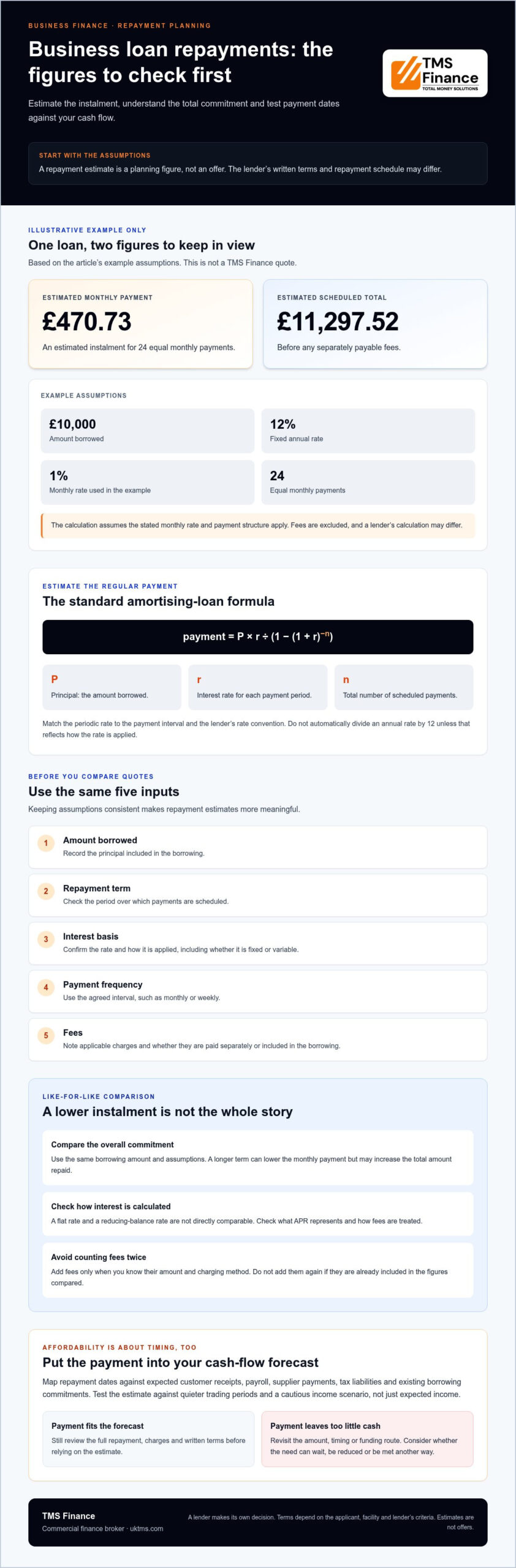
For a standard amortising loan with equal payments, the formula is payment = P × r ÷ (1 − (1 + r)−n). P is the principal, r is the interest rate for each payment period, and n is the total number of payments. The result depends on the rate basis, term and payment frequency you enter.
Use a matching periodic rate
The periodic rate must match the repayment interval and the lender’s rate convention. Don’t automatically divide an annual rate by 12 unless that conversion reflects how the rate is applied. Lenders may treat interest and fees differently, so this formula is an estimate, not a universal calculation method.
Illustrative example only, not a TMS Finance quote: suppose a £10,000 loan has a fixed annual rate of 12%, converted to a monthly rate of 1%, with 24 equal monthly payments. Applying the formula gives an estimated payment of about £470.73. This illustration excludes fees and assumes the stated monthly rate and payment structure apply. A lender’s calculation may differ.
Estimate the total scheduled repayment
Multiply the estimated instalment by the number of scheduled payments. In the illustration, £470.73 multiplied by 24 gives an estimated total of £11,297.52, before any separately payable fees. Add fees only when you know their amount and how they are charged. Don’t count them twice if they are already included in the figures you are comparing.
APR may help you compare overall costs, but it is not automatically interchangeable with the periodic rate used in an amortising-loan formula. Check what each figure represents and how fees are treated. For information on UK government business finance support, review the GOV.UK guidance alongside the terms of any specific facility.
Use the same amount, term and payment frequency when comparing estimates, then check them against the lender’s written repayment schedule. That schedule sets out the proposed payments and terms. If you’re preparing to discuss borrowing, the business loan application process explains the information involved.
Compare business loan repayment quotes on a like-for-like basis
A lower monthly instalment does not automatically mean a lower overall cost. Compare the full repayment and obligations using the same borrowing amount and assumptions. Take particular care if one quote uses a flat rate and another a reducing-balance rate. Their headline rates refer to different ways of calculating interest and may result in different costs.
Record each quote’s details in a table. If a cost or condition is not stated, mark it as “not stated” rather than filling the gap with an assumption.
| Detail | Quote A | Quote B |
|---|---|---|
| Amount borrowed | £___ | £___ |
| Term | ___ | ___ |
| Rate basis and payment frequency | ___ | ___ |
| Scheduled payment | £___ per ___ | £___ per ___ |
| Total scheduled repayment | £___ | £___ |
| Fees and how they are charged | ___ | ___ |
| Security or personal guarantee | ___ | ___ |
| Early-settlement terms | ___ | ___ |
Read the rate, fees and repayment schedule together
Record whether the rate is flat or reducing-balance, fixed or variable, and how often payments are due. A flat rate usually calculates interest against the original amount borrowed, while a reducing-balance calculation applies interest to the outstanding balance. Compare the full scheduled repayment and stated fees for the same amount and term. Check whether fees are included in instalments or payable separately. Identical headline rates do not necessarily mean identical costs.
Check security, guarantees and early settlement terms
Identify whether the lender requires security over business assets or property, or a personal guarantee. If finance is secured, the property or asset could be at risk if repayments are not maintained. Read the early-settlement terms too. Depending on the agreement, settling early may involve a charge, remaining interest, a minimum return or no additional charge. Don’t assume a loan is flexible until you understand its terms.
Compare total repayment and obligations, not only the monthly figure. Use the lender’s written repayment schedule as your reference and check it against the rate, fees and payment frequency in the offer. If a cost or condition is unclear, get it explained before making a decision.
Test affordability and consider alternatives before borrowing
A repayment estimate shows a possible payment, but affordability depends on whether the business can meet it when due. Test the commitment against forecast income, quieter trading periods and existing borrowing. A payment that fits an average month may still leave too little cash if receipts are delayed or costs rise.
Use forecasts to assess repayment resilience
Map expected cash inflows and outflows against each scheduled repayment date. Include existing finance payments and realistic operating costs, not just planned spending. Then test a cautious scenario, such as delayed customer receipts or a quieter trading period. A forecast is a planning tool, not a promise of future performance, so allow for uncertainty rather than relying on the most favourable outcome.
- Expected case: Does the payment fit the usual pattern of receipts and costs?
- Quiet period: Can the business still meet it if sales or incoming payments fall?
- Delayed receipts: What happens if customers pay later than forecast?
- Existing commitments: Is enough cash left for current borrowing and essential operating costs?
Lenders may consider the funding purpose, trading history, bank conduct, credit profile, security and proposed repayment route. The factors assessed vary by lender and application. They are not a universal checklist, and meeting them does not guarantee approval. Clear information about how the funds will be used can help explain the request for assessment.
When a business loan may not be suitable
Pause if repayment depends on uncertain income or if a new payment could deepen an existing cash-flow shortfall. Review whether spending can be reduced, payment timing improved or the funding need delayed. Borrowing may not resolve a gap caused by ongoing costs exceeding income. For tax, legal, accounting or personalised financial questions, seek advice from an appropriately qualified professional.
Match the funding structure to the need. If the gap relates to unpaid customer invoices, invoice finance may be worth considering. If you need funds to acquire equipment, asset finance may align more closely with the purchase. A revolving credit facility may suit a need that rises and falls, but its terms and costs still need careful review. Compare each route against the same cash-flow forecast, including when funds are needed and how they would be repaid. For growth-related cash needs that arise before customer payments arrive, see this guide to working capital finance for growing UK businesses.
Use your findings to decide whether to proceed, adjust the amount or explore another route. TMS Finance can discuss the requirement and consider possible lender fit through selected routes. The lender makes its own assessment and decision.
Prepare for a business loan discussion with TMS Finance
A clear funding request makes a loan discussion more practical. Set out what the money is for, how much you need and when you need it. If you have estimated repayments, bring the assumptions behind the figure, including the term, rate basis and any known fees. A business loan guide for UK firms can also help you understand common terms before comparing routes.
TMS Finance is a commercial finance broker, not a lender. It reviews your funding requirement and relevant business information, then considers possible lender fit through selected routes. The process can include discussing the need, reviewing headline information, collecting documents, preparing the application, supporting lender discussions and reviewing an offer. A broker can help present the case clearly, but the lender assesses the application and makes its own decision.
What to prepare before discussing repayments
Useful information may include recent business bank statements, filed accounts or management accounts, and cash-flow forecasts. Note existing borrowing, regular repayment commitments and the intended use of funds. This helps put a repayment estimate in context and explain how the funding relates to your business plans.
Prepare questions about the repayment schedule, total amount due, fees, security and any personal guarantee. If you receive an offer, review these terms together rather than treating the monthly instalment as the whole commitment. For secured finance, understand which property or asset is being offered as security and that it could be at risk if repayments are not maintained. Seek professional advice on legal, tax or accounting questions.
What TMS Finance can and cannot do
TMS Finance can help organise and present information to selected lenders, explain key commercial terms and support you through the application process. This can help you identify gaps in the information and understand what a lender is being asked to assess.
Broker support cannot override lender criteria, make an unsuitable case acceptable through wording alone or guarantee approval or completion. The outcome depends on the applicant and business, affordability, credit profile, any security involved and the lender’s assessment. Make sure the requested amount and repayment plan reflect the business’s actual need and cash-flow capacity before deciding how to proceed.
Make your next funding decision with clarity
Knowing how to calculate business loan repayments UK lenders may offer gives you a firmer basis for discussion, not a reason to commit before the full terms are clear. Take your funding purpose, repayment estimate and cash-flow forecast into the conversation. You can then consider whether borrowing fits the business need and which available lender route may be relevant.
TMS Finance is a member of the National Association of Commercial Finance Brokers and an appointed representative of Swoop Finance Limited. Fees are agreed before any work is undertaken. TMS Finance can help prepare an application and explain commercial terms, but the lender makes the lending decision.
Contact TMS Finance with the amount you need, what it will fund and when you need it. The team can review your requirement and discuss which funding options may be worth exploring.
Frequently Asked Questions
Are business loan repayments tax-deductible in the UK?
Tax treatment depends on the business’s circumstances and how the borrowing is used. The treatment of interest and capital repayments may differ, so don’t assume that all or part of an instalment is deductible. Keep the loan agreement and repayment records with your business documents, then ask an accountant or tax adviser how the rules apply to your situation.
Can a business loan calculator estimate repayments when the rate is variable?
Yes, but it can only estimate repayments using the rate entered. If the rate changes, the payment or total cost may also change, depending on the agreement. To understand possible changes, compare scenarios using different rates rather than relying on one figure. Check how the lender applies rate changes and whether the repayment schedule can be revised.
Can I use a standard loan repayment formula for a revolving credit facility?
Not reliably in every case. A standard formula assumes a set amount is borrowed and repaid through scheduled instalments. With a revolving facility, the amount drawn can change as the business borrows and repays, so interest and charges may depend on usage and the facility’s terms. For a useful estimate, review how charges apply to the drawn balance and model expected borrowing over time.
Can a UK business make weekly rather than monthly loan repayments?
Possibly, if the lender and facility allow weekly payments. Don’t assume you can change the frequency after agreeing a monthly schedule. Weekly instalments may align more closely with regular customer receipts, but compare the total payable and payment dates, not just the smaller instalment amount. Before accepting an offer, check the written schedule for payment frequency, the first payment date and what happens if a payment date falls on a non-working day.
What happens if a business misses a loan repayment?
The consequences depend on the agreement and lender. Charges or other consequences may apply under the terms, particularly where the facility is secured or includes a personal guarantee. If you think a payment may be missed, contact the lender promptly and explain the situation. Don’t assume a payment can be deferred without agreement.
TMS Finance is a commercial finance broker, not a lender. Finance is subject to status, lender criteria and satisfactory checks. Terms, fees, security and personal guarantees may apply. Contact TMS Finance to discuss your circumstances and the funding options that may be available.