Paying for machinery outright can leave too little working capital for wages, materials or planned work. Asset finance for plant machinery and equipment UK businesses use may spread the upfront cost, but the structure needs to fit the asset’s working life and the cash flow it is expected to support.
Before proceeding, weigh repayments against the full cost, security and commitment involved. Hire purchase, finance leases and asset refinancing work differently, and none is suitable for every business or piece of equipment.
This guide explains how these options work, what may affect affordability and a lender’s decision, and what documents can help support an application. It also covers repayment risks, security and alternatives. TMS Finance is a commercial finance broker, not a lender. It works with selected lenders and providers, and can support you with preparing an application and reviewing an offer. The lender makes the decision.
Key Takeaways
- Compare hire purchase, finance lease and asset refinance by considering how you will use the asset, who owns it and what repayment obligations apply.
- Check that repayments remain affordable alongside existing borrowing and other operating costs, including if the asset takes time to contribute to the business.
- For asset finance for plant machinery and equipment UK applications, prepare an asset quotation or supplier invoice, recent bank statements and accounts.
- Consider whether the finance term fits the machinery’s working life, and understand the security and repayment risks before committing.
- TMS Finance starts with your business need and supports application preparation and offer review through selected lenders and providers.
Why plant machinery costs can put pressure on business cash flow
Essential machinery can require a substantial outlay before it starts generating income. Paying for equipment upfront may leave less cash for suppliers, wages or unexpected costs. But delaying a necessary purchase can also affect your capacity to take on work, mobilise for a contract or maintain production.
Asset finance is funding connected to acquiring or refinancing a business asset. Depending on the arrangement, it may spread the cost while retaining some cash for day-to-day operations. The trade-off is a contractual repayment commitment. The asset or other security may be at risk if repayments are not maintained, and finance may not suit every business. Assess affordability under realistic trading conditions before taking on a commitment.
Asset finance for plant machinery and equipment UK businesses consider is different from general working-capital funding. It relates to a specific asset, while working-capital finance addresses broader business cash needs. Be clear about what you need to fund before comparing options, as the purpose affects which types of facility may be relevant.
What counts as plant machinery and business equipment?
Examples include construction plant used on site, manufacturing machinery used in production and agricultural equipment used in farm operations. The equipment’s purpose, its role in the business and the proposed funding structure can all matter. The asset category alone does not determine whether finance will be offered. Providers assess the asset and application against their own criteria.
This guide focuses on plant and machinery rather than vehicle, IT or property finance. For a general explanation of how borrowing can be connected to business assets, see this overview of asset-based lending. It covers a broader concept, so it is not a guide to the terms of a specific finance agreement.
When could financing support an equipment purchase?
Financing may be worth considering if paying the full purchase cost now would put pressure on cash needed for suppliers, payroll or unexpected expenses. For example, a business preparing to mobilise for a contract might need equipment while also meeting other operating costs. Spreading the equipment cost could help manage the timing of those demands, but it does not guarantee that the contract will generate enough income to cover repayments.
Compare expected repayments with cash flow under a cautious forecast, not only an optimistic projection. Include existing commitments and allow for periods when income may be lower or delayed. If the business has no credible route to meeting repayments, borrowing may not be appropriate. Consider whether you can defer the purchase, continue using existing equipment or choose another funding approach that better matches the need.
The practical question is whether the equipment’s expected contribution to capacity or production justifies the commitment, and whether repayments remain manageable if that contribution takes time to materialise. A broker can help present the funding requirement in the context of the asset and business purpose. The lender decides whether to offer finance and on what terms.
How plant and machinery asset finance structures differ
The right structure depends on what the business needs from the asset, how long it expects to use it and whether ownership matters. Hire purchase, finance lease and asset refinance can all relate to business equipment, but they create different obligations. The agreement sets out the precise terms, including ownership and what happens at the end.
TMS Finance offers Asset Finance and considers the funding requirement before discussing possible routes. The wider range of business finance products serves different needs, but this guide focuses on funding plant and machinery.
Hire purchase, finance lease and asset refinance
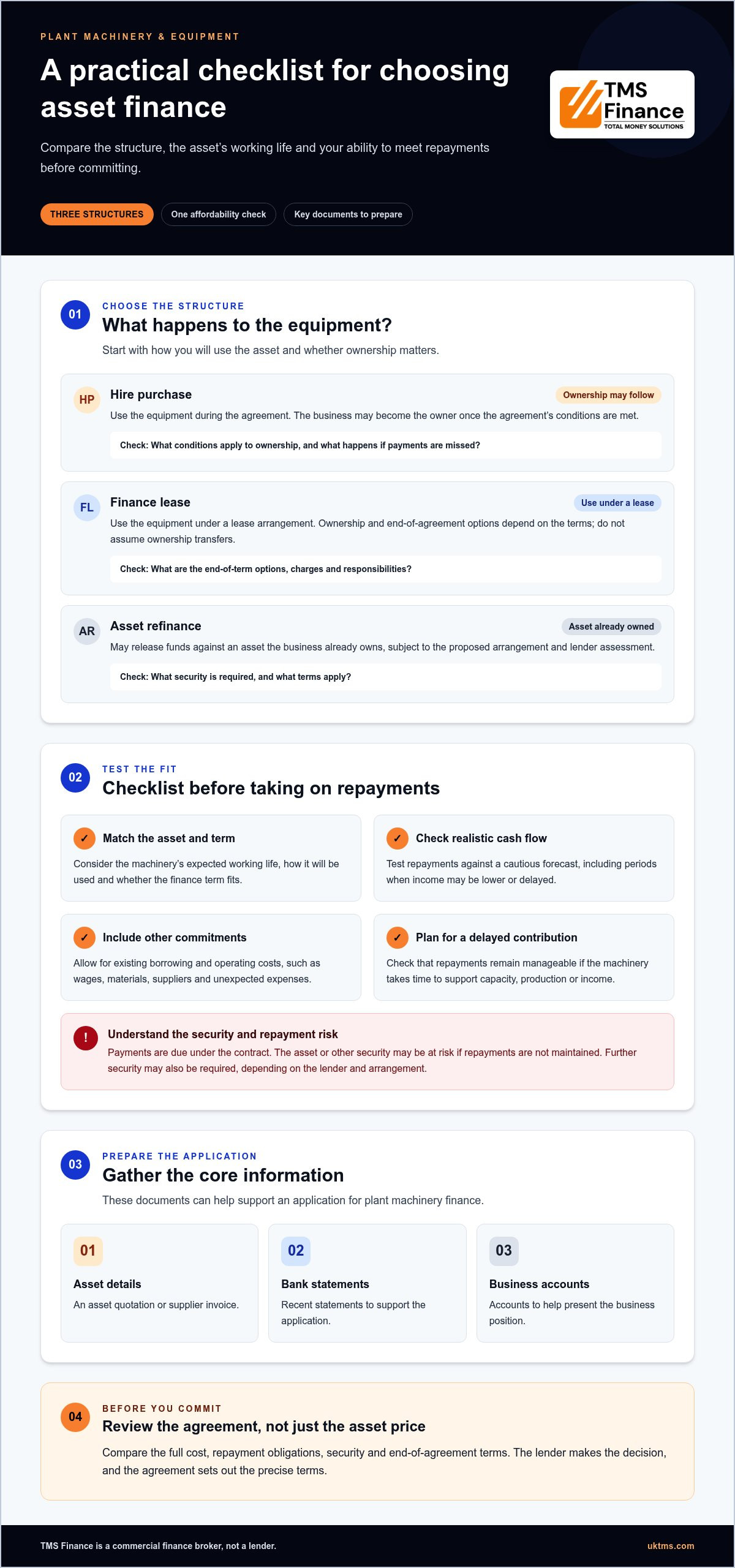
With hire purchase, a business makes contractual payments and may become the owner once the agreement’s conditions are met. A finance lease allows the business to use the asset under a lease arrangement. Ownership and end-of-agreement options depend on the terms, so do not assume the asset will transfer to the business. Asset refinance may release funds against an asset the business already owns, subject to the proposed arrangement and lender assessment.
| Structure | Asset use | Ownership position | Repayment obligation | Questions to resolve |
|---|---|---|---|---|
| Hire purchase | Use the equipment during the agreement | May transfer after the agreement conditions are met | Payments are due under the contract | What conditions apply to ownership, and what happens if payments are missed? |
| Finance lease | Use the equipment under a lease arrangement | Set out in the agreement; do not assume ownership transfers | Payments and other obligations follow the contract | What are the end-of-term options, charges and responsibilities? |
| Asset refinance | Continue using an asset already owned by the business | The arrangement may affect the asset’s security position | Repayments apply to the finance raised | What security is required, and what terms apply? |
These are broad distinctions, not a substitute for reviewing the proposed agreement. The asset or other security may be at risk if repayments are not maintained. Depending on the lender and arrangement, further security may also be required.
Compare the structure with the asset
Start with the machinery’s expected working life and usage pattern. Equipment used regularly over several years may raise different ownership questions from machinery needed for a defined period. Consider whether the business wants to own the asset, use it under an agreement or raise funds against equipment it already owns.
Then compare the full contractual commitment, not just the scheduled repayments. Review fees, repayment profile, security, early-settlement terms and any end-of-term conditions. Early-repayment terms vary by provider and product. A facility may include an early-settlement charge, remaining interest, a minimum return or no additional charge. Costs and terms also vary by applicant, asset, facility and provider. No structure is universally cheaper or more suitable, and the lender assesses the proposal against its own criteria.
To discuss the business requirement and how it might be presented for consideration, you can start a finance enquiry. TMS Finance is a commercial finance broker, not a lender, and can support application preparation and offer review.
How to assess affordability, eligibility and the risks
A finance offer is only workable if the business can meet its obligations while covering other costs. A lender may consider the purpose of the finance, trading history, credit profile and affordability. Existing borrowing, business experience, the repayment route, security and details of the machinery may also affect its assessment. These factors vary by lender and application, so none should be treated as a universal rule.
Assess the full commitment, not just whether the initial repayments appear manageable. Compare repayments and fees with cash flow, and review any early-settlement terms. Costs and conditions depend on the agreement and provider. Ask for the full terms in writing. For help understanding accounting, tax or legal implications, seek appropriate professional advice.
What a business should test before taking finance
Use a realistic cash-flow forecast that includes weaker trading periods, delayed income and existing commitments. Test whether repayments remain manageable if the machinery takes time to contribute to the business. Then compare the proposed finance period with the equipment’s expected useful working life. A long commitment against an asset that may become unsuitable or less useful sooner can restrict future choices.
Review security and personal guarantee terms as carefully as the repayment schedule. A lender may require a personal guarantee, depending on its criteria and the proposed facility. Understand who would be responsible and what obligations could arise before accepting an offer.
When machinery finance may not be suitable
Borrowing may be unsuitable if demand is uncertain, repayment capacity is limited or the equipment does not support a clear business need. Pause if the forecast relies on optimistic assumptions or leaves too little room for existing obligations and operating costs. Taking on finance without a credible repayment route could put pressure on the business.
Alternatives may include delaying the purchase, using available working capital or reconsidering whether the equipment is needed now. A different leasing arrangement may better fit the intended period of use, but its full terms still need review. If the need is for broader business costs rather than a specific asset, a business loan may be relevant. It has its own affordability checks, costs and repayment obligations.
TMS Finance reviews the business requirement and existing commitments, then considers lender fit through selected lenders and providers. As a commercial finance broker, it can support application preparation and offer review, but the lender decides whether to approve finance and on what terms. To set out the funding requirement for discussion, you can make a business finance enquiry.
What to prepare for a plant machinery finance application
A clear funding request helps explain what the business needs and how it expects to meet the commitment. For asset finance for plant machinery and equipment UK applications, organise the information in a logical order: define the asset and its purpose, assess repayment capacity, gather supporting evidence, then discuss which lender routes may fit. The information requested will vary with the applicant, asset, facility and lender.
Evidence that can support an equipment funding request
Start with an asset quotation or supplier invoice. Make sure it identifies the equipment and, where possible, explains its intended business use. Gather recent business bank statements and filed accounts or recent management accounts. These help present the business’s trading position alongside the equipment requirement.
Depending on the case, VAT returns, cash-flow forecasts and details of existing borrowing may also be relevant. Forecasts can show how repayments fit alongside expected income and operating costs. Details of existing commitments help put the proposed finance in context. A lender may request further information, so treat this as a preparation guide rather than a fixed checklist.
What happens after an initial discussion?
TMS Finance begins by discussing the business objective, the asset and the effect of the proposed funding on cash flow. It can then review the requirement and existing commitments, explain what documents may be needed and consider lender fit through selected lenders and providers. As a commercial finance broker, TMS Finance supports application preparation and presentation, but does not make the lender’s decision.
If a lender raises questions or asks for more evidence, TMS Finance can help organise a response as part of supporting the application. Review any offer for repayments, fees, security and other obligations before acceptance. Completion time depends on the case and lender, so do not assume a funding date.
Prepare the funding requirement before making an enquiry
Before discussing options, be ready to state what equipment the business plans to acquire, how it will be used, how much funding is required and when it is needed. Set out a realistic view of repayment capacity, including existing borrowing and other regular commitments. This gives the discussion a practical starting point and helps identify information that may still be needed.
Keep the documents consistent with the request. If the quotation, intended use and forecast tell different stories, explain why. Clear records make it easier to present the requirement accurately, though they do not guarantee approval. A lender’s decision may take account of the applicant, business performance, credit profile, affordability, security and its own criteria.
Once the requirement and supporting information are ready, you can submit a business finance enquiry for discussion. An enquiry starts a process of assessing the requirement, not a promise of funding.
How TMS Finance supports UK businesses considering machinery finance
Choosing asset finance for plant machinery and equipment UK businesses can use starts with the business objective, not a pre-selected agreement. TMS Finance is a commercial finance broker. It considers what the machinery needs to do, how the funding could affect cash flow and what commitments the business already has.
TMS Finance works with selected lenders and providers, not the whole market. Its role is to help prepare and present the case, then support you in reviewing any offer. The lender assesses the application and sets its own terms. A broker cannot override lender criteria or guarantee approval or completion.
From funding need to offer review
The process starts with an initial discussion about the equipment, its intended use and the business’s funding requirement. TMS Finance reviews the information provided, identifies what documents may be needed and considers which lender routes available to it may fit the case. It can help prepare the application, present the details clearly and respond to lender queries as they arise.
If an offer is made, review the full obligations before deciding whether to proceed. TMS Finance can help you understand the proposed repayments, fees, security and any personal guarantee requirements. Check the agreement’s conditions, including what happens if payments are missed or circumstances change. If you need advice on legal, tax or accounting implications, speak to an appropriate professional.
Fees for TMS Finance’s work are agreed before work begins. The lender’s costs and terms are separate and depend on the offer. Understand both before committing.
Decide what to do next
Before making an enquiry, set out the machinery you need, the business purpose, the amount required and when the funding is needed. Include a realistic view of repayment capacity and existing commitments. This gives the discussion a clear starting point without assuming finance is the right choice or that a lender will approve the request.
TMS Finance is a member of the National Association of Commercial Finance Brokers. It supports customers from the initial discussion through application preparation and offer review, while the lender remains responsible for its decision. If you are ready to outline your machinery requirement, use the link below to begin an enquiry.
Make your next machinery funding decision with clarity
Before moving ahead, make sure the funding plan reflects both the equipment’s role and the business’s capacity to meet repayments. A clear, realistic request gives the discussion a practical starting point. Asset finance for plant machinery and equipment UK businesses consider should support a defined need, not add pressure the business cannot sustain.
TMS Finance is an appointed representative of Swoop Finance Limited. As a commercial finance broker, it can help prepare and present your requirement, while the lender assesses the application and decides whether to offer finance. To discuss the requirement, set out the machinery, intended use, funding amount and preferred timing so possible options can be considered in context.
A careful review of any proposed terms can help you make a considered decision about the way forward.
Frequently Asked Questions
Can a newer business apply for plant machinery finance?
Some providers consider applications from newer businesses, but this is not a universal rule. They may look for evidence of trading, contracts, available security and a credible way to meet repayments. A newer business can prepare records that show current trading activity and how the machinery will be used. TMS Finance can review the requirement and information available, but cannot override a provider’s assessment or guarantee an offer.
Can asset finance cover used plant machinery?
Yes, used equipment may be considered. A provider may assess its age, condition, supplier, valuation and expected useful life. Approaches differ, so there is no universal acceptance rule. For example, a quotation for a used excavator should identify the machine and show its price and supplier. Provide accurate asset details and a quotation or invoice for the funding discussion. The provider decides whether the asset fits its criteria.
Will I need to give a personal guarantee for machinery finance?
Possibly. Whether a personal guarantee is required depends on the facility and provider, so do not assume every application will have one. Before agreeing, understand who is guaranteeing the borrowing, what obligations could arise and when the guarantee may apply. If the wording or consequences are unclear, seek appropriate professional advice before signing the agreement.
Does an initial discussion with TMS Finance affect my credit score?
An initial discussion is not a lender application. Consent and any credit searches are explained before an application is submitted. If you proceed, a lender may carry out checks. Ask what checks are proposed and when they would take place before giving consent, and do not assume later lender checks will have no effect.
What happens if my business cannot maintain machinery finance repayments?
Missed or unsustainable payments can have serious consequences under the agreement. The asset or other security may be at risk if repayments are not maintained. Review the terms and your business’s ability to make payments before committing. If you are concerned about meeting an obligation, seek appropriate professional advice and refer to the agreement for the relevant process. A broker cannot prevent enforcement or guarantee that a provider will agree to change the arrangement.
TMS Finance is a commercial finance broker, not a lender. Finance is subject to status, lender criteria and satisfactory checks. Terms, fees, security and personal guarantees may apply. Contact TMS Finance to discuss your circumstances and the funding options that may be available.