

When loan repayments squeeze working capital, your business may have less room to meet supplier commitments, pay staff or take on new work. If you’re considering how to refinance existing business loans UK-wide, start by asking whether a new arrangement would improve the business’s position, not just reduce the monthly payment.
Refinancing may change the repayment schedule, but a longer term or added fees could increase the total amount repaid. A new facility may also involve different security requirements or personal guarantees. Compare the full costs, obligations and risks against the cash-flow benefit you expect before deciding.
This article explains when refinancing may be worth considering, how to compare costs and when an alternative may fit better. It also covers the information to prepare before discussing your requirement with a broker. Keep repayment affordability and the business’s wider needs at the centre of the decision.
Key Takeaways
- Refinancing replaces or restructures existing borrowing. First identify how the current repayments affect working capital and business commitments.
- Compare refinancing with discussing revised terms with your current lender. Invoice finance may be more relevant if unpaid invoices are causing a cash-flow gap.
- Assess whether you’ll repay less overall, not just less each month. Include any applicable settlement, arrangement, valuation, legal or facility-related costs.
- To explore whether you can refinance existing business loans UK-wide, prepare information such as bank statements, accounts, forecasts, VAT returns and details of existing borrowing.
- TMS Finance can help organise your refinancing requirement, prepare information and consider possible lender fit. The lender makes the lending decision.
Why refinance existing business loans in the UK when repayments strain cash flow?
Repayments that no longer fit the way a business earns and spends can tie up working capital needed for day-to-day commitments. That may leave less available for supplier payments, staff costs or planned investment. If you’re considering whether to refinance existing business loans UK-wide, identify what the current facility is making difficult and whether the pressure is temporary or reflects a lasting change in the business.
Refinancing means replacing an existing business loan with a new facility, or restructuring the borrowing through a new facility with different terms. The aim may be to adjust repayments or better match the borrowing to the business’s needs. A loan is an agreement to borrow money and repay it under agreed terms. A new arrangement still needs careful assessment: refinancing does not automatically reduce the total cost or resolve a wider cash-flow problem.
When might you refinance existing business loans UK businesses rely on?
Trading patterns and funding needs can change after a loan is agreed. A business may need to fund contract mobilisation, meet supplier commitments before customer payments arrive or plan an expansion with a different cash-flow profile. These changes do not necessarily mean the business is in difficulty. They may mean it is worth reviewing the repayment schedule alongside other commitments and financial plans.
Set out the objective before comparing finance. Is the priority to bring repayments more in line with income, preserve working capital for a specific commitment or change the borrowing period? A clear objective helps distinguish a genuine mismatch from a temporary dip in cash. If the underlying issue is weak margins or delayed customer payments, new borrowing may shift the pressure rather than address its cause. You could also discuss revised terms with the current lender.
Refinancing one loan is not the same as debt consolidation
Refinancing focuses on replacing or restructuring an existing facility. Debt consolidation combines multiple debts into one new facility. The distinction matters because the borrowing being addressed, the terms being compared and the overall obligations may differ. This section focuses on one loan. For a wider view of business borrowing, see these business finance options.
Delay does not make refinancing the right answer by default. But if repayments continue to compete with essential spending, working capital may remain under pressure and planned commitments could be postponed. Review the current loan terms, remaining balance and business cash-flow needs before exploring a replacement. Base the decision on whether the proposed facility supports a defined business objective, not simply on whether its monthly repayment appears lower.
Which UK business finance route may fit better than refinancing?
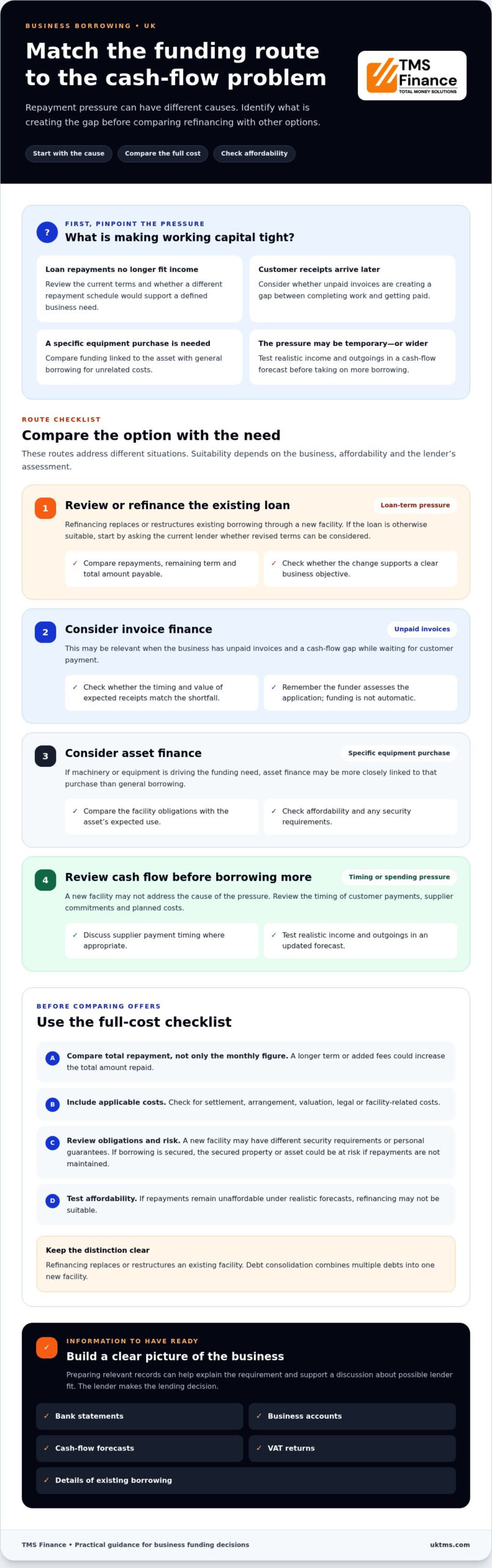
Refinancing is one possible response to repayment pressure, but it may not address the cause. First identify whether the issue comes from the loan terms, the timing of customer receipts, a planned purchase or wider spending. If you’re weighing whether to refinance existing business loans UK-wide, compare possible routes against that specific need. Suitability depends on the business, affordability and the lender’s assessment.
Discuss revised terms with your current lender
If the existing loan is otherwise suitable, discussing the terms with the current lender may be a useful first step. Ask whether revised terms can be considered and how a change could affect repayments, the remaining term and total amount payable. Any proposed change needs careful comparison with the existing agreement. This route may avoid replacing the facility, but you still need a clear view of the business’s future cash flow.
Consider invoice finance for unpaid invoices
Invoice finance may be relevant when the business has unpaid invoices and a gap between completing work and receiving customer payment. It is based on invoice-related cash flow, rather than replacing a general term loan. Consider whether the timing and value of expected receipts match the shortfall. The funder assesses the application, so invoice finance should not be treated as an automatic source of working capital.
Use asset finance for a specific purchase
If the pressure comes from the cost of machinery or equipment the business needs, asset finance may be more closely linked to that purchase than general borrowing. It can fund the asset requirement rather than refinance unrelated borrowing. Compare the proposed facility’s obligations with the asset’s expected use and the business’s ability to meet repayments. Suitability and security requirements depend on the application and lender criteria.
Review cash flow before taking on more borrowing
Some practical steps may help without a new facility. Review when customer payments are due, whether supplier payment timing can be discussed and which planned or discretionary costs could be delayed. Update the cash-flow forecast with realistic income and outgoings, then test how different timing assumptions affect the funds available for commitments. This can help show whether the pressure is temporary or points to a more persistent gap.
Recognise when refinancing may not be suitable
A new facility may not be suitable if it lowers the monthly payment but leaves the underlying problem unresolved, or if repayments remain unaffordable under realistic forecasts. Borrowing more simply to defer a cash-flow problem can add obligations without improving the business’s position. If the cause is uncertain, review the figures and consider appropriate professional advice before committing. A clear funding purpose should guide any application, not simply the desire to secure another loan.
If refinancing still appears relevant after comparing these routes, setting out the purpose and expected cash-flow effect can help structure the next conversation. You can outline your circumstances through the business loan application process.
Does refinancing improve the whole cost, or only the monthly payment?
A lower monthly repayment can ease cash-flow pressure, but it does not show whether the new borrowing costs less overall. A longer term may spread repayments and reduce each instalment while increasing the total amount payable. To judge a proposal, compare what remains under the existing agreement with the full cost and obligations of the replacement facility.
Build a like-for-like refinancing comparison
Start with the current loan’s balance, remaining term, repayment schedule and any charges that may apply if it is settled early. Then review the proposed facility over its full term. Compare the amount borrowed, repayment dates and amounts, term, total payable and all applicable costs. Rates and terms vary by applicant and facility, so a general rate or example is not a quote for your business.
Costs to establish may include settlement charges on the existing loan and arrangement, valuation, legal or other facility-related costs on the new borrowing. Find out how each cost is payable and whether any will be added to the borrowing. If costs are financed, include the resulting repayments in your comparison. Use figures from the lender’s actual terms rather than relying on an estimate.
A practical comparison should set out:
- Existing facility: settlement amount, remaining repayments, time left and any applicable contract charges.
- Proposed facility: repayment schedule, full term, total amount payable and each applicable cost.
- Cash-flow effect: how repayments fit the forecast, including periods when income may vary.
Use the same basis for both options. Do not compare the current balance alone with the new facility’s total repayments, or compare monthly payments without accounting for different terms. If you do not have verified figures, do not rely on an illustrative calculation to decide.
Check security, guarantees and downside risks
Monthly affordability is only one part of the decision. Depending on the facility and lender’s assessment, refinancing may require security over a property or asset, or a personal guarantee. Review who is responsible for repayment, what security is offered and how the obligations change. A secured property or asset could be at risk if repayments are not maintained.
A longer repayment period may leave the business committed for more time, even if each payment is lower. Consider whether that trade-off is justified by the cash-flow benefit and whether the obligations remain manageable under less favourable trading conditions. Read the proposed terms carefully, including any repayment or settlement conditions, and seek legal or financial advice where appropriate.
When considering whether to refinance existing business loans, lenders may assess the applicant, affordability, credit profile, security and the facility against their criteria. Compare the actual offer with the current agreement before proceeding. A lower instalment is useful only if the full cost, risks and obligations also make sense for the business.
What may UK lenders assess, and what should you prepare?
A well-organised refinancing request helps explain what the business needs and how a new facility could be repaid. Lenders may consider the funding purpose, trading history, bank conduct, credit profile, affordability and existing borrowing. They may also consider security and the repayment route. Factors vary by lender and application. Clear, consistent information can help a lender understand the request, but does not guarantee an outcome.
Information to explain the refinancing request
Set out the existing loan’s balance, repayments and remaining term. Explain how much funding is sought, how it would address the existing facility and what repayment route the business expects to rely on. Be clear about the intended business outcome. A request based on a defined need is easier to assess than one focused only on obtaining a lower monthly payment.
Prepare relevant records where available. These may include:
- Recent business bank statements.
- Filed accounts and recent management accounts.
- Cash-flow forecasts showing expected income, outgoings and repayment capacity.
- VAT returns, if relevant to the business and requested.
- Details of existing borrowing, including current balances and repayment commitments.
Check that figures and dates are consistent across documents. If forecasts rely on expected contracts or changes in trading, explain the assumptions clearly and distinguish confirmed income from projections. Include existing commitments so the lender can see the business’s full position.
How a lender may assess an application
Assessment may include the purpose of the refinancing, the business’s trading record, bank conduct, credit profile, affordability and existing liabilities. A lender may also consider available security and the proposed repayment route. These are possible factors, not a universal checklist. Criteria differ by lender, applicant and facility, and no single factor guarantees acceptance or refusal.
Documents should give an accurate picture of the business. If the forecast shows repayments would depend on uncertain income, state that plainly. If trading has changed, provide relevant context without assuming that careful wording can fix an affordability gap. The lender assesses the business’s performance and ability to meet the proposed obligations.
Requirements can vary with the applicant, facility, security and repayment structure, and a lender may request further information during assessment. TMS Finance can help organise the refinancing requirement and prepare relevant documents for lender consideration. To start, set out your circumstances and funding requirement through the business loan application.
How TMS Finance supports a business loan refinancing decision
Refinancing involves more than finding a different repayment figure. TMS Finance is a commercial finance broker, not a lender. It helps businesses explain their funding requirement, organise relevant information and consider possible lender fit through its accessible routes. For businesses looking to refinance existing business loans UK-wide, this process keeps the business objective and likely cash-flow effect in view, rather than treating a lower monthly payment as the only measure of success.
What TMS Finance does during the refinancing process
The process starts by understanding the purpose of the request, the amount involved, the timing and the outcome the business wants. TMS Finance reviews relevant headline information about the business, its credit profile, affordability, existing borrowing, available security and proposed repayment route. This helps frame the request clearly, but does not replace the lender’s assessment or guarantee that finance will be available.
TMS Finance can support document preparation and consider possible lender and facility fit through its accessible routes. It helps present the application and respond to lender queries as the assessment progresses. If an offer is made, TMS Finance can help explain key commercial terms, including costs, repayment obligations, security and any personal guarantee. The business can then compare the offer with its existing loan and cash-flow needs before deciding whether to proceed.
TMS Finance is a member of the National Association of Commercial Finance Brokers. Its support also covers offer review and completion where an offer proceeds. Completion time depends on the case and lender. The lender makes the lending decision, based on its criteria and checks.
What to do next if refinancing may fit
Before making an enquiry, bring together the current facility details and a clear summary of what the business wants the new arrangement to achieve. Include the outstanding balance, repayment commitments, requested funding amount and timing requirements. Add relevant financial information and note any questions about costs, security or guarantees. A complete and accurate picture gives the funding requirement a clear starting point.
To outline your circumstances, submit a business loan application. This starts a discussion about the requirement; it does not guarantee approval or an offer. Review any proposed terms carefully and seek appropriate professional advice before entering into commitments.
Make your next step a considered one
If you’re considering whether to refinance existing business loans UK-wide, focus on the outcome you need, not simply the appeal of changing facilities. Compare the full cost and obligations with the cash-flow benefit you expect. This can help you protect the business’s room to operate while keeping future commitments in view.
If refinancing remains worth exploring, prepare a concise summary of your circumstances and the change you’re seeking. TMS Finance can discuss the requirement and help consider possible funding routes. Any offer depends on the lender’s assessment.
When you’re ready, take the next step with a clear view of what the business needs and what it can sustain.
Frequently Asked Questions
Can a newer business refinance an existing business loan?
A newer business may be considered where suitable funding is available, but the lender assesses each application. A shorter trading record means there may be less financial history to review, so prepare clear records of income, costs and existing commitments. Lenders may consider the business plan, recent account activity and forecast alongside the loan purpose. Funding is not guaranteed.
Does refinancing a business loan affect the company’s credit file?
A lender may consider the business’s credit profile as part of its assessment. The existing facility’s repayment history and current borrowing may also be relevant. The process and information considered depend on the lender and application. TMS Finance can help organise the funding request and explain the key terms and obligations of an offer.
Can a secured business loan be refinanced without putting an asset at risk?
Not necessarily. A replacement facility might require security over a property or another asset, which could be at risk if repayments are not maintained. An unsecured option may avoid securing a specific asset, but availability depends on the applicant and lender criteria, and a personal guarantee may still apply. Review the proposed security and guarantee obligations before accepting an offer, and seek legal advice if you’re unsure about their effect.
How long does it take to refinance an existing business loan?
There is no fixed timeframe. It can depend on how quickly the business provides complete information, the complexity of the borrowing, whether valuation or legal work is needed and the lender’s assessment process. Responding promptly to requests may help keep the process moving, but cannot guarantee a completion date. Avoid relying on new finance for a time-critical payment until an offer is confirmed and completion arrangements are clear.
Can a business refinance if it has missed loan repayments?
Missed payments may affect a lender’s view of the application and the options available. Explain the circumstances accurately, including whether payments are still overdue and what has changed since. Prepare an up-to-date cash-flow forecast showing how proposed repayments could be met. You may also discuss the missed payments with the current lender to clarify the existing position. An explanation cannot guarantee approval.
TMS Finance is a commercial finance broker, not a lender. Finance is subject to status, lender criteria and satisfactory checks. Terms, fees, security and personal guarantees may apply. Contact TMS Finance to discuss your circumstances and the funding options that may be available.