

When bills fall due before enough customer payments arrive, your business may face pressure on wages, stock or supplier invoices. If you’re asking how does a merchant cash advance really work, the key is its repayment mechanism: under some agreements, repayments are linked to card sales. Deductions can therefore affect the cash available to run your business.
A link to sales may feel more manageable than a fixed repayment when takings fluctuate. But it does not make an advance automatically cheaper, safer or affordable. The total amount due, how deductions are collected and what happens during quieter periods depend on the specific agreement.
This guide explains how a merchant cash advance may be funded and repaid, what to check in an offer, and when this type of finance may not suit your business. It also compares merchant cash advances with business loans, invoice finance and revolving credit facilities, so you can consider how each could affect cash flow.
Before considering an offer, prepare information about your business and card processing, and make sure you understand the full commitment. TMS Finance is a commercial finance broker that can help assess possible lender fit, prepare an application and review commercial terms. It cannot promise approval or funding.
Key Takeaways
- Understand how does a merchant cash advance really work by checking whether and how the agreement links repayments to card sales.
- Compare the amount you receive with the total amount repayable, not just the size of each deduction.
- Check how payment timing could affect the cash available for wages, suppliers, tax commitments and other costs.
- Compare alternatives such as a business loan, invoice finance or a revolving credit facility, particularly if card sales are falling.
- Prepare relevant business and card-processing information so TMS Finance can assess your funding requirement and help review possible options and offer terms.
How does a merchant cash advance work when card sales create a cash-flow gap?
A business may have bills due before customer payments have cleared or enough cash has arrived. This timing gap can put pressure on wages, stock purchases and supplier invoices. A merchant cash advance is a form of business finance that may provide funds in return for repayment linked to card-payment activity. The structure and terms depend on the agreement.
So, how does a merchant cash advance really work? The business provides information for a lender to assess. If an offer is made and accepted, the business receives an agreed advance. Repayment then follows the collection method and conditions set out in the contract. The lender’s assessment and any terms offered depend on the individual application and its criteria.
A merchant cash advance may link repayments to card sales under agreed contract terms. A conventional fixed-instalment loan instead sets scheduled payments under its agreement. This difference describes the repayment mechanism, not the overall risk. Sales-linked deductions still reduce cash available to the business. They do not make the finance cost-free or automatically affordable. The Merchant cash advance overview provides further background on the general concept.
What does the business receive and agree to repay?
An offer should state the advance amount the business would receive and the total amount it would need to repay. These are separate figures. Compare them, then review any stated fees, the deduction method, payment conditions and other obligations. Do not judge the commitment by the amount arriving in the business account alone.
Read the terms that apply if card sales change, payments are interrupted or the agreement is not followed as expected. Check whether the agreement explains how deductions are reviewed or reconciled, and whether any minimum payment or other collection condition applies. The contract sets out the obligations for that specific arrangement.
How do card sales connect to repayments?
Where an agreement provides for card-linked repayment, the lender collects an agreed amount or share connected to card-processing activity. This may involve payment-processing arrangements or another collection method specified in the contract. The calculation, timing and route can vary, so understand each before accepting an offer.
In general, card transactions are processed, a deduction is calculated or collected under the arrangement, and payments continue according to the contract until its repayment obligations are met. Do not assume every transaction is handled in the same way, or that a quieter sales period changes the total amount due. Check how deductions are calculated, when they are taken and what happens if card sales fall. These details help you estimate the effect on cash available for day-to-day costs.
How are merchant cash advance repayments taken from card sales?
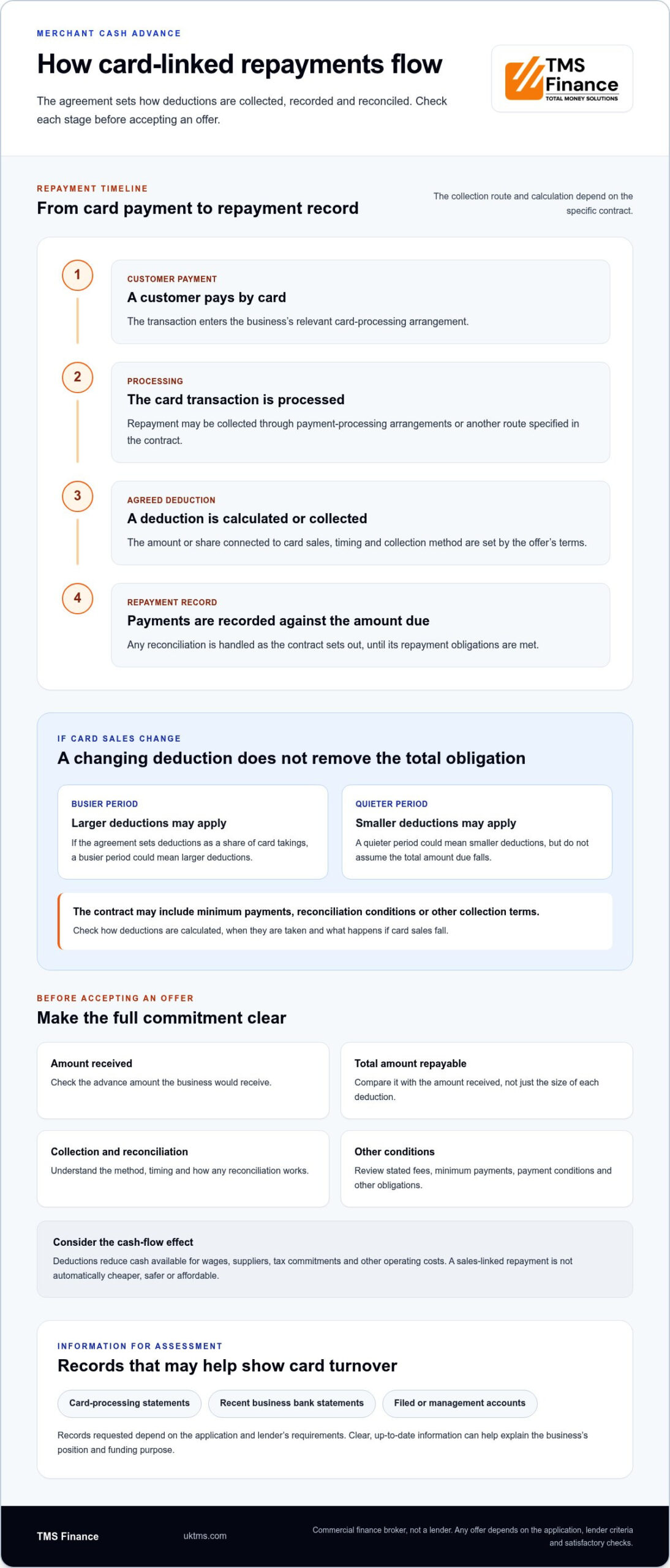
The collection method depends on the agreement. Where repayments are linked to card processing, the process may work like this:
- A customer pays the business by card.
- The transaction is processed through the relevant card-processing arrangement.
- A deduction is calculated or collected according to the agreed terms.
- The lender records repayments against the amount due, with any reconciliation handled as the contract sets out.
This differs from a conventional loan with fixed scheduled instalments. A card-linked deduction may vary with sales if the offer specifies that method. That does not necessarily mean the total repayment falls when sales are weak. The agreement may include minimum payments, reconciliation conditions or other collection terms, so review these before accepting.
What happens when card sales rise or fall?
If the contract sets deductions as a share of card takings, a busier period could mean larger deductions and a quieter period smaller ones. The pattern depends on the specific offer. It does not guarantee lower financial pressure or a longer repayment period. Confirm whether minimum payments apply, how often deductions are taken, how reconciliation works and what collection arrangements are in place. A slower deduction pattern does not, by itself, remove the total repayment obligation.
Card-processing statements can show a business’s card turnover and may be requested to assess a merchant cash advance application.
Which records may be needed to assess card turnover?
Card-processing statements can help show transaction volumes and changes in sales over time. Recent business bank statements and filed or management accounts may also inform an assessment, depending on the application and lender’s requirements. Clear, up-to-date records help explain the business’s position and the purpose of the funding.
If you’re asking, “How does a merchant cash advance really work?”, look beyond the deduction itself. Read the collection and reconciliation terms alongside the total amount due, and consider how deductions could affect cash available for operating costs. To compare funding categories, explore merchant cash advance and business finance products.
To discuss your requirement and prepare an application, use the business finance application.
How should you compare an MCA’s total cost and cash-flow impact?
A deduction that looks manageable on a busy trading day may still reduce the money available for stock, wages and suppliers. Compare the full commitment and how payments fit your cash flow, not just the amount of an individual deduction. Costs and terms vary by applicant and facility, so use the figures in the specific offer rather than assuming a standard price.
What costs and terms should you check in an offer?
Write down the key terms before comparing options. Check the amount you’ll receive against the total amount repayable, then review how and when payments are collected. Include any stated fees and the consequences of missed obligations. If the offer uses a factor rate, check how it is applied and how the total repayment is calculated. Do not treat a factor rate as directly equivalent to an APR without a valid comparison.
| Offer detail | What to compare |
|---|---|
| Total repayable | How much is due overall compared with the amount received? |
| Deduction method | Is collection linked to card sales, or based on another arrangement? |
| Payment frequency and term | When are payments collected, and what period or conditions apply? |
| Security | Is an asset or property offered as security? If so, it could be at risk if repayments aren’t maintained. |
| Personal guarantee | Does the agreement require one, and what obligations does it set out? |
How does an MCA compare with other working-capital finance?
How does a merchant cash advance really work in comparison with other options? Its defining feature is that repayments may be linked to card sales if the offer provides for this. A business loan usually sets scheduled payments under its agreement. A revolving credit facility lets a business draw funds up to an agreed limit, with repayment and charges governed by its terms. Invoice finance is linked to eligible unpaid invoices rather than card transactions. Each structure can affect cash flow differently, and none is automatically right for every business.
Compare the timing and conditions of each facility with when your business needs funds and expects cash to come in. For example, a business with eligible unpaid invoices may want to compare invoice finance with a card-linked arrangement. A business needing funds for a defined purpose may also compare a loan with scheduled payments. For more detail on invoice finance, read the UK invoice finance guide.
To review potential options in light of your funding needs, you can discuss business funding options with TMS Finance. TMS Finance is a commercial finance broker, not a lender. It can help assess possible lender fit through the routes available to it and review commercial terms. A discussion is not a promise of funding.
When might a merchant cash advance not suit your business?
Variable card-linked deductions do not remove the cost of finance or the obligation to repay. If card sales are declining, or deductions would leave too little to cover essential costs, an advance could add pressure rather than address the underlying cash-flow problem. Before borrowing, test whether the business could meet its commitments during weaker trading periods.
Consider whether another step could address the timing gap. You might delay discretionary spending, use invoice finance against eligible unpaid invoices, compare a business loan with scheduled payments, or consider a revolving credit facility. Each option has different costs, terms and eligibility requirements. If the business’s cash-flow forecast shows that new repayments would worsen a shortfall, borrowing may not be suitable. A business loan guide for UK firms can help explain how scheduled repayments compare with a card-linked arrangement.
What may lenders consider in an MCA application?
Depending on the case, assessment may consider the funding purpose, trading history, bank conduct, credit profile, existing borrowing and proposed repayment route. Affordability, security and relevant business experience may also be relevant. These are possible considerations, not universal rules or a promise of acceptance. A lender assesses the application against its own criteria.
Check whether the offer requires security or a personal guarantee. If property or another asset is secured, it could be at risk if repayments aren’t maintained. A personal guarantee may create obligations for the person giving it. Read the agreement carefully and seek legal or other professional advice if you’re unsure what those obligations mean.
What warning signs call for a pause?
Pause if the total amount repayable, fees or collection arrangements are unclear. Make sure you understand each term before deciding. Prepare a cash-flow forecast that tests the proposed deductions against weaker sales periods as well as expected trading. This can help show whether repayments would leave enough for essential operating costs.
If the forecast still shows a shortfall, taking on more borrowing may not be appropriate. Consider professional accounting, legal or tax advice for questions in those areas, and seek personalised financial advice where needed. The repayment structure should fit your business’s cash flow, not deepen an existing shortfall.
What happens when you discuss an MCA with TMS Finance?
TMS Finance is a commercial finance broker, not a lender. It starts by understanding the business, the funding purpose, the amount required, timing and desired outcome. It can review the information, consider possible lender fit through the routes available to it, help package an application and support you through the process. A broker cannot override lender criteria or guarantee funding, terms or completion.
The process includes an initial discussion and assessment of your business’s needs, followed by document collection and consideration of possible lender fit. If you decide to apply, TMS Finance can present the case and respond to lender queries. If an offer proceeds, it can help you understand key commercial terms, costs, security, guarantees and repayment obligations, and support communication through completion. Requirements depend on the circumstances and the lender.
What information should you prepare before the discussion?
Bring a clear outline of the amount required, what the funds would be used for, when they’re needed and what outcome the business needs. Explain how the proposed funding would fit the business’s expected cash flow, including the costs it needs to cover while repayments are due.
Depending on the assessment, documents may include recent business bank statements, filed or management accounts and details of existing borrowing. Card-processing statements may be requested when assessing a merchant cash advance application. Having relevant records to hand can help present the business’s position clearly, but the documents required vary with the case.
How can a broker help you assess the next step?
If you’re asking, “How does a merchant cash advance really work?”, a discussion with TMS Finance can help relate the repayment mechanism to your business’s funding need and cash flow. TMS Finance can consider possible lender fit through its available routes, help present application information and review an offer’s costs, security, any personal guarantee and repayment obligations with you.
Review the offer carefully before deciding. Check that the amount received, total repayment, deductions and other obligations are clear. Raise any questions before proceeding. A discussion is an opportunity to consider possible options, not a promise of approval or funding.
Make your next funding decision with clarity: how does a merchant cash advance really work?
The key is to look beyond card-linked deductions. Check the total amount repayable, how collections are calculated and whether the terms leave enough cash for essential costs. If sales are weakening or borrowing could deepen a shortfall, compare other options or consider whether taking on finance is appropriate.
TMS Finance is a commercial finance broker and a member of the National Association of Commercial Finance Brokers. It can support your application and help review key commercial terms and obligations. Prepare the amount you need, its intended use, the timing and relevant business records so the discussion can focus on your circumstances. Any offer and its terms depend on lender assessment.
A considered decision starts with clear figures and a realistic view of cash flow. Explain how much you need, what it will fund and when it is required. Contact TMS Finance to discuss your merchant cash advance requirement and consider which funding options may be worth exploring.
Frequently Asked Questions
How does a merchant cash advance repayment work?
Repayment follows the collection method and obligations set out in the agreement. The advance may be linked to the business’s card-payment activity where the contract provides, but the deduction method can vary. Check the offer for the total amount due, fees, collection arrangements and other repayment obligations. The practical answer to how does a merchant cash advance really work lies in the specific contract, not assumptions about how every arrangement operates.
Are merchant cash advance repayments taken from every card sale?
Not necessarily. The agreement determines whether deductions relate to card-processing activity and how they’re calculated and collected. It should also explain how refunds or other transaction types are treated. Review the deduction terms and total amount repayable before deciding. Even if repayments vary with sales, that does not confirm the finance is affordable or remove other obligations under the agreement.
Is a merchant cash advance a loan?
Do not rely on the product label alone to determine its legal or contractual structure. Read the agreement to understand what amount is advanced, how much is due overall, how collection works, and whether fees, security or personal guarantees apply. If you need help interpreting legal, tax or accounting consequences, seek advice from an appropriately qualified professional. The contract sets out the obligations for the specific arrangement.
Can a business get a merchant cash advance with low card sales?
There is no universal card-sales threshold that guarantees acceptance. Card-processing activity may be relevant, alongside factors such as the funding purpose, trading history, bank conduct, credit profile, existing borrowing, security and repayment route. Lenders may assess these differently. TMS Finance can review your requirement and consider possible lender fit through its available routes, but cannot promise an offer.
What should I compare before accepting a merchant cash advance?
Compare the amount you’ll receive with the total amount repayable, then check fees, how deductions are calculated, payment arrangements and what happens if trading changes. Review any security or personal guarantee, too. Consider whether payments leave enough working capital for wages, suppliers, tax commitments and other costs. Compare the arrangement with a business loan, revolving credit facility or invoice finance, since each has different terms and cash-flow effects.
Finance is subject to status, lender criteria and satisfactory checks. Terms, fees, security and personal guarantees may apply. Contact TMS Finance to discuss your circumstances and the funding options that may be available.
To compare costs and suitability for your own card takings, visit our merchant cash advance page. It includes a repayment example, the effect on available cash and a card-sales enquiry form.